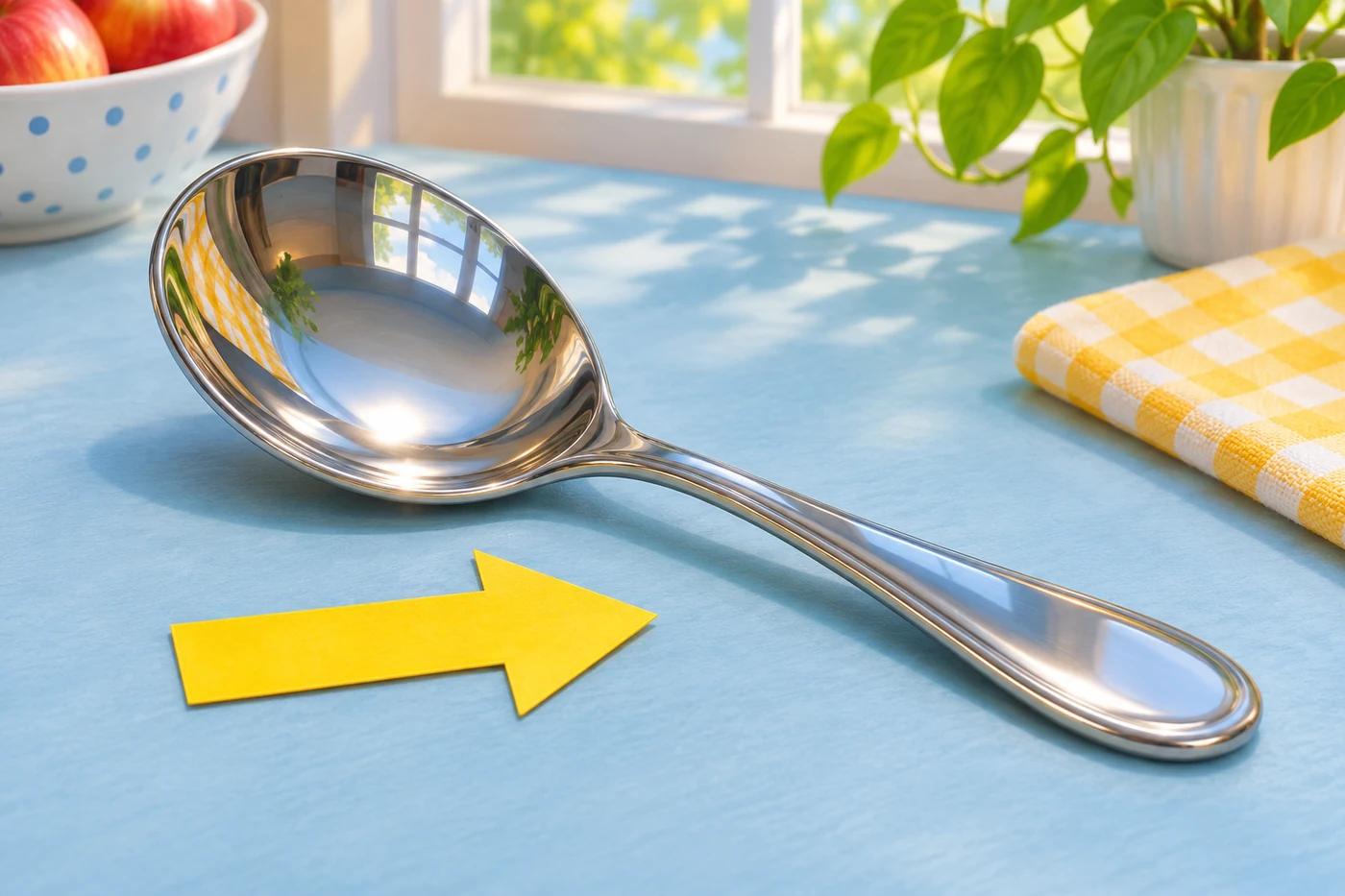
The inside of the spoon curves inwards. From far enough away, reflected rays meet in front of the spoon and form an upside-down image. Up close, the image can appear upright. On the outward-curving back, it usually stays upright and looks smaller.
The cover is an illustration. You can try this with a spoon at the kitchen table.
A surface that tilts in many directions
Light falls on your face and bounces off in many directions. Some of it reaches the spoon. The shiny surface reflects it like a mirror. Because the surface curves, each little patch tilts a different way. Those patches send light back in different directions.
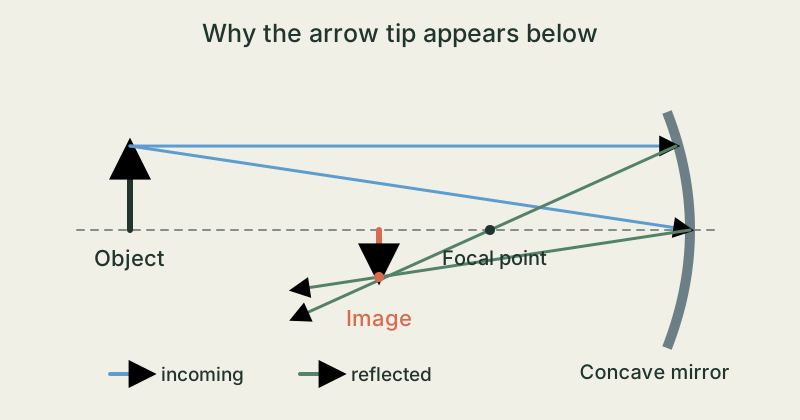
The inside can turn the image upside down
The bowl of the spoon is concave. It can bring light together. If your face is far enough away, rays from a point on your forehead meet below the middle of the reflection. Rays from your chin form points higher up. The image is upside down. The diagram shows how this happens with an arrow.
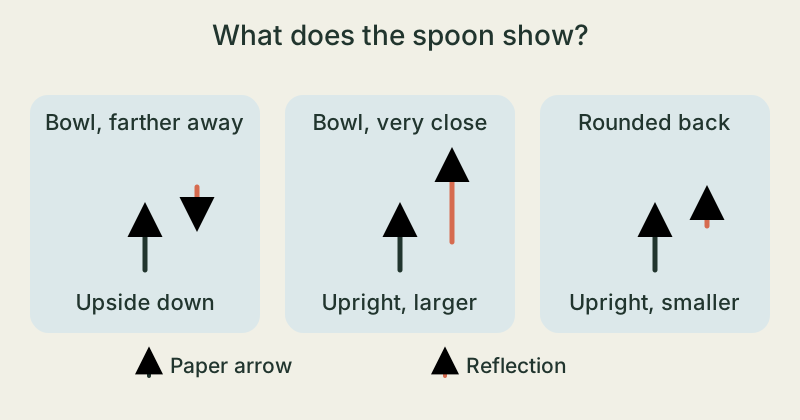
Up close, the image can look upright again
An ideal concave mirror brings straight, parallel incoming rays together at about one point. The distance from the mirror to this focal point is the focal length. If an object is closer to the mirror than that, the reflected rays spread out. They appear to come from behind the mirror, and the image looks upright and larger.
The back curves outwards
This shape is called convex. The rays reflected from an object spread out. Its image appears behind the spoon, upright and smaller. A real spoon often curves more across its width than along its length, or vice versa. That can make the image look distorted too.
Watch an arrow in a spoon
- Draw a bold upward arrow on a small piece of paper. Find a clean, shiny tablespoon. Sit at a table in ordinary room light.
- Hold the spoon with the bowl facing you and the arrow just to one side of your line of sight. Look at its reflection from about an arm’s length away first. Slowly move the arrow towards the bowl and watch how the image changes.
- Turn the spoon over and repeat with the back. Sketch which way the arrow points each time. If the image gets blurry or moves out of the bowl, adjust the angle slightly. Different spoons may give different results.
Use an ordinary tablespoon with smooth edges. Keep it away from your eyes. Room light is enough.
The takeaway
The curved inside can bring light together. Far enough away, the image is upside down. Very close, it can look upright. The rounded back usually shows a smaller, upright image.
When can the arrow look upright and larger on the inside of the spoon?
Sources & further reading
OpenStax / Rice University · Physics 16.1: Reflection ↗Florida State University · Molecular Expressions: Reflection of Light ↗Our stories explain the main idea in our own words. Pictures and models simplify reality and are not drawn to scale.