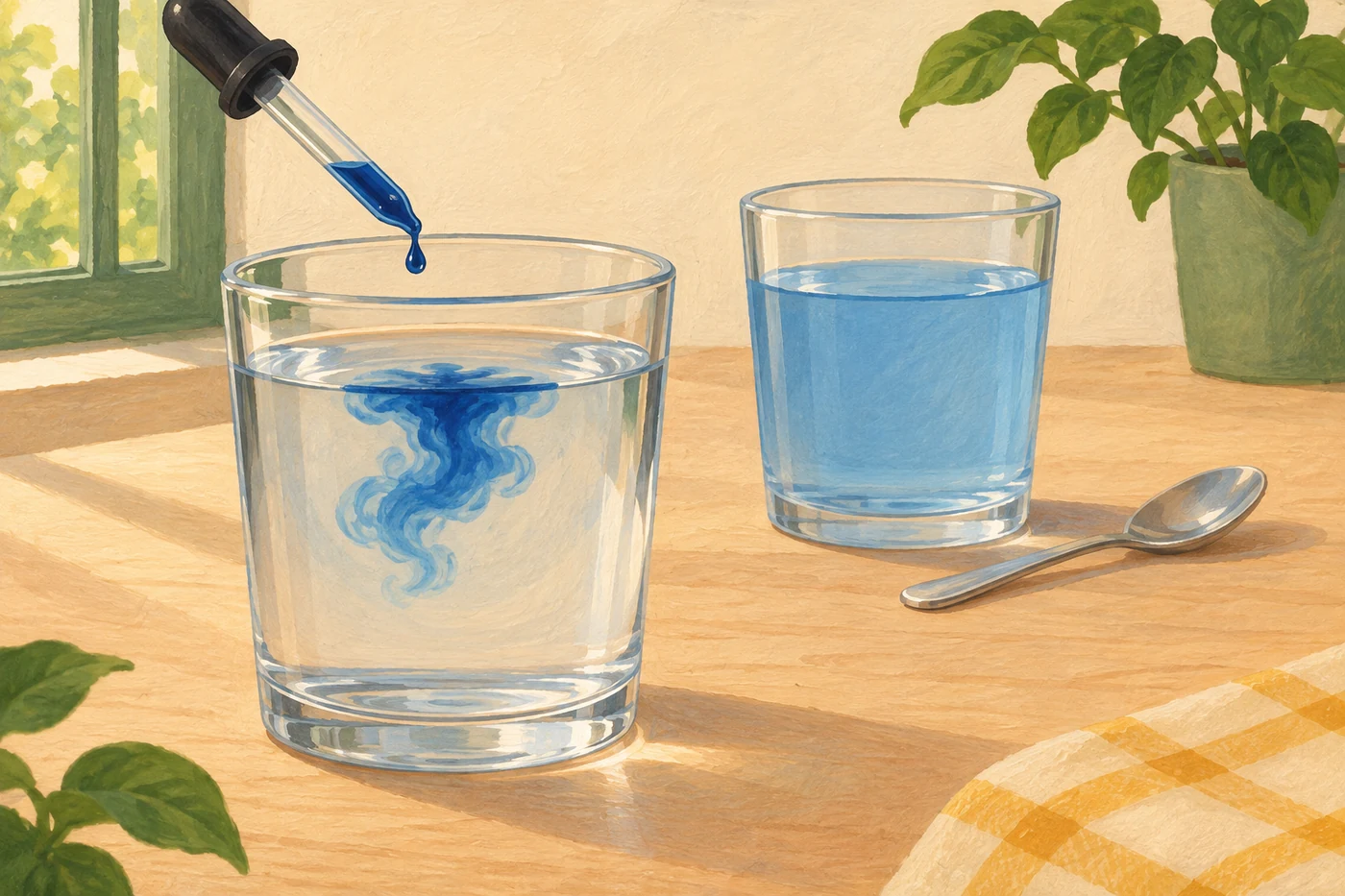
Dissolved dye particles move randomly and spread out: this is diffusion. Water currents can carry the colour too. Fast streaks therefore do not prove that diffusion alone is at work.
The cover is an illustration. We observe visible colour patterns, not individual molecules.
Still water contains moving particles
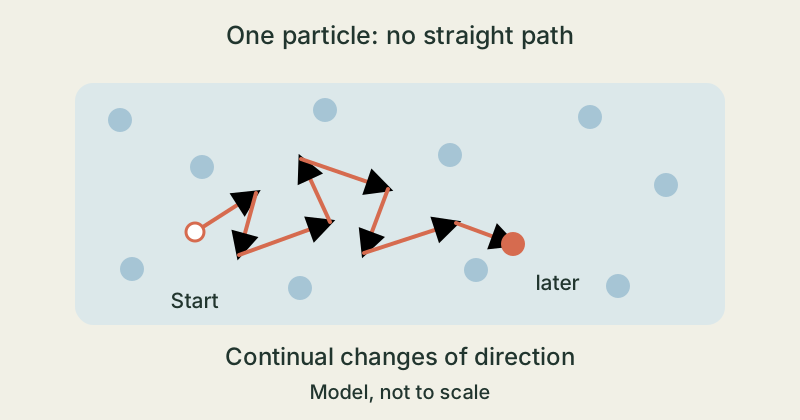
Water and dissolved dye consist of tiny particles. They keep moving, changing direction as they collide. They do not need a spoon to do this.
Many random paths produce spreading
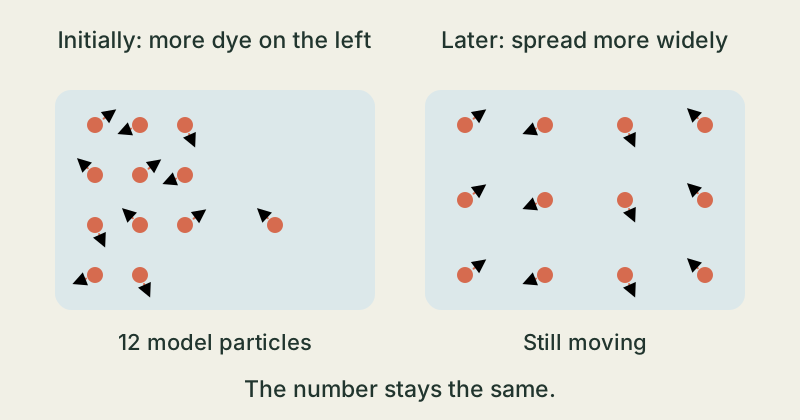
Near the drop, many dye particles initially occupy a small volume of water. This is a high concentration. Their random movements take more particles out of this region than into it overall. Individuals can return too. This spreading process is diffusion.
A current carries water along
Stirring moves larger amounts of water together, carrying dye along. Currents left after pouring can persist without stirring. A sinking drop of colouring can move water too. This transport differs from the random movement of individual particles.
Uniform does not mean motionless
Diffusion through water is slow over longer distances. Fast swirls therefore do not show how quickly individual molecules diffuse. Once the colour is uniformly spread, particles keep moving; only the concentration difference has evened out.
Observe with and without a spoon
- With an adult, place two matching clear plastic cups on a tray. Put 150 ml of room-temperature water in each. Leave them undisturbed for five minutes.
- Add one drop of the same liquid food colouring to each cup. Leave one alone; gently stir the other three times. Draw the patterns immediately, after one minute and after ten minutes.
- Compare streaks and colour distribution. Stirring will usually spread the colour faster. Currents can occur in the unstirred cup too: this comparison does not measure a pure diffusion rate.
Observe together, protect surfaces from stains and wipe up splashes. Use only water and food colouring; do not drink the samples. No hot water.
The takeaway
Diffusion results from random particle movement. Currents can carry dye as well. Visible mixing alone does not separate the two processes.
Which statement about diffusion is correct?
Sources & further reading
OpenStax / Rice University · College Physics 12.7: Diffusion ↗OpenStax / Rice University · Biology 2e 5.2: Passive Transport ↗Clemson University · Physics demonstration: Food Color in Water ↗Penn State · Center for Nanoscale Science: Diffusion Races ↗Our stories explain the main idea in our own words. Pictures and models simplify reality and are not drawn to scale.