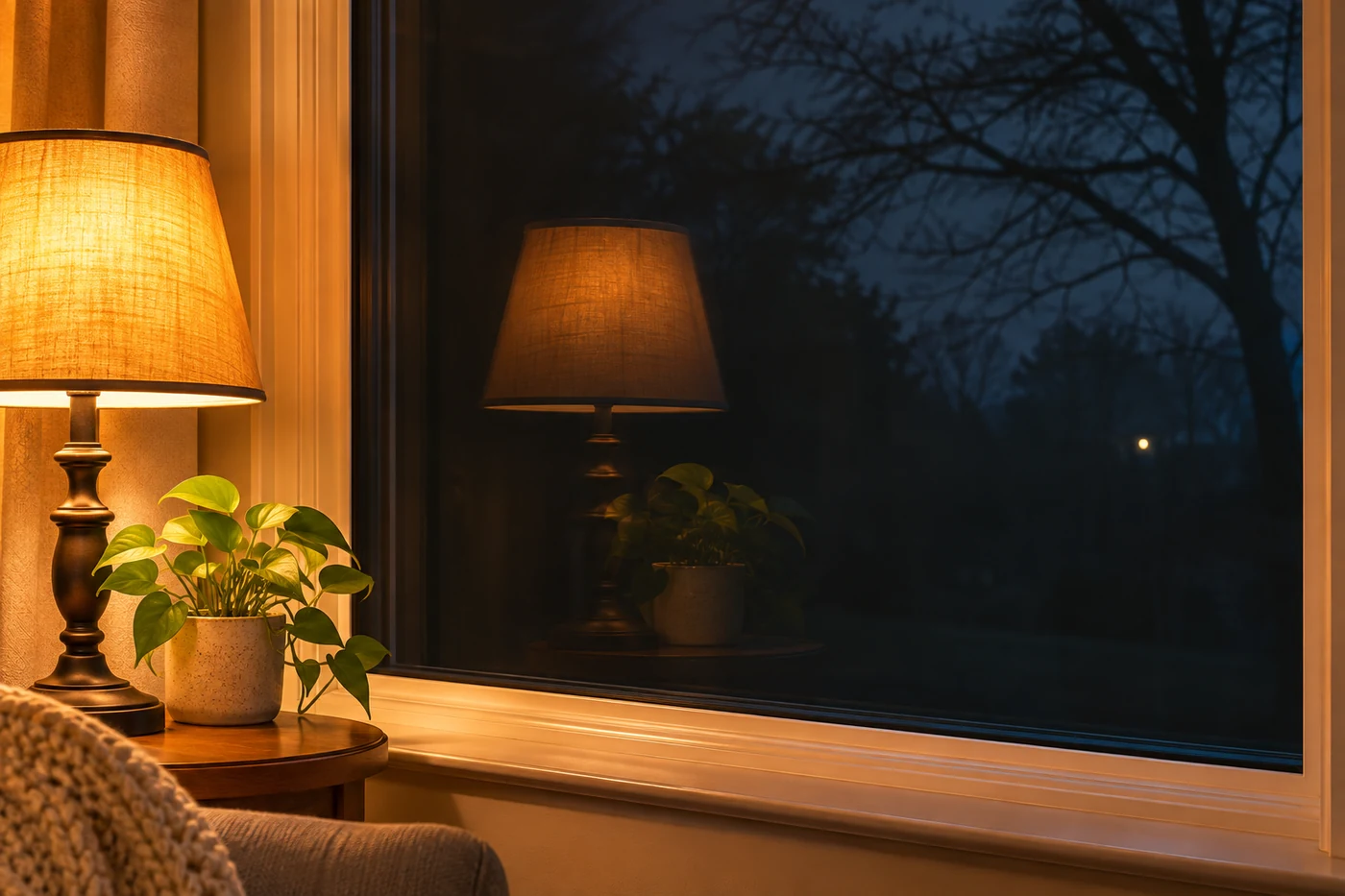
A window lets most light through and reflects a small part of it. At night, often very little light comes in from outside. The light reflected back from the bright room is then easier to see.
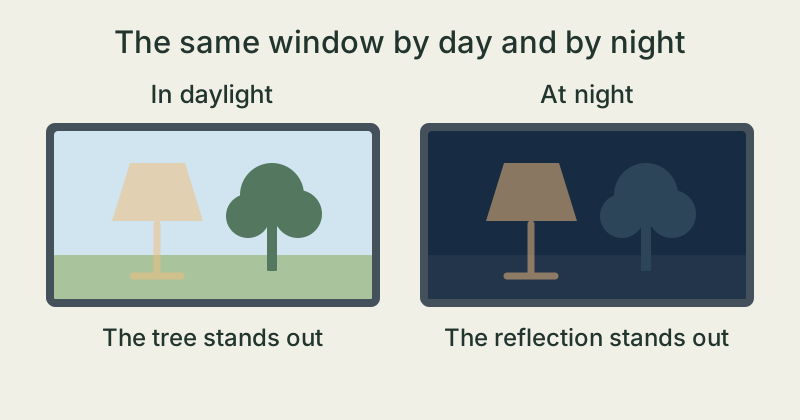
During the day, you might see a tree through the window. In the evening, you suddenly see your lamp in the same spot. Where does that image come from if the glass is still transparent?
The glass splits the light
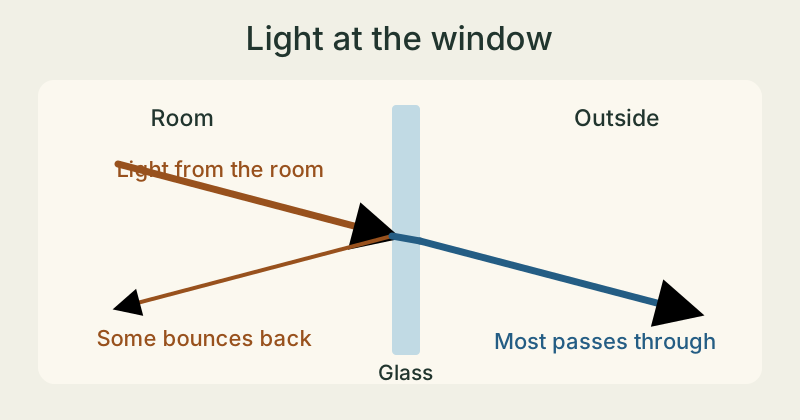
When light travels from air to the glass, most of it passes through an ordinary window. A small part bounces back into the room. This is called reflection.
Light from things that are lit up, such as a book or your face, also reaches the window. The glass can bounce some of it back to your eyes. That is how the reflection forms.
Two images overlap
When you look out from inside, two kinds of light reach your eyes. Light from outdoors comes through the glass. Some light from the room bounces back as a reflection. You can see both at once.
In daylight, the tree outside is often so bright that you barely notice the lamp’s reflection. In the evening, much less light comes from the tree. If the lamp stays on, its reflection stands out. A bright streetlight can still be visible next to it.
Turn down the light to see outside
When you switch the lamp off, less light from the room reaches the glass. Less of it bounces back towards you. Things that are lit up outdoors are often easier to see.
Someone on the dark side of the window may be able to see into the brightly lit room quite clearly. The same pane lets light through in both directions.
Compare the view with the lamp on and off
- Stand a short distance from a closed window in the evening. Leave a lamp on in the room. Look for its reflection and for something dimly lit outdoors, such as a tree under a streetlight.
- Stay in the same spot. Ask someone to switch off or dim the lamp. Notice how the reflection changes and whether the object outdoors is easier to see.
- Switch the lamp back on. Compare the two views. If almost no light falls on the object outside, it will still be hard to see with the room lamp off.
Keep the window closed and both feet on the floor.
The takeaway
A window lets light through and reflects part of it. If the reflected light from the room is brighter than the light coming through from outside, the reflection stands out.
Why is the lamp’s reflection easier to see at night?
Sources & further reading
The Open University / Brock University · Rays and geometrical optics ↗H. Joachim Schlichting · Reflections on reflection (Universität Münster) ↗Our stories explain the main idea in our own words. Pictures and models simplify reality and are not drawn to scale.