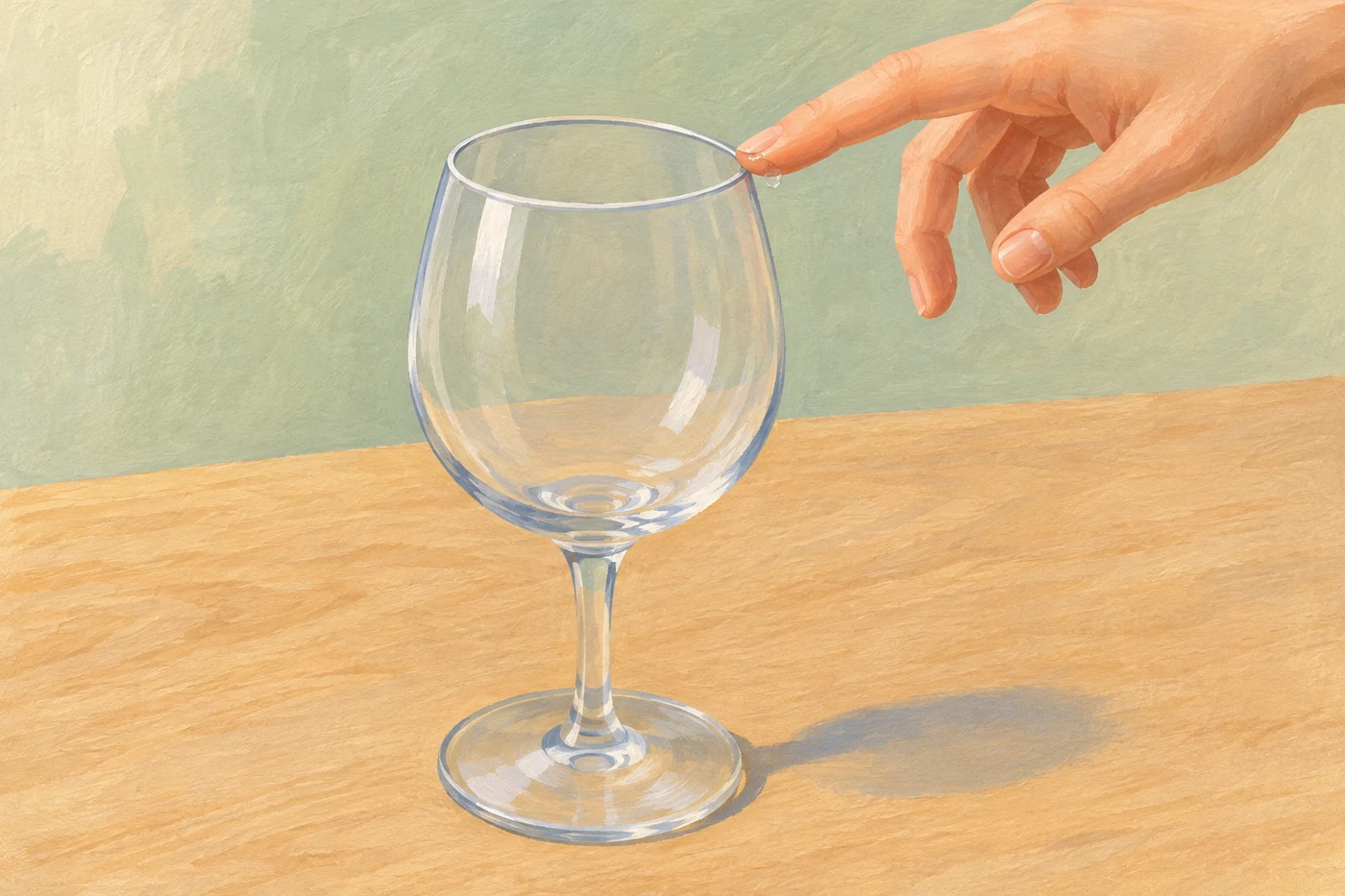
Your wet finger briefly grips the rim, then slips. This happens over and over. It sets the glass itself vibrating, which makes the air around it move. You hear that movement as a note.
Set a stemmed glass on the table. Slowly run a damp finger around the rim. At first, you might hear nothing. Then a note rings out and lasts much longer than the clink of a spoon against the glass. Where does it come from?
Your finger grips and slips
Your damp fingertip does not glide perfectly smoothly. It grips for a moment and pulls the rim a tiny distance. Then it slips and the rim springs back. This repeats so quickly that you cannot pick out each movement.
Think of a swing: small pushes at the right moments can keep it moving. As long as you keep rubbing, your finger can keep giving the glass energy.
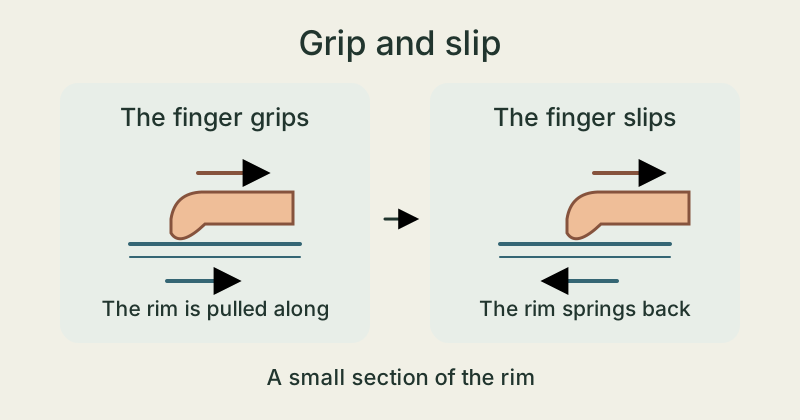
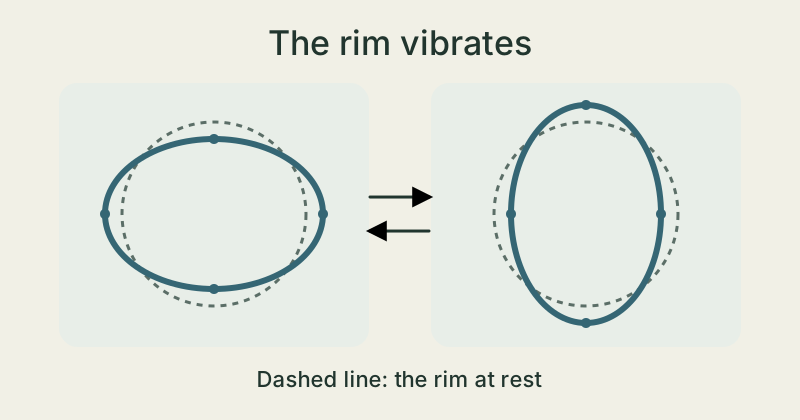
The rim changes shape
Glass feels rigid, but it can bend a little. Seen from above, the round rim gets a tiny bit wider one way and then a tiny bit wider the other way. The changes are much smaller than in the drawing.
The vibrating glass moves the air. That movement travels as sound to your ear. The faster the glass moves back and forth, the higher the note.
What changes when you add water?
If you pour in some water, the vibrating glass wall has to move the water too. The wall vibrates more slowly, so you usually hear a lower note from the same glass. The damp finger helps start the vibration. The water inside can change the pitch.
Compare the same glass with and without water
- Put a clean, undamaged stemmed glass on a level table. Hold the base steady with one hand.
- Dip the tip of your index finger in water. Run it smoothly around the rim, pressing lightly. When the glass sings, listen to the pitch.
- Fill the glass about one third full with water and try again. Is the note higher or lower? Compare the pitch even if one note is quieter.
Try this with an adult. Do not use a glass with cracks or chips, and press gently.
The takeaway
Your finger keeps the vibration going. The glass vibrates and makes the note. Water inside can make the note lower.
What vibrates and makes the air move when the glass sings?
Sources & further reading
University of Colorado Boulder · Singing Wineglass ↗Pacific Science Center · Singing Glasses ↗American Journal of Physics · Why does water change the pitch? ↗Our stories explain the main idea in our own words. Pictures and models simplify reality and are not drawn to scale.