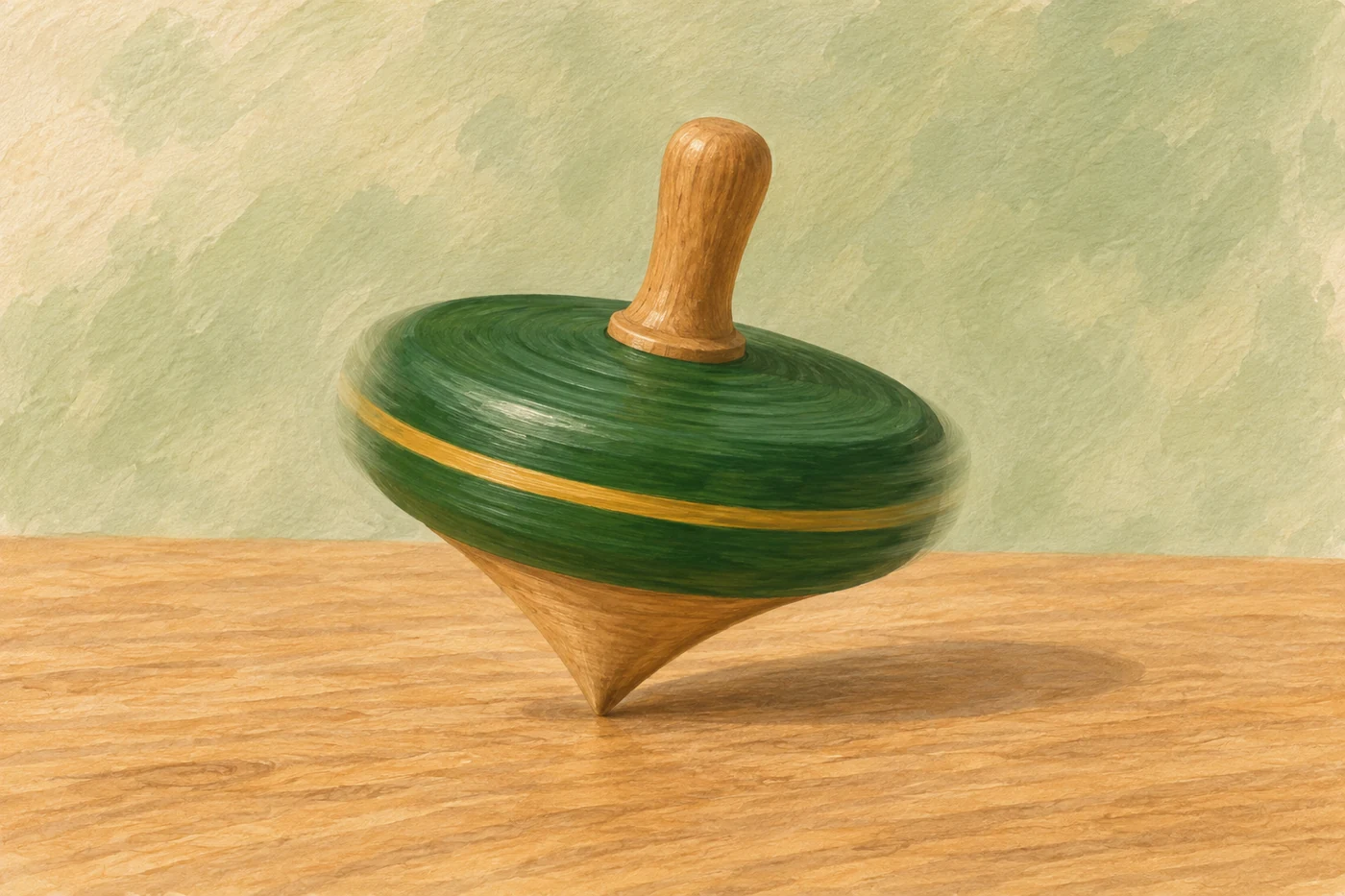
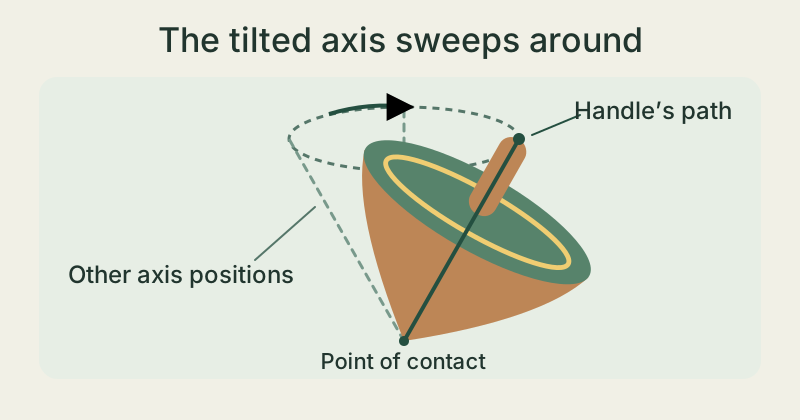
A fast-spinning top has a lot of angular momentum, so a small influence changes the direction of its spin axis only a little. When the top leans, gravity pulls it down. If it is spinning fast, the tilted axis often sweeps around in a circle and the top stays on its point for a while.
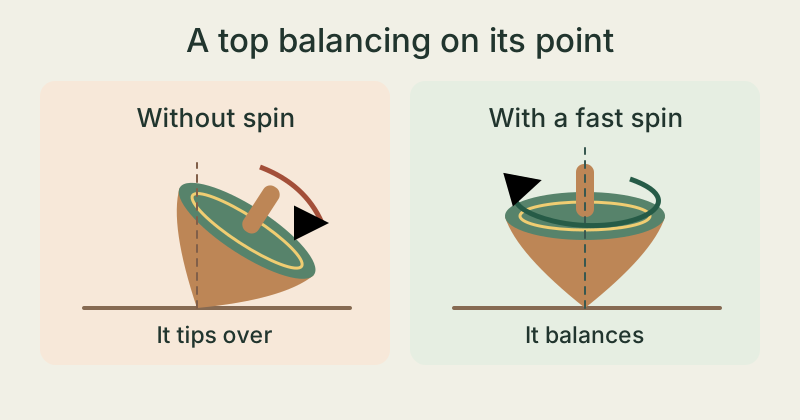
Stand a toy top on its point and let go without spinning it. It usually tips over at once. Give it a good spin and it may stay upright for several seconds. Look closely: the handle can trace a small circle while the body of the top spins much faster.
Spinning fast gives the top angular momentum
The spin axis is an imaginary line through the point and the handle. The top spins around that line. The faster the same top spins, the more angular momentum it has.
Angular momentum describes its spinning motion and direction. When the top is spinning fast, a small influence changes the direction of its axis only a little. This helps it balance on its point.
The handle can trace a circle
When the top leans, its centre of mass is off to one side of the point. Gravity pulls down at the centre of mass. This creates a turning effect around the point, called torque.
While the top spins fast, the torque mainly changes the direction in which the handle leans. The axis sweeps around the vertical. This slow circling of the axis is called precession.
Eventually the top tips over
Friction at the point and air resistance slow the top down. As it slows, it loses angular momentum.
Once it spins slowly enough, it often wobbles more. Eventually its rim touches the table and the top comes to rest.
Watch the handle instead of the rim
- Take a small toy top with a blunt point. Spin it in the centre of a shallow tray and watch the handle from above and to one side.
- First, notice how steady the handle looks while the top spins fast. As the top slows, see whether the handle traces a circle or wobbles more.
- Spin the same top a little more slowly. Compare how long it stays on its point. Repeat both trials so a single crooked start does not decide the result.
Put the tray on a level surface and let the top stop before picking it up.
The takeaway
A fast-spinning top can balance on its point. If it leans, its axis can sweep around in a circle. When it spins too slowly, it tips over.
Which motion is called precession?
Sources & further reading
OpenStax · Precession of a Gyroscope ↗University of Colorado Boulder · Rotational Stability ↗Our stories explain the main idea in our own words. Pictures and models simplify reality and are not drawn to scale.