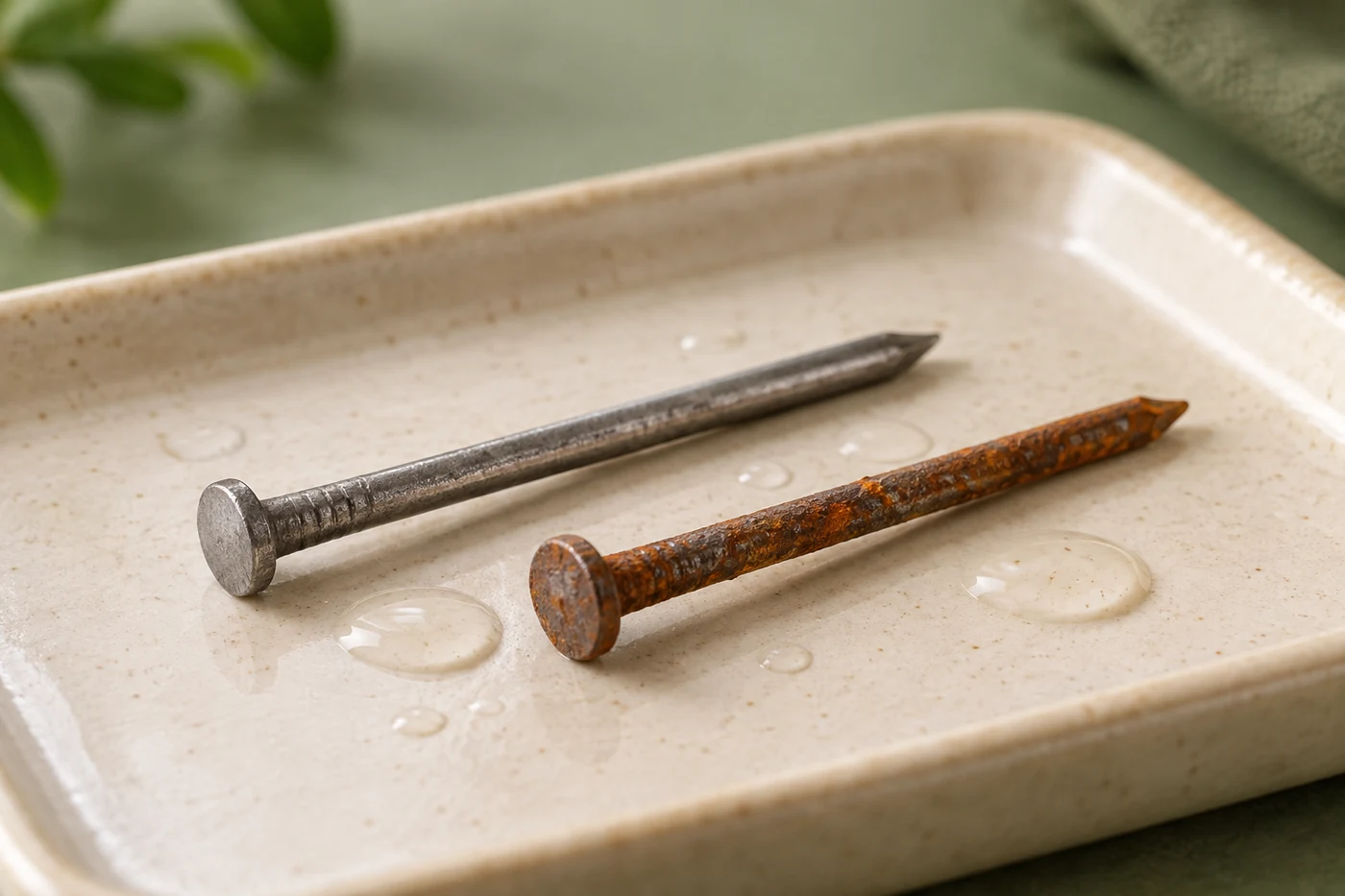
During ordinary rusting, iron reacts with oxygen in the presence of water. Some of the metal becomes new iron-containing compounds: rust. Damp air can supply enough moisture. The often loose rust layer protects the remaining iron poorly, so the reaction can continue.
You might spot rust on unprotected nails or garden fences. Let's look at the substances involved and how a protective coating helps.
Water and oxygen take part
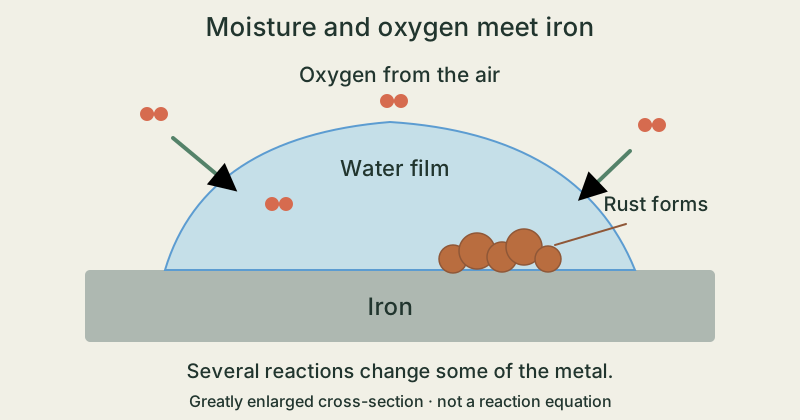
At room temperature, ordinary rusting needs both water and oxygen. A thin film of moisture on the iron can be enough. Oxygen from the air can dissolve in it.
Linked chemical reactions happen at different places on the surface. Iron loses electrons in the process. Several steps produce new compounds containing iron and oxygen, with water also taking part.
Rust is a new material
The orange-brown coating is not simply dirt arriving from outside. Some of the iron has changed chemically. Ordinary rust contains hydrated iron oxides: iron oxide compounds that incorporate water. Its exact composition can vary.
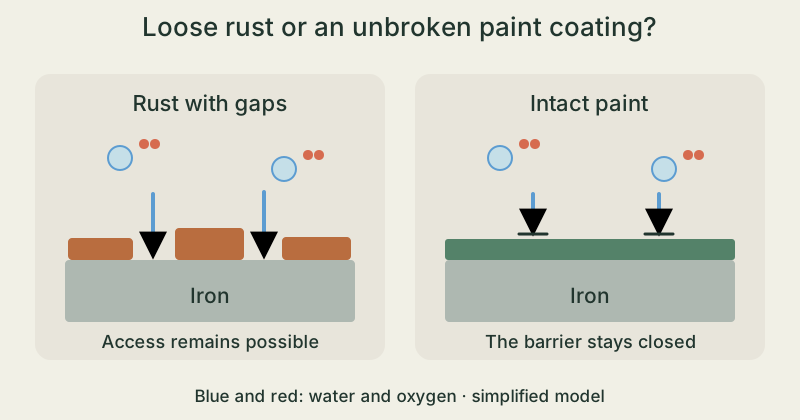
The rust layer is often porous and can flake away. Gaps let water and oxygen reach more metal. That is why a visible rust layer usually does not reliably stop further rusting.
Ordinary steel can rust too
Many nails are made of steel. Ordinary carbon steel is mostly iron, with some carbon and other ingredients. Its iron can rust too.
Stainless steel contains enough chromium to form a protective surface layer. It resists corrosion much better. Two equally shiny objects may therefore behave differently in the same experiment.
An unbroken coating keeps moisture out
An intact paint coating separates iron from water and oxygen. A scratch through that coating exposes a place where rusting can begin.
Dry storage and maintaining suitable coatings help protect iron. Our comparison uses uncoated ordinary steel: an unknown coating could hide the effect we want to observe.
Dry or damp: what changes?
- An adult places two identical new, uncoated steel nails from the same pack in two open plastic dishes. Avoid galvanized or stainless nails, and do not sand off a coating. Put an equal-sized piece of white paper towel under each nail. Label the outside of the dishes “dry” and “damp.”
- Leave the first towel dry. Use a teaspoon to add enough tap water to the second to dampen it evenly without making a puddle. Place both dishes side by side at room temperature on a protected surface. An adult keeps only the second towel damp with a few drops of water.
- Look from above without touching the nails: at the start, then once a day for seven days. Draw or photograph orange-brown patches and record the day. “No visible change” counts too. The dry dish still contains moisture from the air, so this comparison measures neither complete water removal nor how much iron has changed.
Work with an adult, who handles the sharp nails and disposes of them safely afterward. Keep the dishes away from young children, pets and food. Do not heat anything or add other substances; do not touch, scrape or put the nails or deposits in your mouth. If mold appears, the adult should end the activity. Wash your hands afterward.
The takeaway
Rusting chemically changes iron through reactions involving water and oxygen. Ordinary rust usually does not make a sealed protective layer. Intact coatings can keep moisture and oxygen away from the metal.
What does iron need for ordinary rusting at room temperature?
Sources & further reading
Purdue University · Oxidation-Reduction Reactions: Corrosion ↗American Chemical Society · Coastal Chemistry: Oxide layers ↗OpenStax / Rice University · Chemistry 2e: Corrosion ↗Royal Society of Chemistry · Iron: Uses and properties ↗Our stories explain the main idea in our own words. Pictures and models simplify reality and are not drawn to scale.