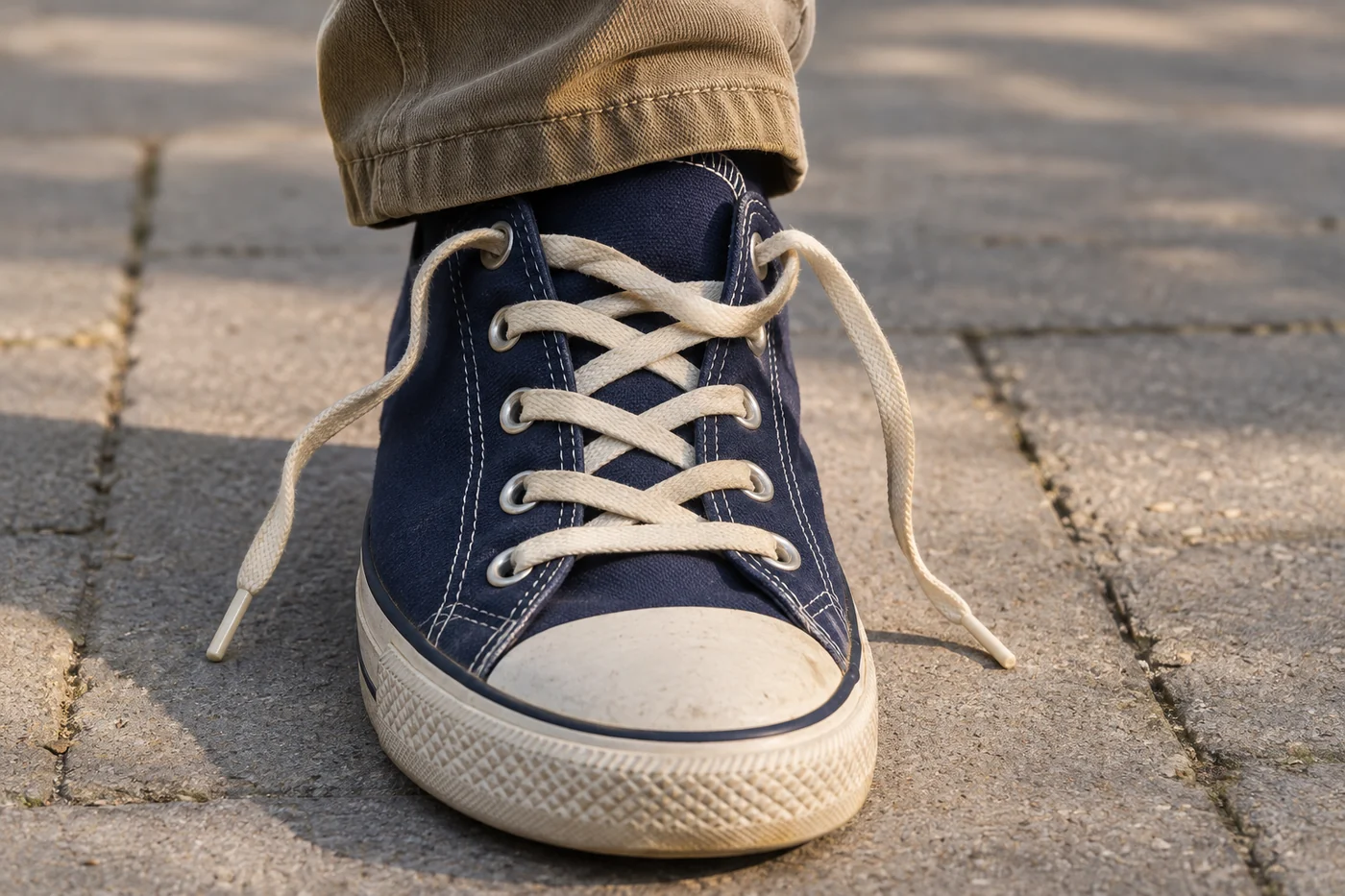
When your shoe lands, the knot gets a jolt and can loosen. As your foot swings, the loose ends keep moving and can tug on the loosened knot. After many steps, the bow can suddenly come undone.
Your bow is tight when you leave home. A few streets later, the lace is dangling over the toe of your shoe. How does the bow come untied on its own?
Each step jolts the knot
When your heel hits the ground, your shoe slows down sharply. The jolt also reaches the knot. The parts of the lace pressed against one another can shift a little.
A single step usually makes hardly any visible difference. But the movement repeats each time your shoe lands.
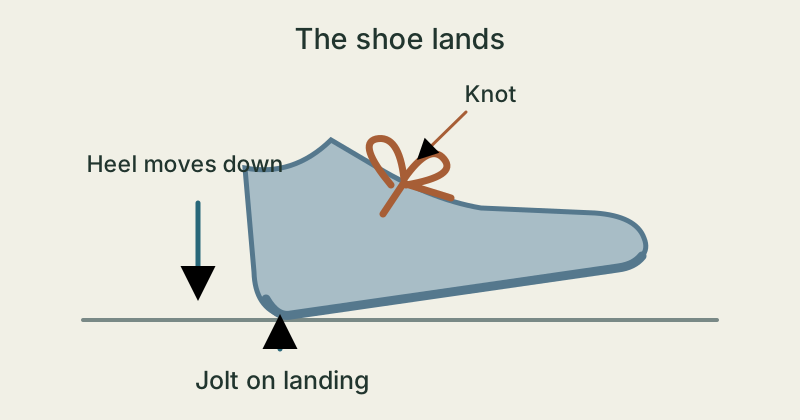
The loose ends tug as they swing
When you lift your foot for the next step, your shoe swings forward. The loose ends move with it. When the shoe changes its motion, the ends can keep swinging a little farther. This is called inertia.
If the knot has loosened, one free end can slip a little farther out of it. The loop attached to that end gets smaller. You can see this happen when you pull on a free end by hand.
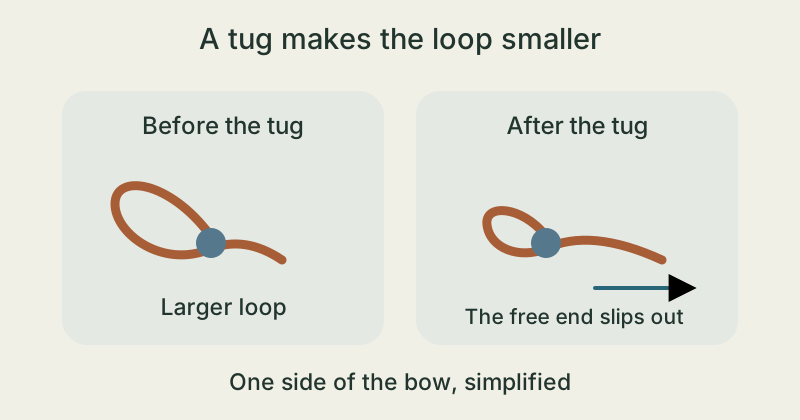
A small change becomes a big one
As a free end gets longer, it can tug harder when it swings. This can make the loop slip through the loose knot even faster. The bow can look secure for a long time and then come undone within a few steps.
A research team filmed this happening in slow motion while someone ran. They also tested shoelace knots on a swinging test rig. Of the two ways they tied the bow, one held up better under repeated jolts.
Take a close look at a loop
- Put a shoe on the table and tie an ordinary bow. Find the two loops and the two free ends.
- Pull slowly on one free end and stop after a short tug. Look to see which loop has become smaller.
- Pull a little farther. What happens when the bend of the loop disappears into the knot? When you walk, the swinging ends can give the knot a similar tug.
Keep the shoe on the table for this activity. Tie the lace securely before putting the shoe on and walking.
The takeaway
Landing can loosen the knot. The swinging ends tug on the loose knot until a loop slips through and the bow comes undone.
What can make a loop smaller once the knot has loosened?
Sources & further reading
Proceedings of the Royal Society A · The roles of impact and inertia in the failure of a shoelace knot ↗UC Berkeley Mechanical Engineering · Science shows why shoelaces come untied ↗Our stories explain the main idea in our own words. Pictures and models simplify reality and are not drawn to scale.