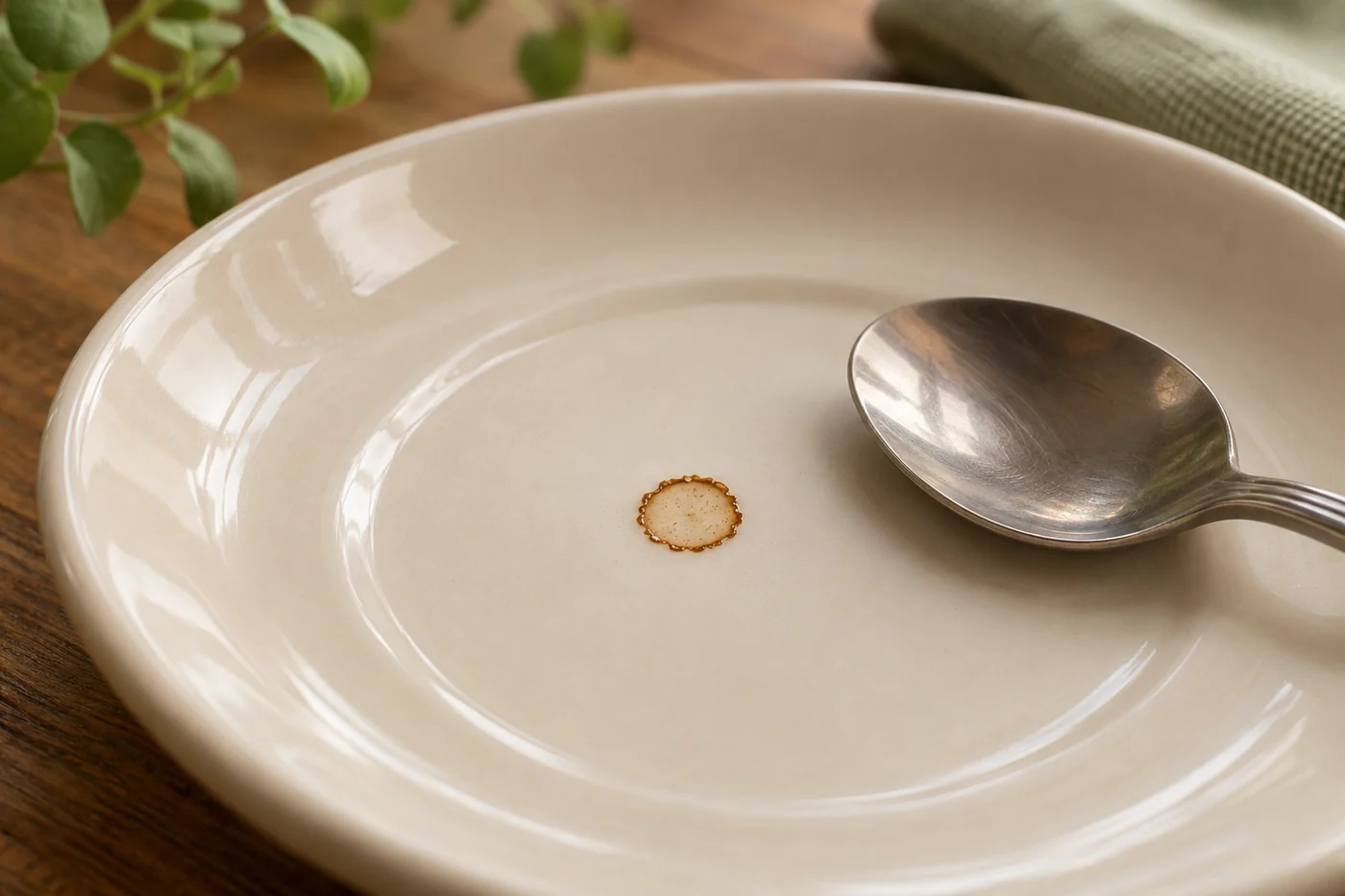
When the edge of a coffee drop stays in place, evaporation can make water flow outwards from the middle. The water carries tiny coffee particles to the edge. They gather there and leave a dark ring.
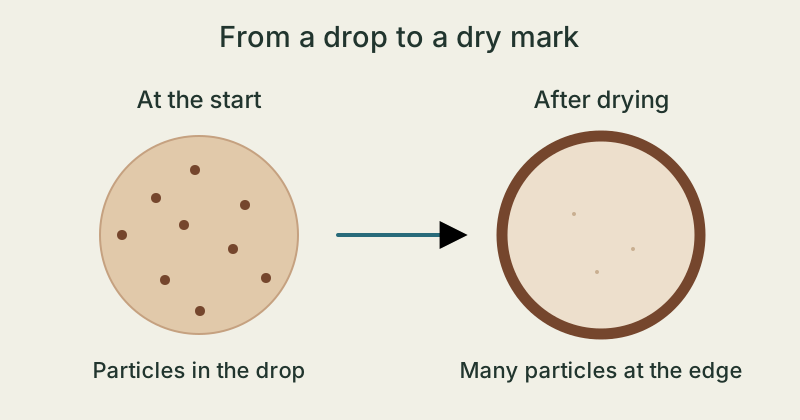
A little coffee drop lands on a pale plate. Later, it’s dry. The middle is faint and the edge is dark brown. How did so many coffee particles reach the edge?
The edge stays in place
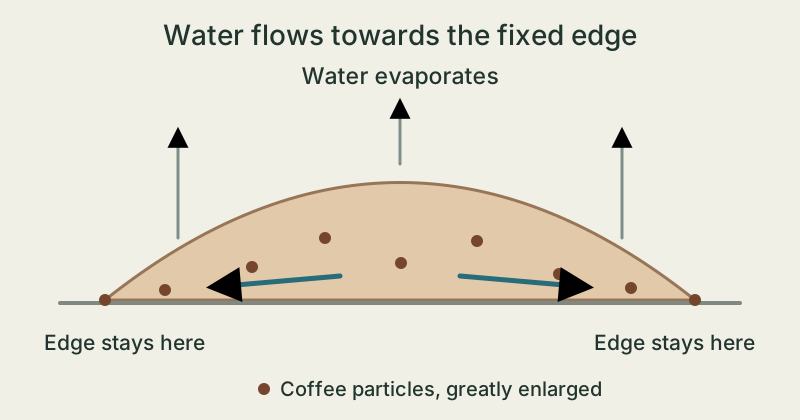
Where the drop meets the plate, its edge can catch on tiny bumps. As the drop dries, its outer circle then stays the same size for a while. The drop gets flatter.
Water escapes into the air as invisible water vapour. This is evaporation. In a shallow drop, water evaporates especially quickly near the edge.
Water carries particles outwards
As water evaporates near the edge, water from inside flows out to replace it. Tiny particles floating in the water travel with this flow.
The particles gather at the thin edge. When the water has gone, more brown material is left there than in the middle. This is called the coffee ring effect.
Drops can dry in different ways
The surface and the particles help decide how clear the ring will be. If the edge moves inwards, or other flows spread the particles around, a different pattern can form. That makes several drops worth watching.
Watch a drop as it dries
- Use a teaspoon to put three small, separate drops of cooled black coffee on a clean, smooth, pale plate. Leave it level somewhere it won’t be disturbed.
- Take a photo of the drops from above. Check again after a while and take another photo from the same direction. Does the outer edge stay in place at first?
- Wait until the drops are completely dry. Compare the edge and middle of each stain. Are all three rims equally dark? Drying can take several hours, depending on the size of the drops and the room.
Use cooled coffee and a washable plate. Wipe up splashes promptly to prevent stains.
The takeaway
When a drop’s edge stays in place, evaporation can drive a flow outwards. The water carries coffee particles to the edge, leaving a dark ring.
How do many coffee particles reach the edge of the drop?
Sources & further reading
University of Chicago · Coffee stains ↗Robert D. Deegan · Pattern formation in drying drops ↗University of Pennsylvania · Penn Physicists Undo the Coffee Ring Effect ↗Our stories explain the main idea in our own words. Pictures and models simplify reality and are not drawn to scale.