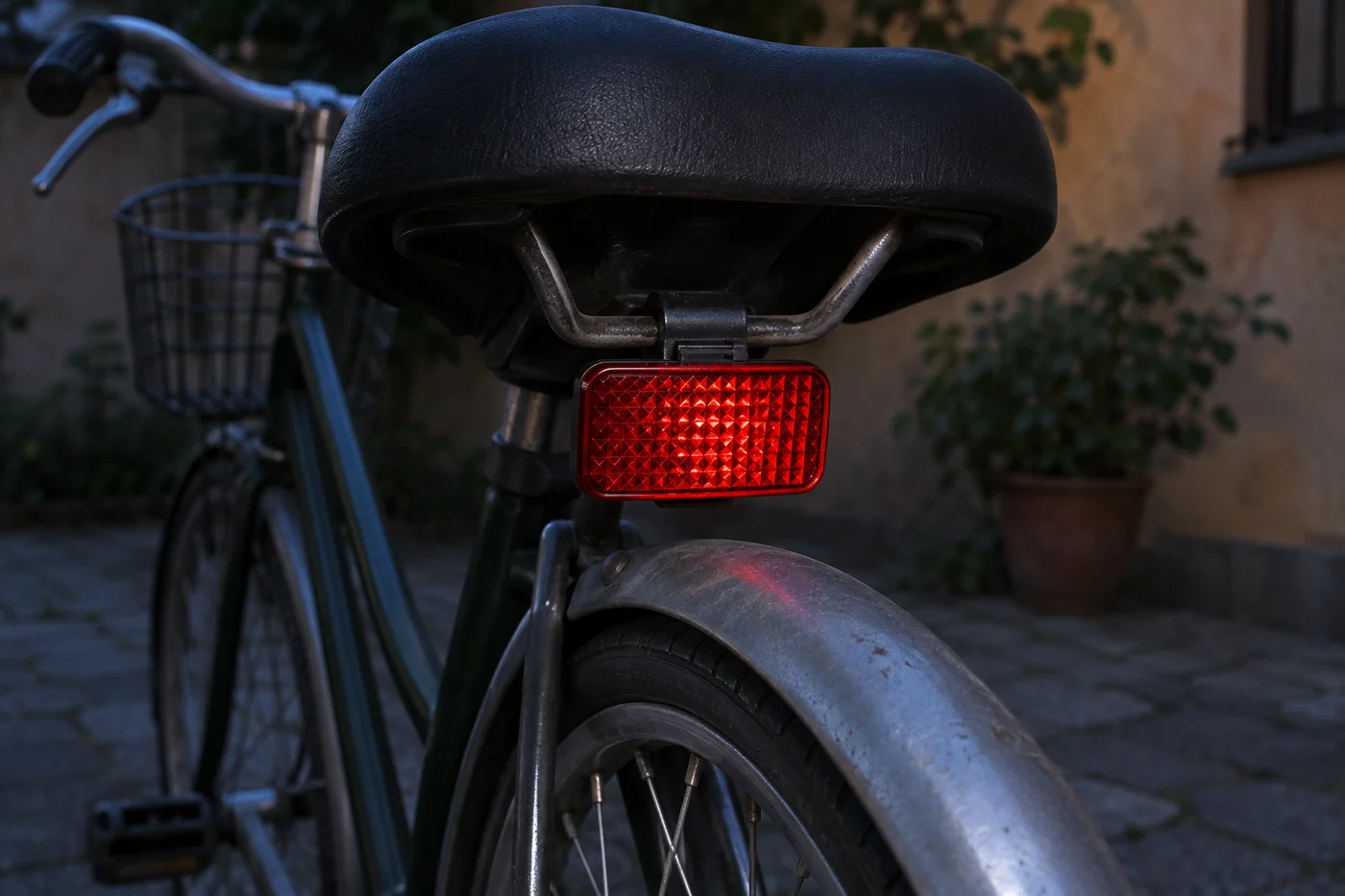
A bicycle reflector sends some light back towards the lamp. If you’re close to the lamp, some of that light reaches your eyes too. That’s why the reflector looks especially bright from that direction.
In the dim light, your torch catches a parked bicycle. Suddenly its little red reflector shines brightly. Point the torch somewhere else and it goes dark again. What does the reflector do with the light?
The light heads back towards the lamp
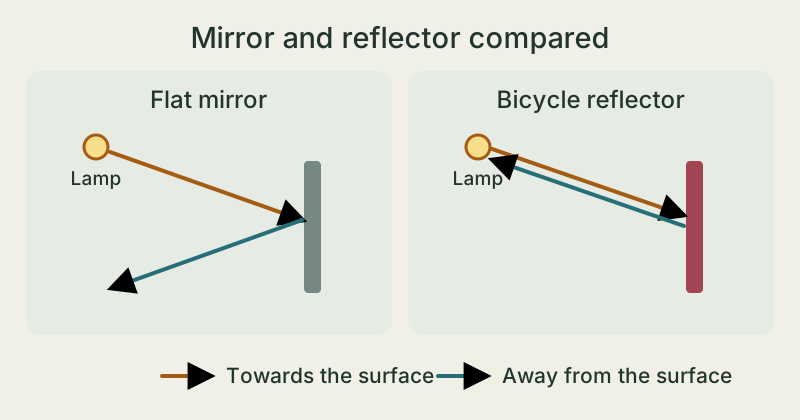
When a ray hits a flat mirror at a slant, it bounces off. Imagine a line at right angles to the mirror where the ray hits. The incoming and reflected rays make the same angle with that line.
A bicycle reflector can send light back towards the lamp even when the light comes in at a slant. This is called retroreflection. In a car, the driver’s eyes are close enough to the headlights to catch some of the returning light.
Tiny corners turn the light around
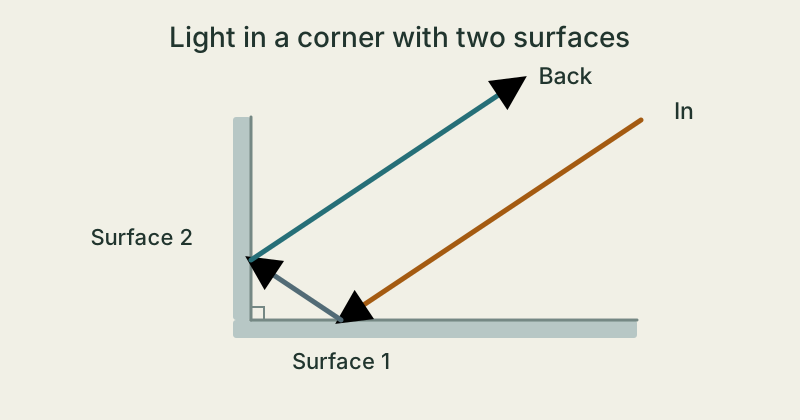
Look closely at the back of a clip-on bicycle reflector. Many have a pattern of tiny corners. Picture the corner of a room where two walls meet the floor. Each surface is at right angles to the other two.
When a ray hits all three surfaces of a corner like this, it changes direction at each bounce. After the third bounce, it travels parallel to the incoming ray in the opposite direction. There can be a small gap between the two paths.
Without light, the reflector stays dark
A reflector needs no battery or power supply. It uses the light that falls on it. A bicycle light makes its own light, so you can see it even when no headlights are shining on the bike.
Move the torch from beside you to one side
- Park a bike with a reflector securely in a dim room. From about two metres away, point a torch at the reflector and hold the torch just beside your face.
- Stay in the same spot and stretch your torch arm out to one side. Keep the beam aimed at the same reflector. Watch how bright it looks from where you’re standing.
- Bring the torch back beside your face. Does the reflector look brighter again?
Use a torch and try this away from traffic. Keep the beam out of people’s eyes.
The takeaway
The little corners in the reflector send light back towards the lamp. That makes the reflector easiest to see when you’re close to the light source.
Where will the reflector usually look brightest in this activity?
Sources & further reading
OpenStax · University Physics: The Law of Reflection ↗Appalachian State University · Corner Cube ↗Texas A&M Transportation Institute · Exploring the Science of Retroreflectivity ↗Our stories explain the main idea in our own words. Pictures and models simplify reality and are not drawn to scale.