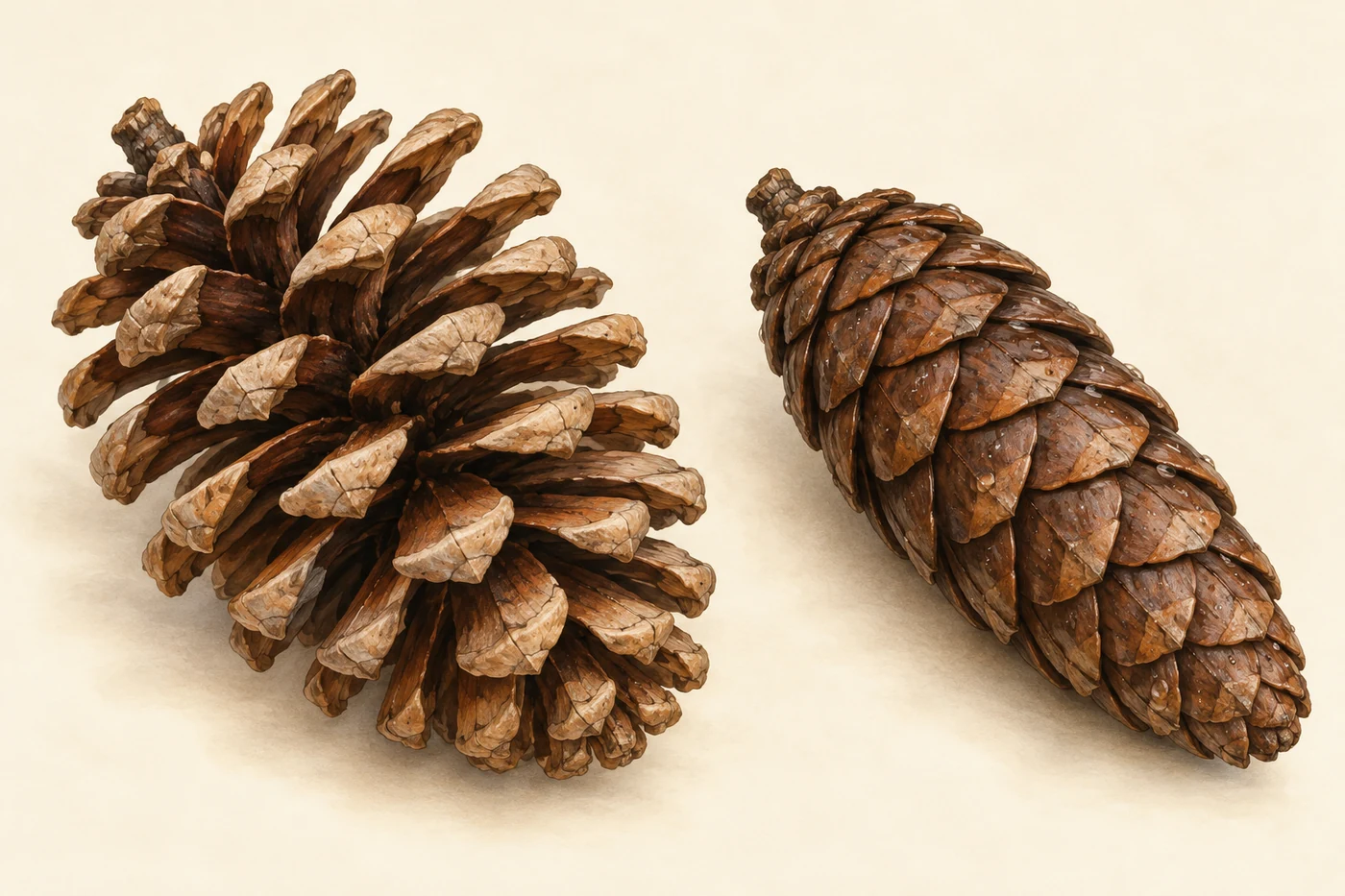
The scales of many mature pine cones absorb moisture. Their tissues swell differently and change flexibility in different ways. This bends the scales towards the cone's central axis, closing the cone. Drying can open it again.
Even a fallen brown cone can respond to moisture. The cover illustrates open and closed forms; it does not document an experiment.
Movement built into the material
The cells in mature woody scales are dead. Their cell walls remain, however, and can absorb and release water.
These material properties produce the movement. The cone does not need to come back to life.
Several tissues work together
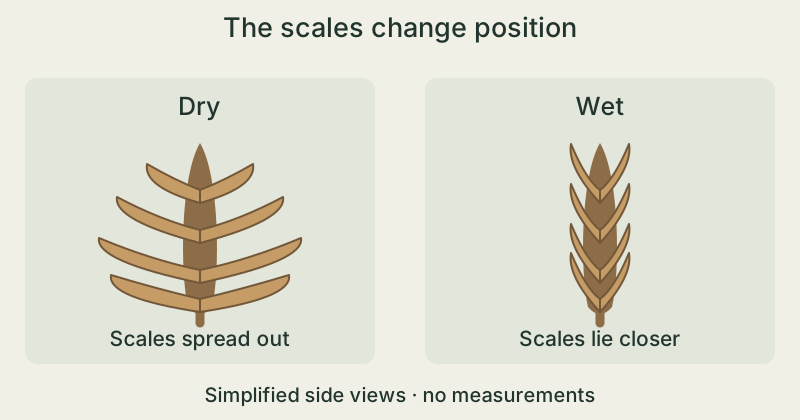
A scale contains different connected tissues. When wetted, some regions expand especially along their length. Fibre bundles become softer and allow bending more easily.
Together, these changes make the scale move inwards. An actual scale is more complex than a model made from just two simple layers.

Dry conditions help seeds travel
In many pines, wind can carry light seeds from open, mature cones. This dispersal works better in dry conditions than in wet ones.
As the scales lose water, their shape and flexibility change again. They can bend outwards and open the cone. Old cones you find may already be empty.
Moisture does not have to mean rain
Humid air can also trigger movement; immersion is not required. The response takes time and depends on factors such as the cone's species, condition and surroundings.
A water test does not measure air humidity precisely. A closed cone also does not reliably predict rain tomorrow.
Compare wet and dry cones side by side
- An adult selects two similar, already open, brown, unpainted pine cones. Put them in two plastic bowls side by side in the same room. Sketch or photograph the scale positions.
- Add room-temperature water to one bowl, leaving the other dry. Wet all sides of the water cone, gently turning it when observing if it floats. Compare about every 15 minutes for at least an hour. Record small changes or no change too.
- Take the wet cone out and let it air-dry on a paper towel at room temperature. Compare again after several hours and the next day. Opening may take longer. Do not force the scales apart: individual cones need not respond equally quickly.
Work with an adult. Avoid mouldy or sharply prickly cones and keep them away from mouths. Do not heat them or dry them in an oven. Wash hands and wipe up water afterwards.
The takeaway
Moisture changes the shape and flexibility of scale tissues. Their combined response closes the cone; drying can reopen it. This is slow movement of a material, not a reliable weather forecast.
Why can a fallen, mature pine cone close in water?
Sources & further reading
Eger et al. (2022), Advanced Science · The Structural and Mechanical Basis for Passive-Hydraulic Pine Cone Actuation ↗Dawson, Vincent & Rocca (1997), Nature · How Pine Cones Open ↗University of Freiburg, CPI · Research into Pine Cone Mechanics ↗Paleontological Research Institution · Weather Instruments ↗Royal Meteorological Society · Pine Cone Weather Station ↗Our stories explain the main idea in our own words. Pictures and models simplify reality and are not drawn to scale.