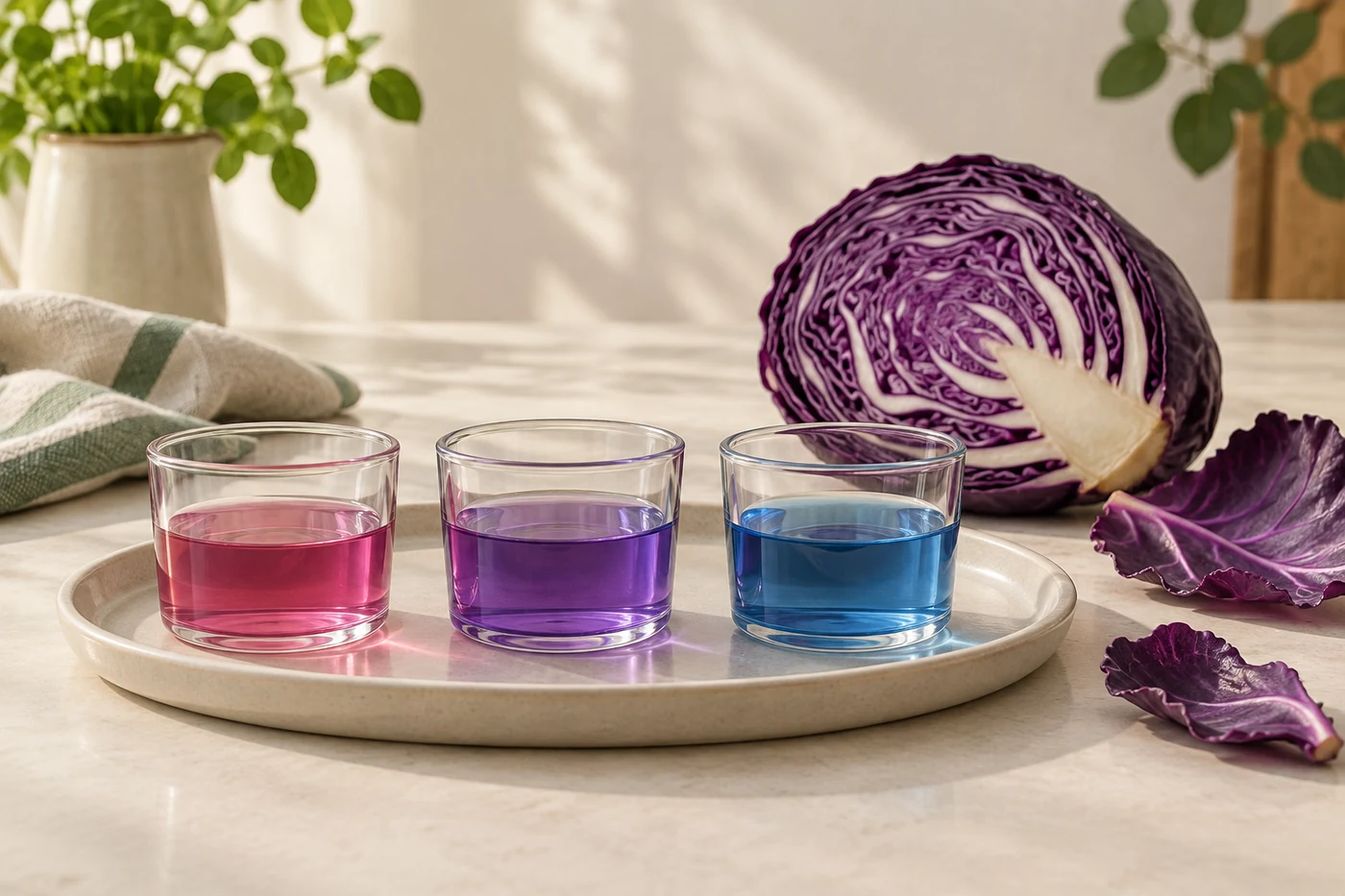
Red cabbage juice contains pigments called anthocyanins. They occur in different chemical forms in acidic and basic solutions. These forms absorb visible light differently. Vinegar can therefore make the juice look pink, while baking soda solution tends to make it blue.
A little red cabbage can provide a simple colour indicator. It reveals a property of a solution that we cannot normally see. The cover illustrates possible colours; it is not a measurement.
The colour is already in the leaf
Anthocyanins are plant pigments. Some pass from torn red cabbage leaves into water. This gives us a coloured extract without adding food colouring.
A pigment that changes colour in response to acidic or basic solutions is called an acid–base indicator. An indicator gives us a visible sign.
What does pH mean?
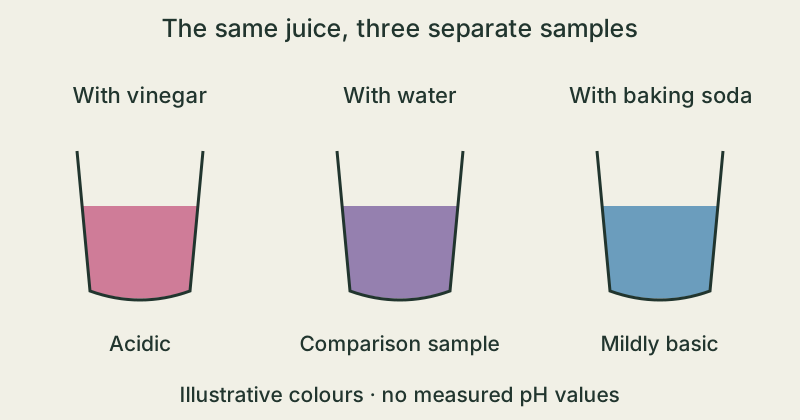
pH describes how acidic or basic a water-based solution is. At room temperature, a value below 7 means acidic, around 7 neutral, and above 7 basic. Basic is also called alkaline.
Household vinegar is acidic. Baking soda dissolved in water is mildly basic. We test these properties with our indicator, without tasting the liquids.
Different pigment forms absorb different light
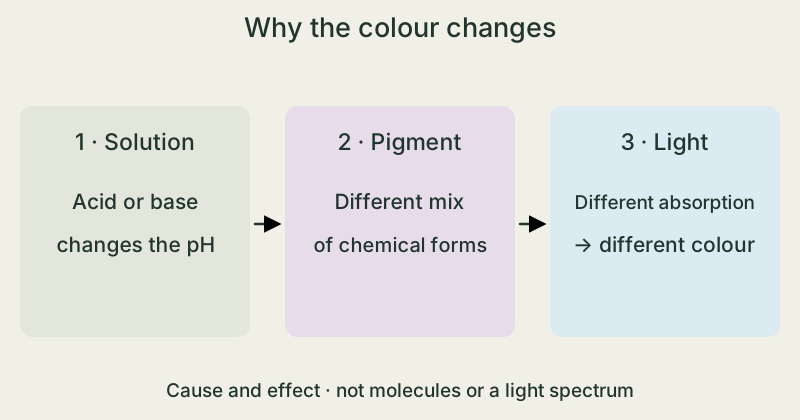
When pH changes, the mixture of chemical forms of the pigments changes too. These forms absorb different parts of visible light. A different mix of colours then reaches our eyes.
Vinegar does not simply add red dye. The pigments themselves react to the changed solution. Acidic samples often look pink to red, and basic ones tend towards blue or green.
A colour hint is not an exact number
The cabbage, water, amounts and lighting affect what we see. Our water sample provides a comparison; tap water need not have a pH of exactly 7.
These colours therefore give a rough indication, rather than an exact pH value. They also cannot tell us whether an unknown liquid is safe to drink or handle.
Compare three separate colour samples
- Work with an adult, wearing safety goggles, over a tray. Tear two red cabbage leaves into a securely sealable bag with about 150 ml of water. Close it and gently squeeze the leaves for a few minutes until the water is clearly coloured. The adult pours the juice through a sieve. No heating is needed.
- Label three open plastic cups Water, Vinegar and Baking soda. Put one tablespoon of juice in each. The adult dissolves a quarter of a level teaspoon of plain food-grade baking soda in 50 ml of water. Add one teaspoon of water, clear household vinegar with about 5% acidity, or baking soda solution to the matching cup. Use separate spoons.
- Stir each sample with its own clean stick. Compare them against white paper and record the colours straight away: usually pink with vinegar, more blue with baking soda solution, and close to the original colour with water. Record different results too. Keep the samples separate; their colours are not exact pH measurements.
Do not taste or drink the samples. Use only water, household vinegar and food-grade baking soda, with no baking powder, vinegar concentrate or cleaning products. Avoid splashing eyes. Leave cups open, wipe up stains promptly, and wash hands and equipment afterwards.
The takeaway
Anthocyanins respond to pH. Their chemical forms and light absorption change, giving cabbage juice different colours. Known comparison samples help us observe this; colour alone does not give exact numbers or establish safety.
Why can clear vinegar turn violet cabbage juice pink?
Sources & further reading
American Chemical Society · Chemistry Color Changers ↗Australian National University · DIY Red Cabbage pH Test ↗Georgia Tech · Make a Cabbage Juice pH Indicator ↗Royal Institution · Colour Changing Cabbage Juice ↗University of Illinois · Red Cabbage pH Indicator ↗Our stories explain the main idea in our own words. Pictures and models simplify reality and are not drawn to scale.