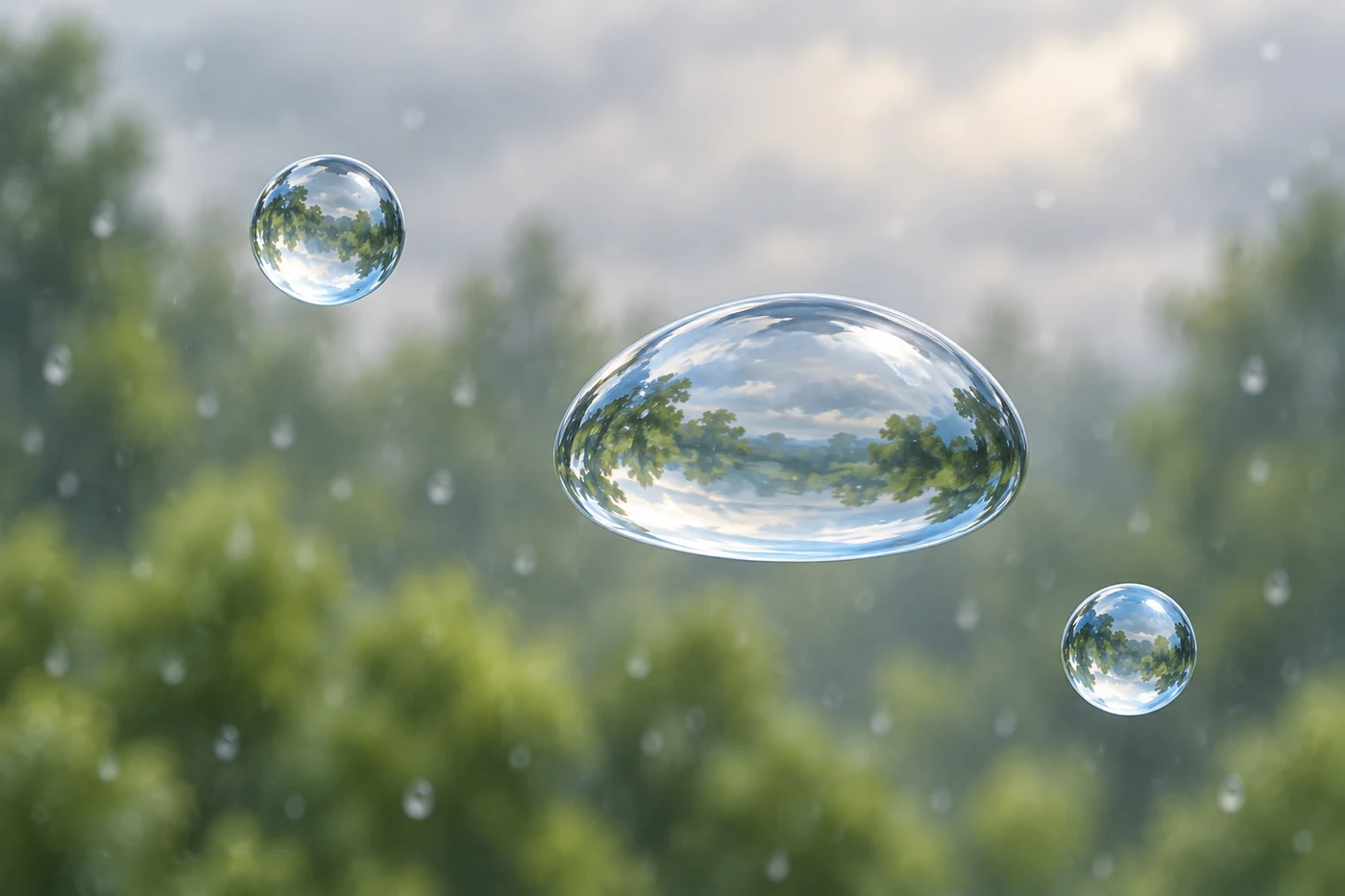
Surface tension keeps small raindrops nearly spherical. Air flowing around larger drops deforms the water: the bottom can flatten while the top stays rounded. A long upward-pointing tail is not the typical shape of a freely falling raindrop.
A weather symbol needs to be easy to recognise, so it need not reproduce nature exactly. The water drops in the cover are enlarged illustrations, not a measurement image.
Water holds together
Water molecules attract one another. This helps hold a drop together. Surface tension favours a small water surface.
A sphere has the smallest surface area for a given amount of water. Small free drops are therefore nearly spherical. Their surface is not a solid skin.
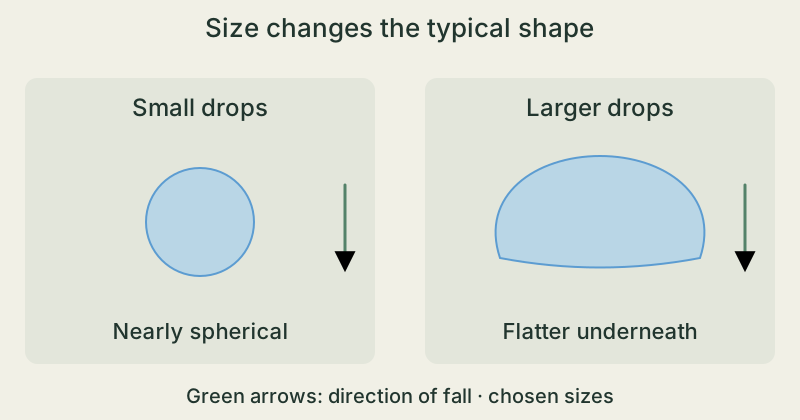
Air changes the shape of larger drops
As a drop falls downwards, air moves past it from below relative to the drop. This can create higher air pressure underneath a larger falling drop than above it.
The drop changes shape. Its bottom becomes flatter while its top stays rounded. It then looks more like the top half of a bread bun than a teardrop.
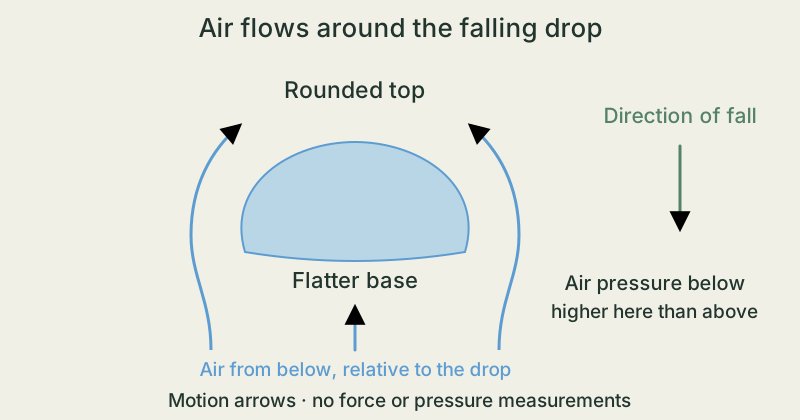
A drop cannot grow without limit
Collisions can make drops grow. Very large raindrops can become unstable in the airflow: they change shape strongly and eventually break into smaller drops.
Rain therefore contains different sizes and shapes. Our drawings show typical examples, not fixed size classes or the complete life story of every drop.
A dripping tap is a different situation
A drop at a tap is initially still attached to a surface. A thin neck can briefly form as it detaches. Water on a window also touches a solid surface and can flow along it.
Those shapes cannot simply be applied to freely falling rain. A familiar symbol and a real raindrop serve different purposes.
Watch a small dome of water
- With an adult, place a clean, dry coin flat on a tray with a paper towel. Have a small plastic cup of tap water and a clean plastic dropper ready.
- Slowly add single drops to the coin's centre from just a few millimetres above it. Look from the side: does a small dome form? Count until water runs over the edge. There is no required number of drops.
- Dry the coin and repeat twice with the same face upwards. Sketch the water's shape and note differences. The dome shows an effect of surface tension; the coin supports the water. It is not a falling raindrop or a measurement of raindrop size.
Work with an adult. Keep coins and the dropper away from mouths and small children. Use only water, wipe up spills, and wash hands and equipment afterwards.
The takeaway
Surface tension keeps small raindrops nearly round. Air deforms larger drops, especially their underside. Very large drops can break up; the pointed tail in drawings is not a typical feature of rain.
Which description fits freely falling raindrops?
Sources & further reading
NASA GPM · The Anatomy of a Raindrop ↗USGS Water Science School · Are Raindrops Shaped Like Teardrops? ↗Hong Kong Observatory · The Shape of Raindrops ↗NASA STEMonstrations · Surface Tension ↗Our stories explain the main idea in our own words. Pictures and models simplify reality and are not drawn to scale.