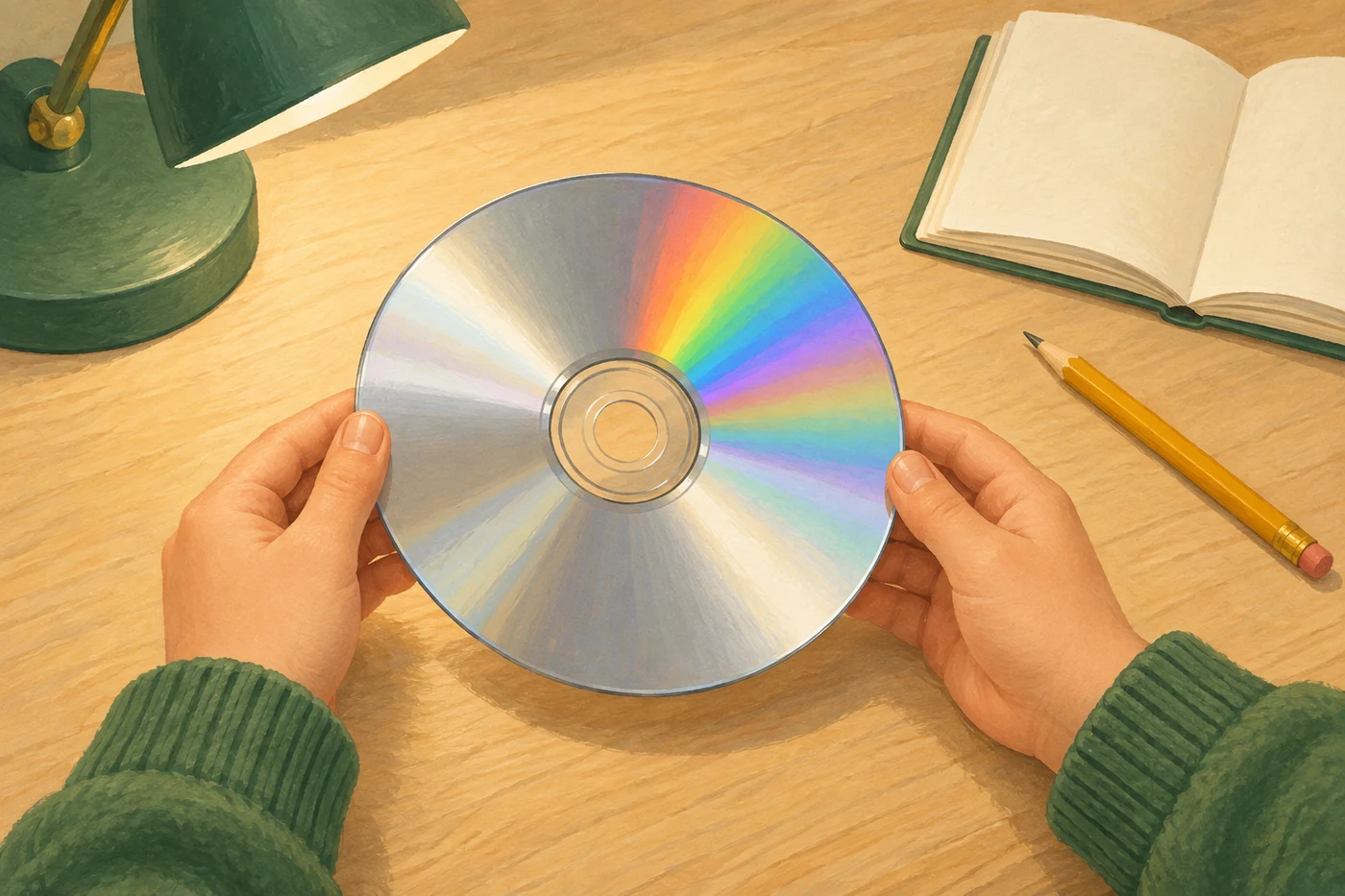
White light contains many colours. A CD's very closely spaced tracks act together as a diffraction grating. Light waves overlap, making different colours particularly bright in different directions. The colourful bands are not painted on.
The cover illustrates iridescence; it is not a photograph of a measured spectrum. We look at the reflective underside of an intact CD under ordinary white room lighting.
A long track in a small space
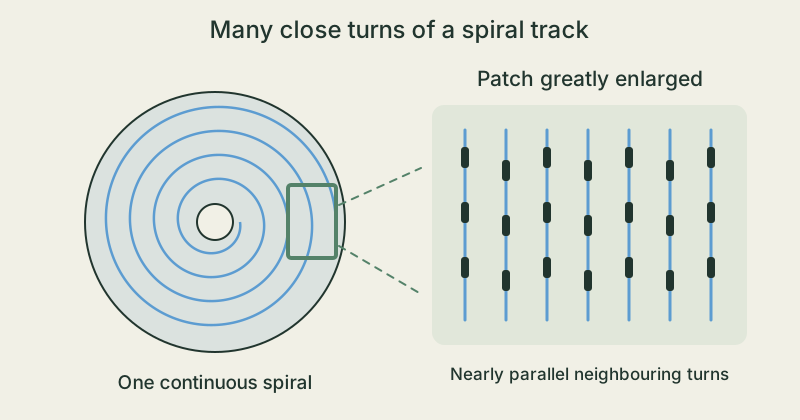
A CD stores data in tiny structures along a tightly wound spiral track. Neighbouring turns lie very close together.
A small patch therefore looks roughly like many parallel tracks. Their spacing is small enough for the wave properties of visible light to matter.
Light waves can overlap
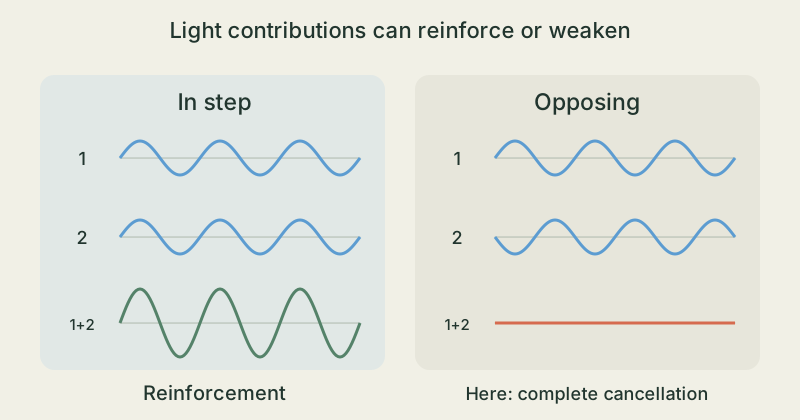
Light also behaves as a wave. Contributions from neighbouring tracks meet after travelling slightly different paths.
When their oscillations line up, they reinforce each other. When they oppose each other, they weaken each other. This overlapping is called interference. Together with diffraction at the fine structure, it produces bright directions with darker regions between them.
Each colour has a wavelength
Red light has a longer wavelength than blue light. Which paths line up well depends on wavelength.
The bright directions therefore differ for different colours. The grating separates colour components already present in white light; it does not need to create them. A bright, largely white mirror-like reflection can appear alongside them too.
Tilting changes your view of the pattern
Tilting the CD changes the directions between lamp, tracks and eye. A different colour now reaches you especially strongly. The CD does not need to rebuild its surface.
The pattern also depends on the light source. Not every white lamp shows all colours equally strongly. Although it looks similarly colourful, a rainbow in raindrops forms differently: refraction and internal reflection are especially important there.
Compare three viewing angles
- Ask an adult to check an unwanted CD for cracks and sharp edges. Sit at a table under an ordinary white LED lamp. Hold the intact disc by its edges, tilted with the silvery side facing upwards and well away from your face. Keep the lamp and seat in place. Slowly tilt the disc to find a colourful area; immediately tilt away from any dazzling reflection.
- Sketch the disc as a circle on paper and mark a rough area to observe, without writing on the CD. For the first position, record two visible colours and where they appear. Tilt the disc a little one way and then the other. Draw each position again: which colours strengthen, fade or move? Keep looking at the same patch of the CD.
- Return to the first position and repeat the comparison three times. Look for a similar pattern; holding exactly the same angle by hand is difficult. Faint or absent colours are a result too. You are observing the dependence on viewing angle, not measuring wavelengths or tiny track spacings. Without a CD, you can compare the first explanatory diagram instead.
Observe with an adult. Use only an intact CD and ordinary room lighting. Avoid lasers, direct sunlight, candles and unusually bright lamps; never stare into a dazzling reflection. Do not cut, break, bend or peel the disc. Keep lamps closed and do not touch them if hot.
The takeaway
A CD's fine spiral structure acts as a diffraction grating. Diffraction and interference make existing light colours bright in different directions. Tilting changes which ones reach your eye.
What produces the moving coloured bands on a silvery CD under white light?
Sources & further reading
OpenStax / Rice University · Multiple Slit Diffraction: Reflection Gratings ↗Universität Kiel / Joachim Köppen · Experiments with CD ROMs: CDs as Diffraction Gratings ↗Optical Society of America / Florida State University · Splitting White Light ↗Florida State University · Investigating Special Properties of Light: CD Rainbows ↗Our stories explain the main idea in our own words. Pictures and models simplify reality and are not drawn to scale.