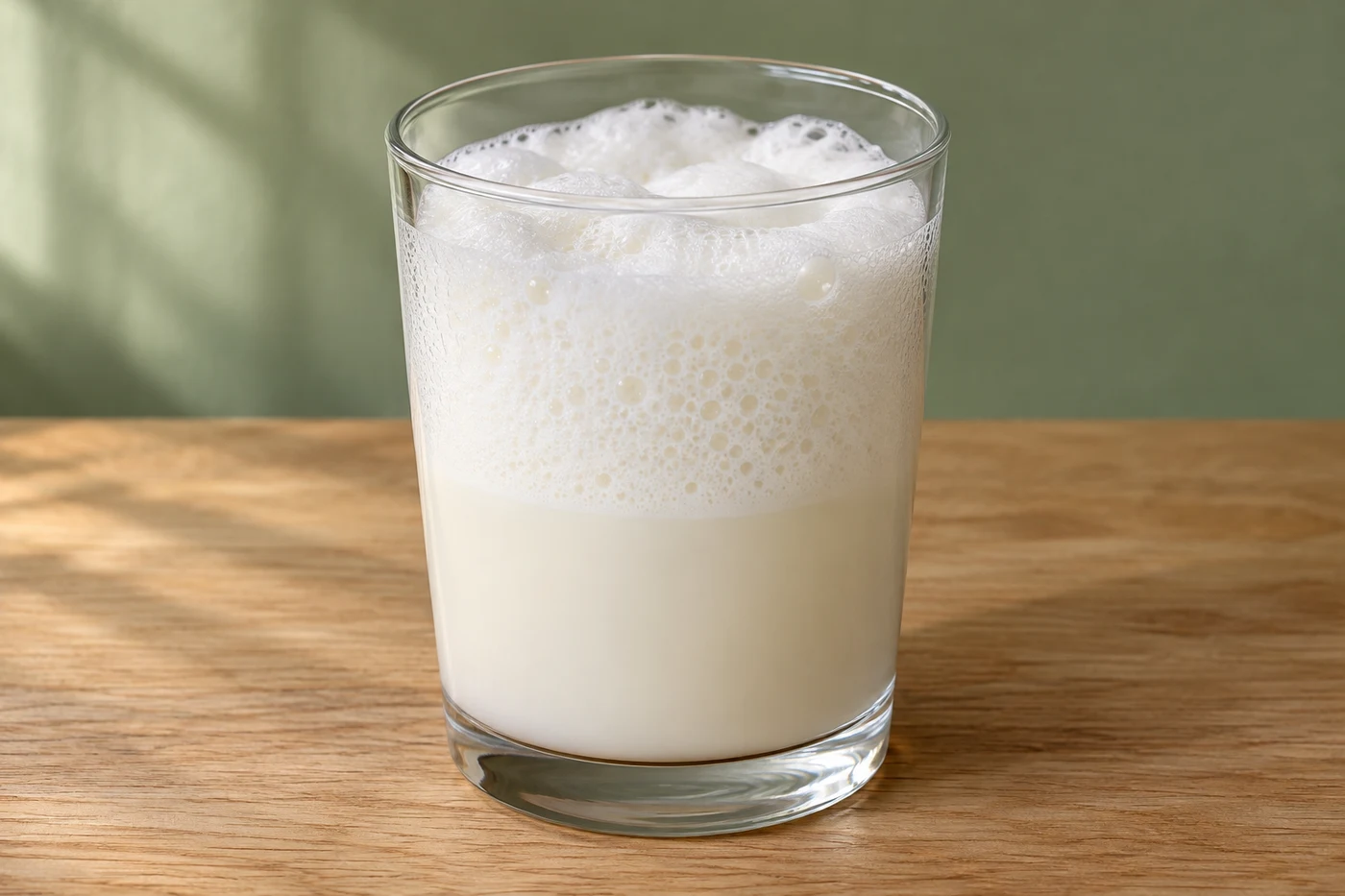
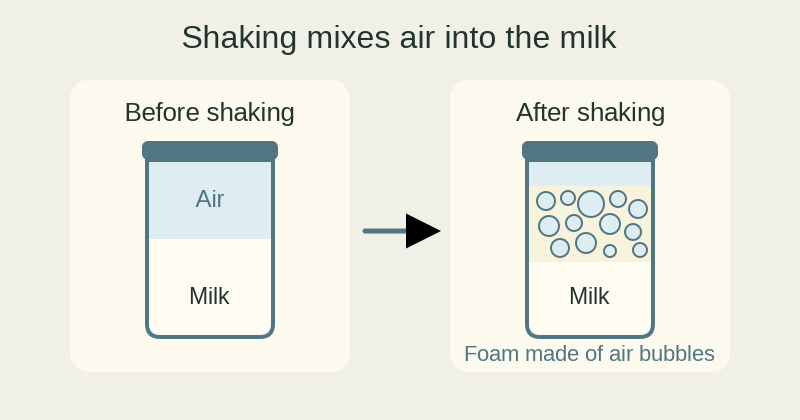
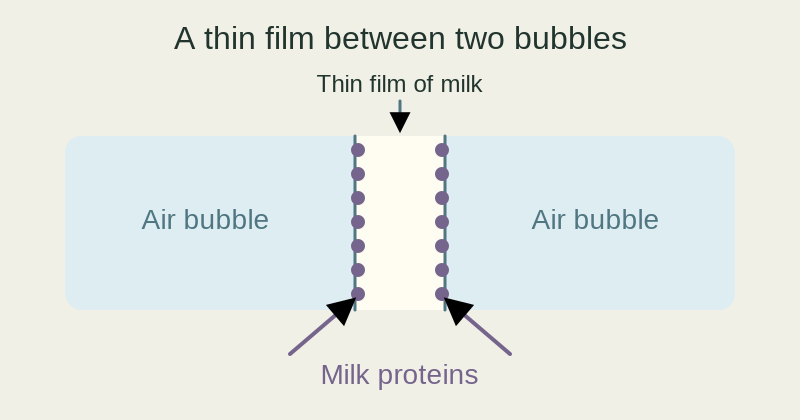
Shaking breaks up some of the air above the milk into lots of small bubbles. Milk proteins collect where the air touches the liquid. They stabilize the thin films around the bubbles, so the foam sticks around for a while.
Shake some milk in a small bottle and set it down. There’s now a pale layer full of tiny bubbles on top. If you shake water on its own, that layer usually disappears much sooner. What makes milk different?
The air comes from above the milk
In a half-full bottle, there’s air above the milk. When you shake it, the milk sloshes around and traps little pockets of air. The bubbles rise and collect at the surface.
Foam takes up more room than the liquid that makes it because the bubbles contain air. Some milk stays liquid at the bottom. Some of it forms the thin walls between the bubbles.
Milk proteins help the bubbles stay intact
Milk contains several kinds of protein. Some collect where an air bubble touches the milk. They form a very thin layer at the surface of the bubble.
This layer helps the liquid film hold together when the bubble changes shape a little. Bubbles can still pop or merge. Water shaken on its own has no milk proteins, so under similar conditions its bubbles usually disappear sooner.
Foam changes as it sits
While the foam sits, some liquid drains down through the spaces between the bubbles. The films can get thinner. Some break, and the foam layer shrinks.
How much foam forms and how long it lasts depend in part on the temperature, the milk, and the way you froth it. Even cold milk can foam when you shake it.
Shake cold milk and cold water
- Take two clear plastic bottles of the same size with screw caps. Put three tablespoons of cold water in one and three tablespoons of cold milk in the other. Close both tightly and leave room for air above the liquid.
- Shake each bottle separately for about 15 seconds, using about the same effort. Set each one down and look right away at how thick the layer of bubbles is.
- Look at each bottle again after about one minute. Which one has more of its layer of bubbles left?
Use clean plastic bottles with tight lids and cold liquids. Rinse away any traces of dish soap first, since it can make foam on its own.
The takeaway
Shaking mixes air into milk. Milk proteins stabilize the thin films around the bubbles, helping the foam last longer.
What helps the bubbles in milk foam last longer?
Sources & further reading
Kamath et al. · The composition of interfacial material from skim milk foams ↗Xiong et al. · Foaming properties of milk protein dispersions ↗Lajnaf et al. · Foaming and air-water interfacial properties of milk proteins ↗Our stories explain the main idea in our own words. Pictures and models simplify reality and are not drawn to scale.