Your eyes are a little way apart. Each sees the finger from a different viewpoint. Switching eyes changes its position against the distant background. The finger itself stays still.
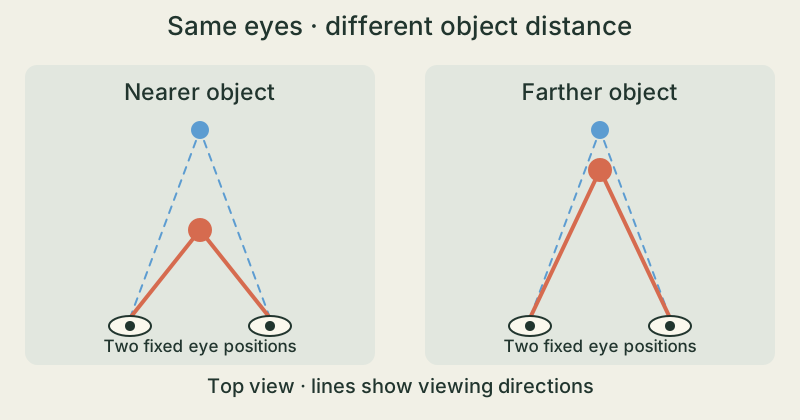
The cover illustrates the observation. It is neither a measurement nor an eye test.
Two eyes in two places
Your left eye sits to the left of your nose, and your right eye to the right. Both receive light from many of the same things, but from slightly different directions.
They can therefore see different parts of a nearby object. Its position against the background differs too.
Nearby things shift more
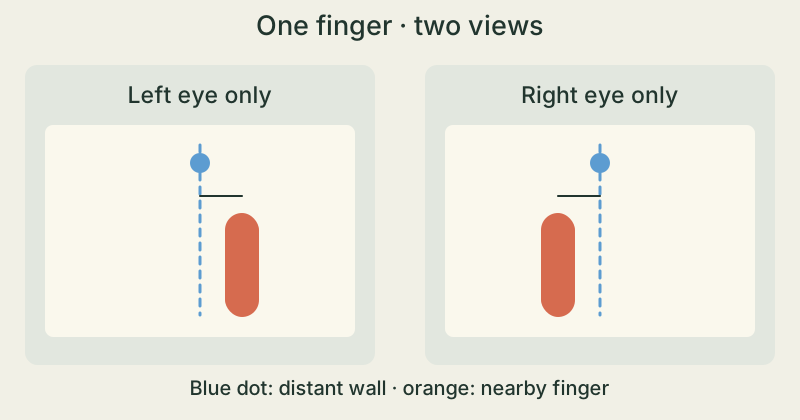
With your head still, switching between eyes makes a nearby finger seem to jump sideways. You are now viewing it from the other position.
Against the same distant background, this difference is usually larger for a nearer finger than a farther one. The viewpoint changes; the finger does not move.
The brain uses the differences
With both eyes open, the brain processes their views together. Small differences between them provide a clue to what is nearer and what is farther away.
This kind of depth perception is called stereopsis. It helps with tasks such as reaching for an object. Your eyes do not send out measuring beams.
Distance has other clues too
Even with one eye, there are clues to depth: one object hides part of another, or familiar things look smaller in the distance.
Distance therefore does not simply disappear when you close one eye. The brain combines several clues; stereopsis is one of them.
One still finger, two views
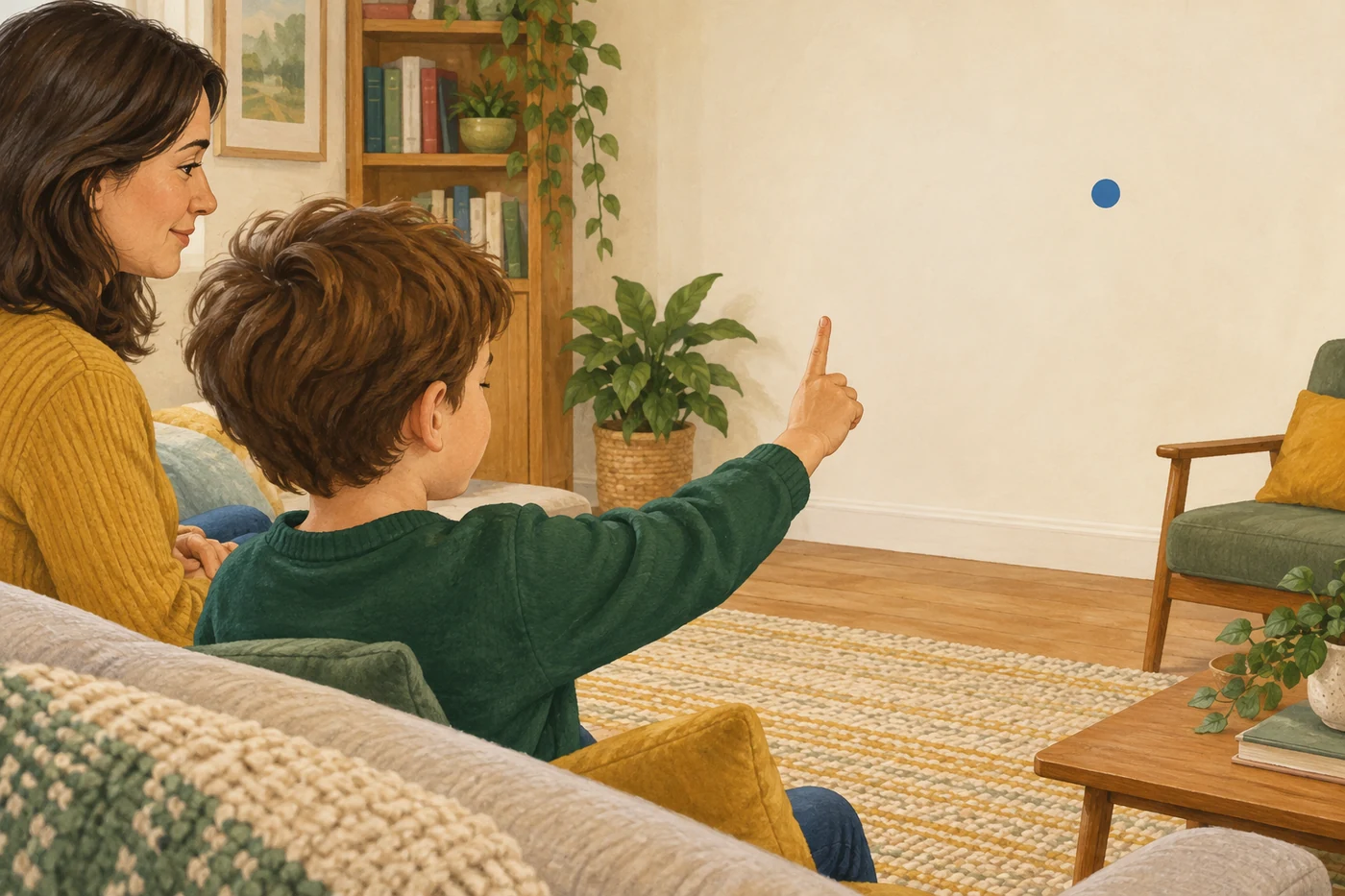
- With an adult, sit comfortably in an evenly lit room. Choose a small mark on a wall several metres away. Hold one index finger upright at eye level, about an arm's length in front of you. Keep your head and hand still.
- Gently close one eye and then the other, looking at the wall mark each time. Repeat slowly three times. Note or sketch whether the finger appears to the left or right of the mark. It can look blurry because you are looking at the distant wall.
- Take a break. Repeat with your finger a little closer, keeping it at least about 30 cm from your face and only while comfortable. Does the sideways difference look larger? Check that your head and hand stay still. A small or unclear difference is fine. This observation measures neither visual sharpness nor your ability to see stereoscopic depth.
Stay seated. Do not press on your eyes, deliberately cross them or bring objects towards your face. Stop if it feels tiring. Do not look at the Sun or bright lamps. This is an optional observation, not a health test.
The takeaway
A still finger can seem to jump when you switch eyes because the viewpoint changes. Differences between the two views help the brain perceive depth. Overlap and size provide other clues.
Why does a still finger seem to jump when you switch eyes?
Sources & further reading
OpenStax / Rice University · Psychology 2e: Vision — Depth Perception ↗National Eye Institute / NIH · Cool Eye Tricks ↗UTHealth Houston · Neuroscience Online: Visual Processing — Binocular Fusion ↗NPTEL · Visual Perception: Depth Perception ↗Our stories explain the main idea in our own words. Pictures and models simplify reality and are not drawn to scale.