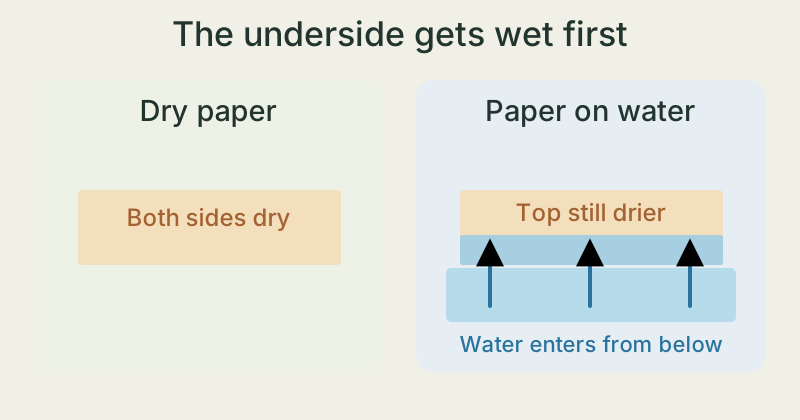
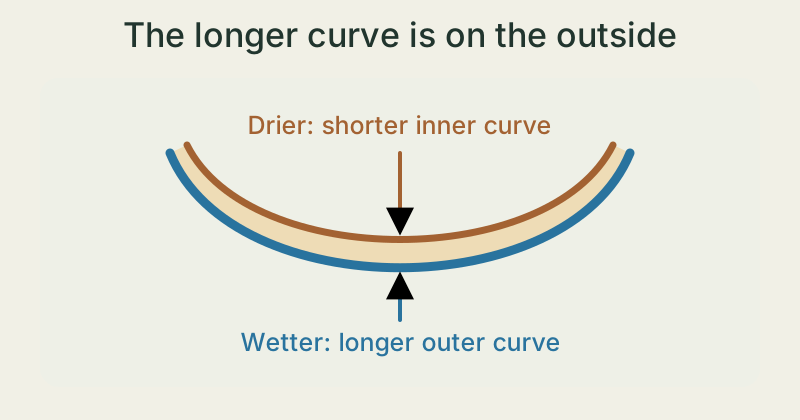
The fibres on the underside of the paper absorb water first and swell. This makes the underside expand more than the drier top side. Since both sides are part of the same sheet, the paper bends. The wetter side forms the longer, outer curve.
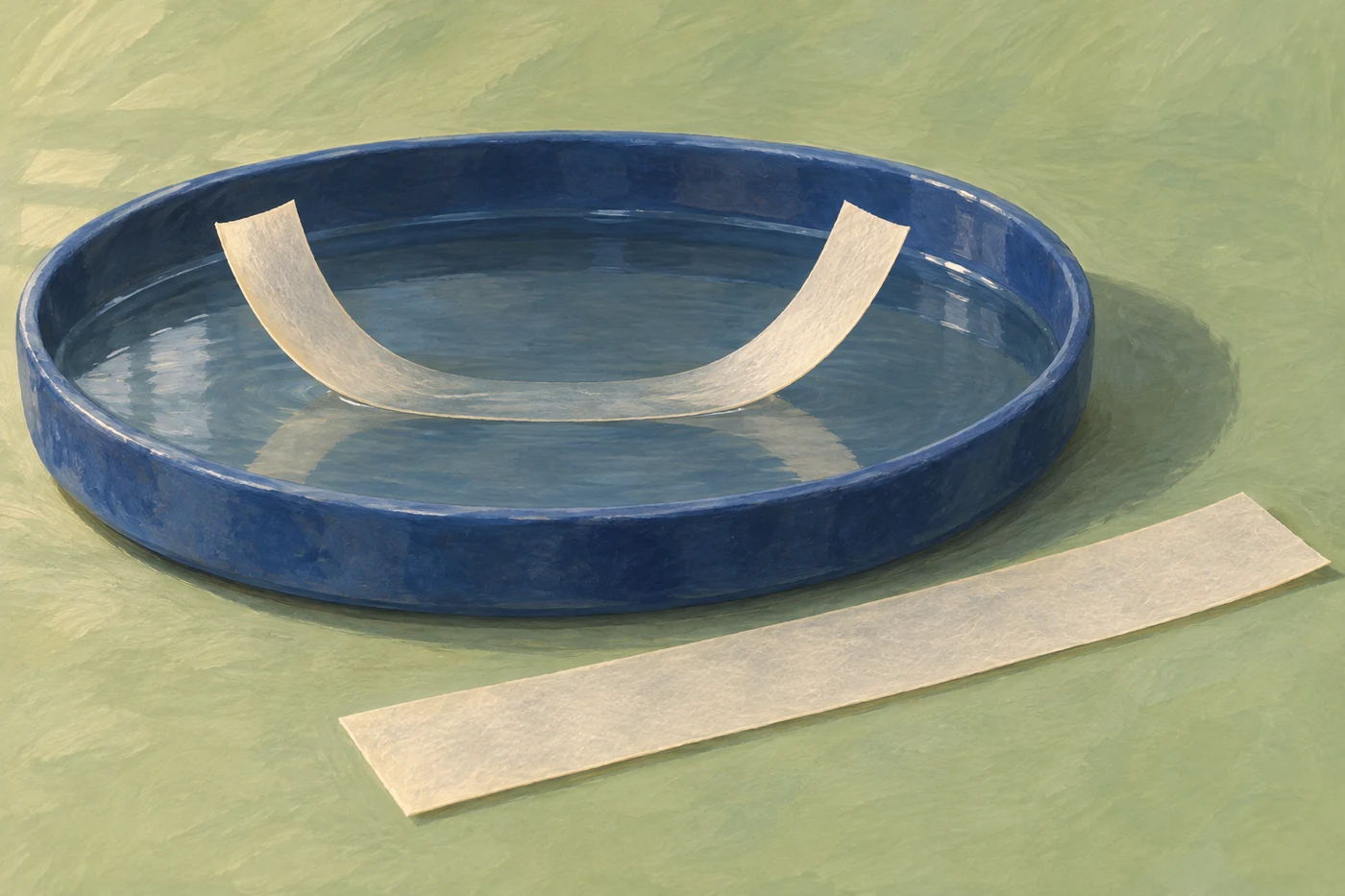
A flat strip of tracing paper floats on a dish of water. Soon its edges may lift above the surface. Keep watching: the strip may flatten again even while it is still wet.
Water makes the fibres swell
Paper is a web of tiny fibres joined together. The fibres contain cellulose, a substance found in plants. When they take up water, they swell and get thicker. This can make the whole sheet expand a little.
On the water, the underside gets damp first. At first, there is less water nearer the top of the paper. The underside therefore expands more than the top.
The longer side is on the outside
The two sides are part of the same sheet and cannot slide freely past each other. The sheet bends. Think of two lanes going around a bend. The outside lane is longer than the inside lane.
In the floating strip, the underside that swelled more is on the outside. The drier top side is on the inside. That is how the edge can lift upwards.
When water reaches the top side
Over time, water moves through the paper. The top side swells too. The difference between the two sides becomes smaller, and a short strip can flatten again.
How much the strip bends and how quickly it flattens depend on the paper. A longer piece can roll up so far that its ends stick together.
Watch a strip of paper on water
- Cut two matching narrow strips from a sheet of thin tracing paper. Pour a little tap water into a shallow dish.
- Lay one strip flat on the surface without pushing it under. Leave the other strip dry beside the dish. Look from the side right away and compare the edges.
- Watch the floating strip for another minute or two. Does it become flatter? If it rolls all the way up, try again with a shorter strip.
Set the dish on a waterproof surface and wipe up any spills.
The takeaway
Water makes paper fibres swell. When one side expands more than the other, the sheet bends. The side that expands more ends up on the outside.
Which side is on the outside of the curve when the paper first bends?
Sources & further reading
É. Reyssat und L. Mahadevan · How wet paper curls (Harvard SEAS) ↗A. Maass und U. Hirn · Long term curl of printing paper due to ink solvent migration (TU Graz) ↗Our stories explain the main idea in our own words. Pictures and models simplify reality and are not drawn to scale.