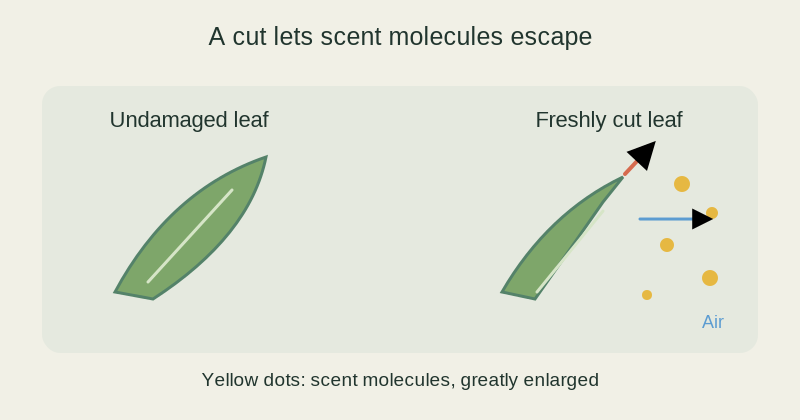
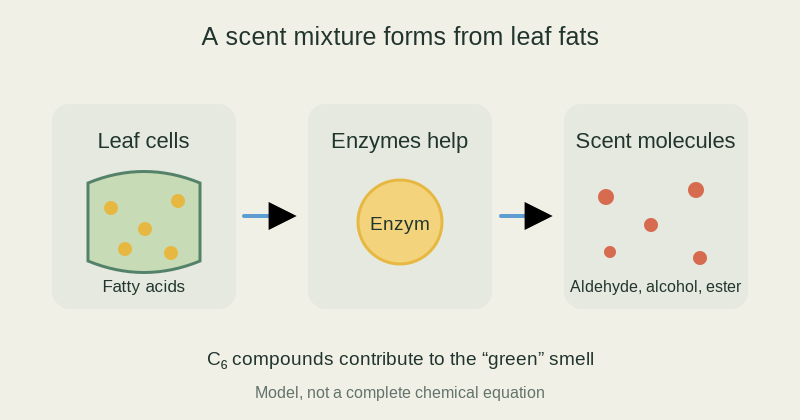
Cutting damages grass cells. Enzymes then help form small, volatile molecules from certain leaf fats. These “green leaf volatiles” enter the air and can waft to our noses.
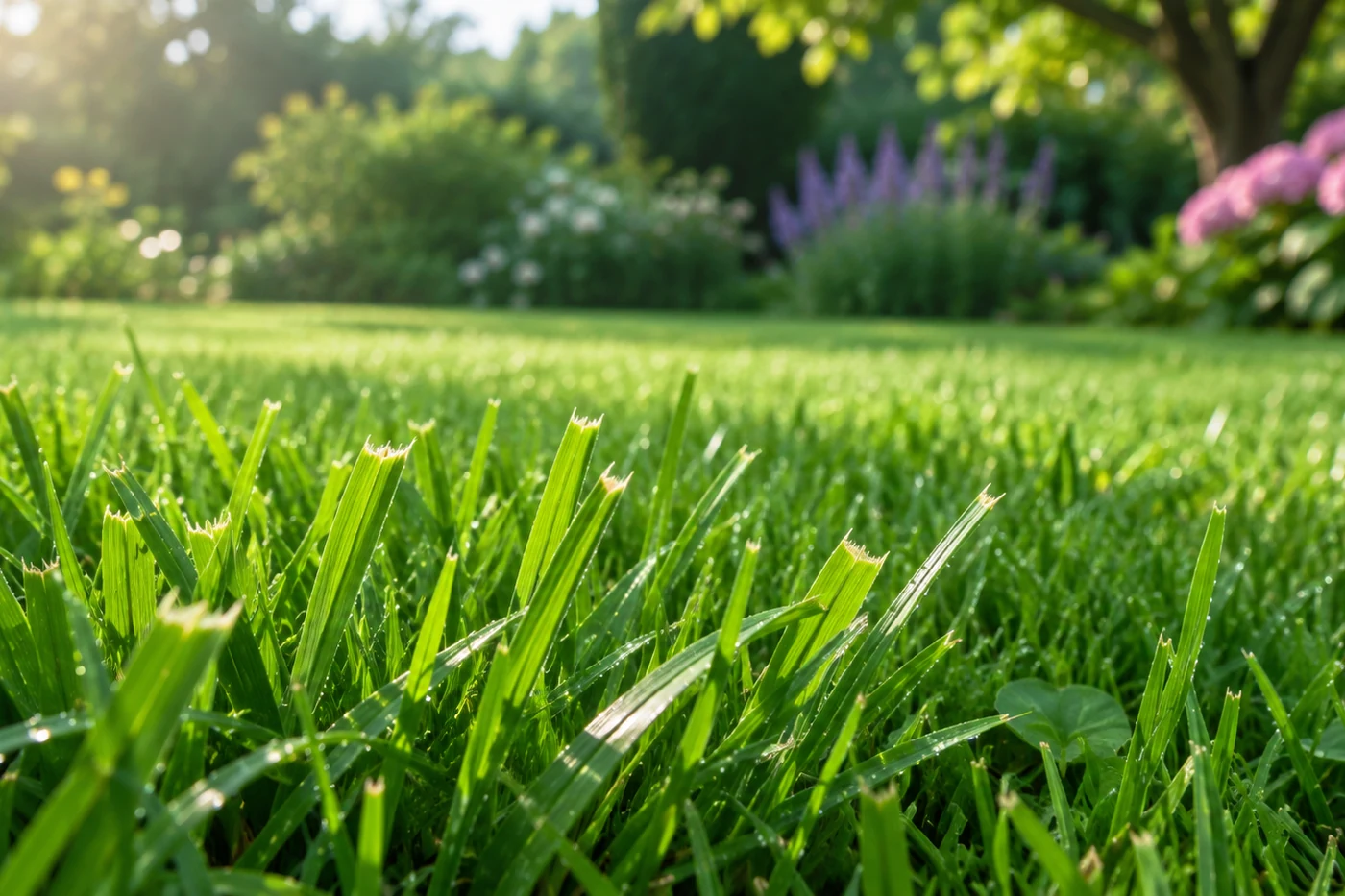
The cover shows a mown lawn. The diagrams below are models: scent molecules are far too small to see like this.
A cut changes the leaf cells
A blade of grass is made of many cells. Their membranes contain fats with particular fatty acids. While cells are intact, many reaction partners stay apart. A cut damages the tissue, allowing substances that were separated to meet.
Enzymes then help with a series of reactions. Among the products are small molecules with six carbon atoms. Some evaporate easily and leave the blade.
The smell is a mixture
Several compounds contribute to the smell of freshly cut grass: especially aldehydes and alcohols, as well as esters. One familiar ingredient is called (Z)-3-hexenal. It contributes to the characteristic green smell, but it is not the only cause.
The molecules move with the air. If they reach your nose, they can activate smell receptors. Your brain combines those signals into a perception of odour. Wind, the type of grass and the time since cutting can change which compounds you notice.
The scent can matter to the plant
These green leaf volatiles are also released when animals chew leaves. In some plants, they can trigger defence responses or attract natural enemies of plant-eating insects. The effect depends on the plant and the situation.
That does not mean grass deliberately makes a scent for us. We notice by-products of a plant response that can have other effects for the plant.
Compare fresh and dry grass
- Ask an adult to place some freshly mown grass and a small amount of older, dry blades into two clean jars. Cutting or mowing is not part of the activity.
- Hold each jar at a distance and gently fan a little air towards yourself with your hand. Do not smell directly from the jar. Compare whether the odours differ.
- Note the type of grass, roughly equal amounts and the time. Repeat the comparison later using the same jars. This is an observation, not a laboratory test: moisture and different blades can affect the result.
Observe clean grass with an adult. Do not taste it or breathe in deeply. Do not take part if you have a grass allergy, asthma or irritation; wash your hands afterwards.
The takeaway
Damaged grass cells release a mixture of volatile green leaf compounds. Air carries these molecules to our noses; some can also take part in plant defence responses.
What mainly makes freshly cut grass smell different from uncut grass?
Sources & further reading
Royal Society of Chemistry Education · The aroma of fresh-cut grass ↗American Chemical Society · cis-3-Hexenal ↗Our stories explain the main idea in our own words. Pictures and models simplify reality and are not drawn to scale.