
No. The shell picks up sounds from the surroundings and changes their mix. Air in its hollow space vibrates especially well at some pitches.
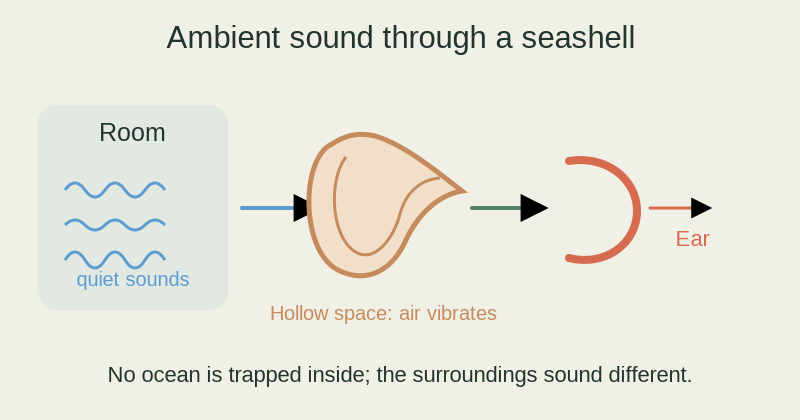
Hold a large shell near your ear and it can sound as if waves are close by. Yet you can hear the same kind of rush in a bedroom. The shell does not carry the ocean inside it. It changes quiet sounds that are already around you.
The sounds are already there
There are almost always quiet sounds in a room: air moving, a fridge humming, or a car passing far away. These sounds are vibrations in the air. Without a shell, you may hardly notice many of them.
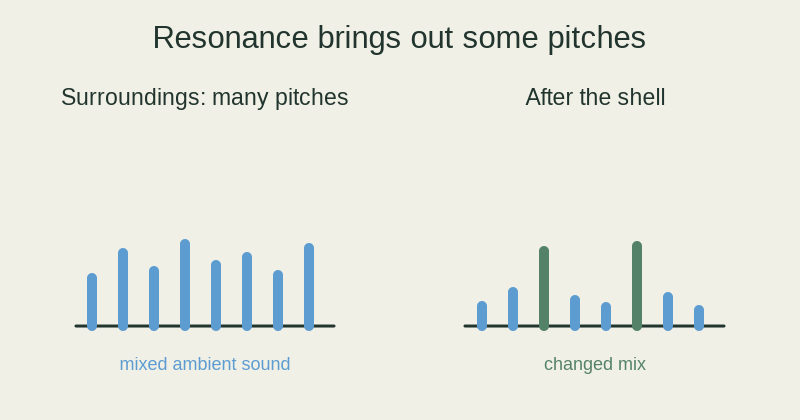
The shell’s opening lets some of those vibrations inside. Sound sets the air in its hollow space moving. Depending on the shell’s shape, some pitches vibrate more strongly than others. This strengthening at certain pitches is called resonance.
The shell changes the sound
Its inner surfaces reflect sound, and the air in the hollow space vibrates especially clearly at some frequencies. The shell changes the mixture of sounds. The result can resemble a steady rush, a little like surf.
A shell does not simply make every sound louder. It brings out some parts and reduces others. That is why a cup or a curved hand held near the ear can create a similar impression, though each shape sounds a little different.
The ocean is not inside the shell
Try the shell in another room and the rushing sound changes. In a noisier place, you will usually hear more; in a quiet room, less. That fits the idea that the shell changes sounds from its surroundings.
So you are not hearing a recording of the sea, and usually not your blood flow either. You are hearing the current surroundings through a small hollow space that shapes sound. On a real beach, actual surf can of course reach the shell too.
Compare a shell, your hand and a cup
- With an adult, find a quiet room. Listen for a moment before holding anything near your ear.
- Hold a clean shell near your ear with a little space; do not press it into your ear. Then listen with a loosely cupped hand and, if available, an empty cup near the ear.
- Walk together to a slightly noisier room and compare again. Which sounds stand out? Does each shape give a different impression?
Use only a clean, unbroken shell and hold it loosely near your ear. Never put objects into your ear. Keep the listening volume comfortable.
The takeaway
A shell gathers sounds from its surroundings and changes their mix. Air in its hollow space vibrates especially well at some pitches, creating a soft sound like the sea.
Where does the rushing sound in a shell come from?
Sources & further reading
Washington State University · Ask Dr. Universe: The sound of a seashell ↗University of Iowa Department of Physics and Astronomy · Open Tube Resonance ↗Our stories explain the main idea in our own words. Pictures and models simplify reality and are not drawn to scale.