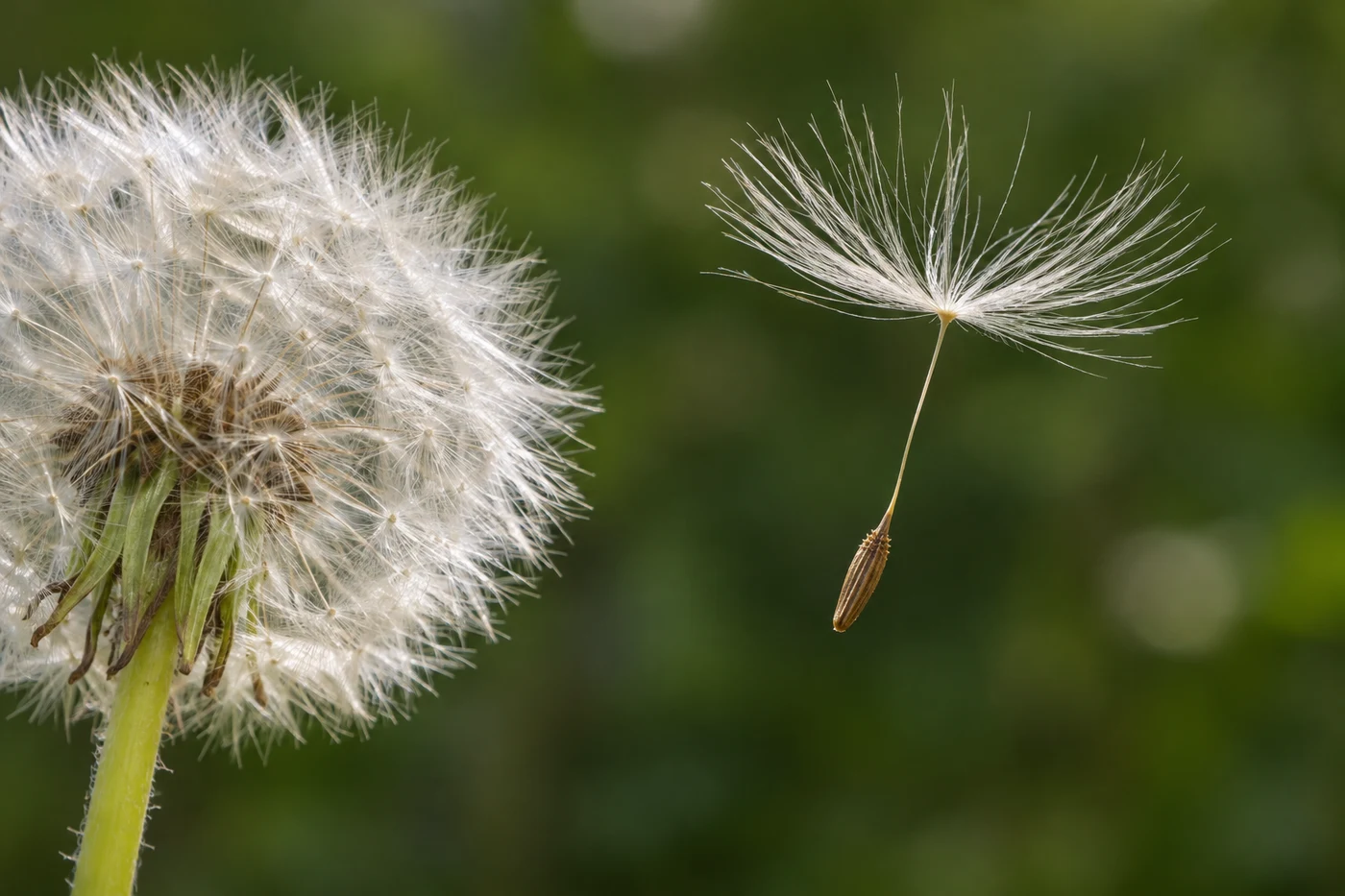
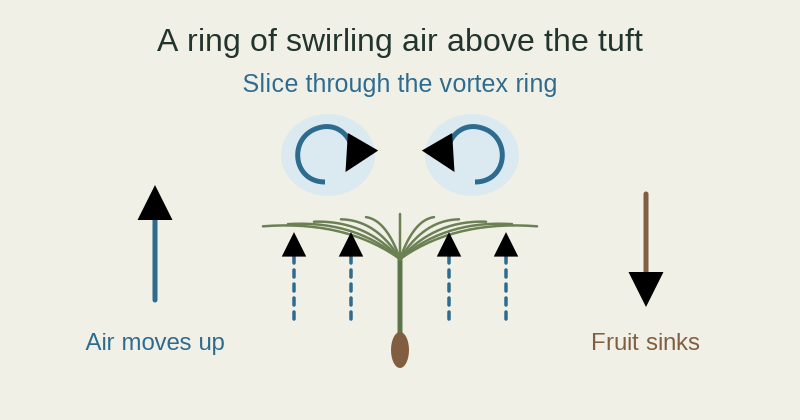
A dandelion fruit’s tuft of hairs creates drag. As the fruit sinks, air moves up between the hairs. A ring of swirling air can form just above them. The tuft and the airflow around it slow the fruit’s fall, giving the wind more time to carry it.
A little white tuft comes loose from a dandelion seed head. It drifts through the air for a while before it reaches the ground. Why doesn’t the little brown part underneath fall much faster?
A little parachute made of fine hairs
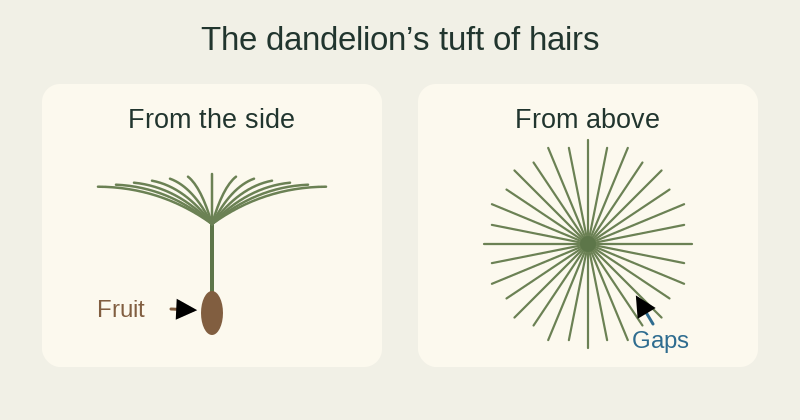
The brown part that we often call a seed is a small dry fruit with a seed inside. A thin stalk joins it to the white tuft of hairs. This tuft is called the pappus.
The hairs spread outward from the center, leaving lots of gaps between them. That makes the tuft light even though it spreads over a much larger area than the fruit below.
The fall creates a ring of swirling air
As the fruit sinks, the air moves upward relative to it. Some air passes between the hairs, and some flows around the outside of the tuft.
Researchers used a wind tunnel to see how the air moves. Just above the hairs, it can circulate in a ring. Imagine taking a slice through the ring. From the side it looks like two separate swirls. The gaps between the hairs help keep that ring steady.
A slow fall means more time in the air
Drag acts upward as the fruit sinks. The open tuft creates enough drag for the light fruit to fall slowly in still air. A breeze can carry it sideways during that time.
In very humid air, the hairs can fold closer together. In drop tests, fruits with a partly closed tuft fell faster than those with an open one. The shape of the tuft helps determine how long the fruit stays in the air.
Watch two dandelion fruits fall
- In dry weather, find two similarly sized fruits from a ripe dandelion seed head. Hold them by their brown ends. Look at how the hairs fan out from the stalk.
- Gently pull off the white tuft from one fruit. Drop the fruits one at a time from the same height over a dark tray. Choose a spot without a draft.
- Repeat the comparison. Which fruit reaches the tray first? You can ask someone to watch from the side or film the two drops in slow motion.
Keep both feet on the floor while you watch. Hold the tiny fruits away from your face and collect them after the activity.
The takeaway
The open tuft lets air through and creates drag. The dandelion fruit sinks slowly, giving the wind more time to carry it.
What slows a dandelion fruit as it falls?
Sources & further reading
Cummins et al. · A separated vortex ring underlies the flight of the dandelion ↗University of Edinburgh · Dandelion seeds reveal a form of natural flight ↗Seale et al. · Environmental morphing enables informed dispersal of the dandelion diaspore ↗Our stories explain the main idea in our own words. Pictures and models simplify reality and are not drawn to scale.