An unripe banana contains plenty of starch. During ripening, enzymes help break down this store and convert it into smaller, soluble sugars. These include glucose, fructose and sucrose. This change contributes to a ripe banana's sweeter taste.
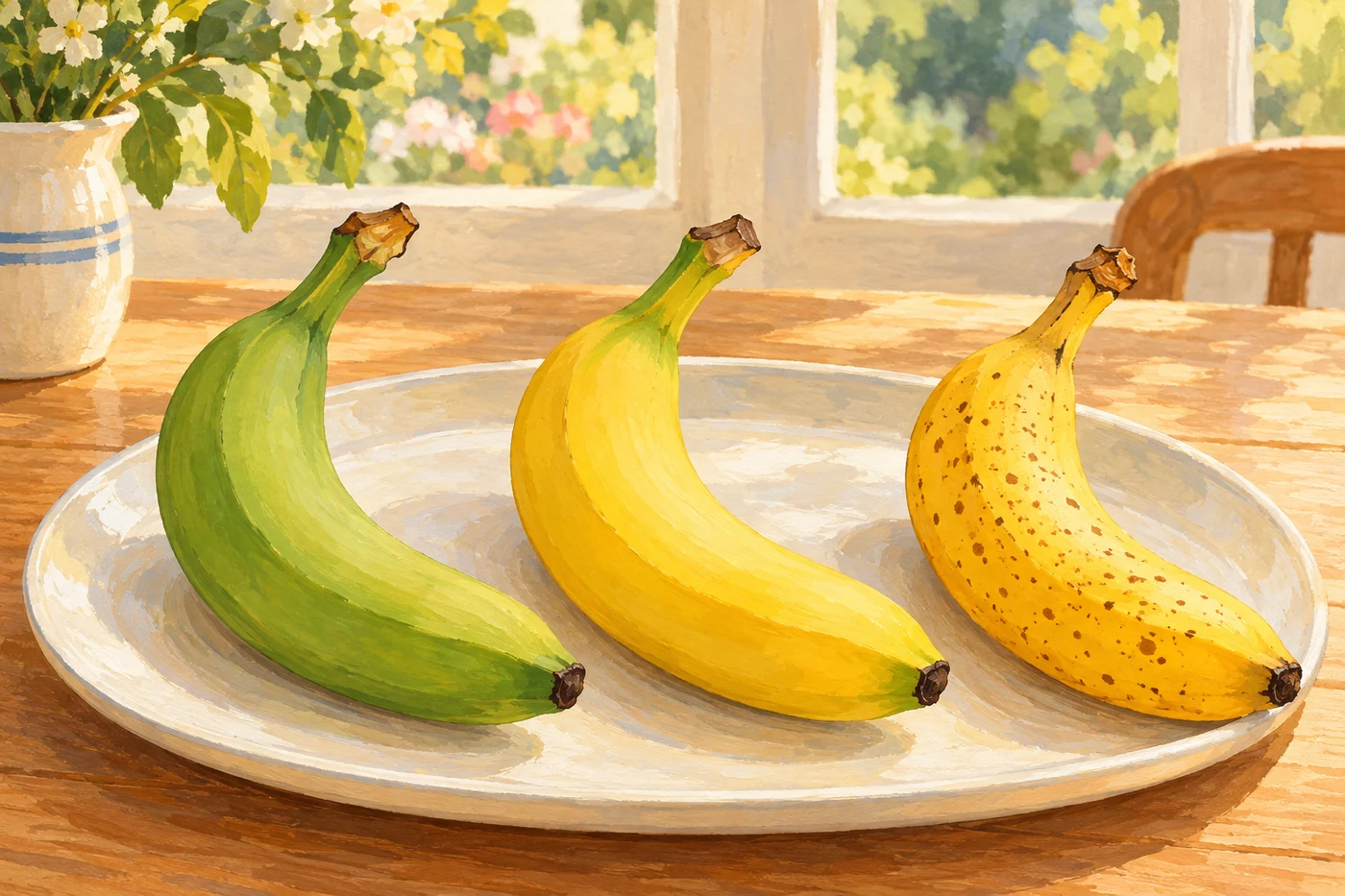
The cover illustrates different ripeness stages; it is not a time-lapse photograph. We are discussing ordinary dessert bananas such as Cavendish. Our observation below needs no knife, chemicals or tasting.
The fruit has stored a reserve
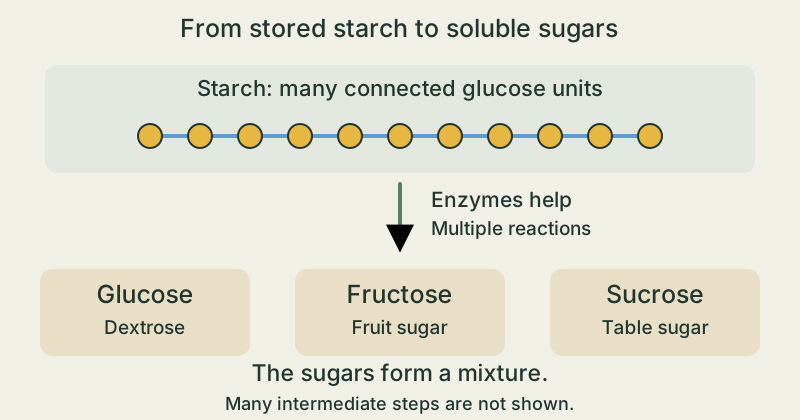
Starch is a carbohydrate made of many connected glucose units. Its long molecules can also branch. Plants use starch as a reserve.
A green, unripe dessert banana contains plenty of it. Starch itself tastes hardly sweet. As the fruit ripens, the balance between starch and smaller sugars changes.
Enzymes transform the store
Enzymes are tiny helpers for chemical reactions. Different enzymes work together during ripening: starch chains break down, and further reactions transform the sugars produced.
Glucose is also called dextrose, while fructose is sometimes called fruit sugar. Sucrose is the type we know as table sugar. A banana develops a mixture. The diagram compresses many steps; a single cut in starch does not immediately produce all three sugars.
Ripening continues after harvest
Chemical processes continue in a banana's cells after it is picked. Fruit that has developed sufficiently can therefore carry on ripening.
Ethylene helps regulate this process. It is a gaseous plant signal that the fruit can produce itself. Firmness, colour and aroma also change as ripening progresses.
The peel is not a precise sugar meter
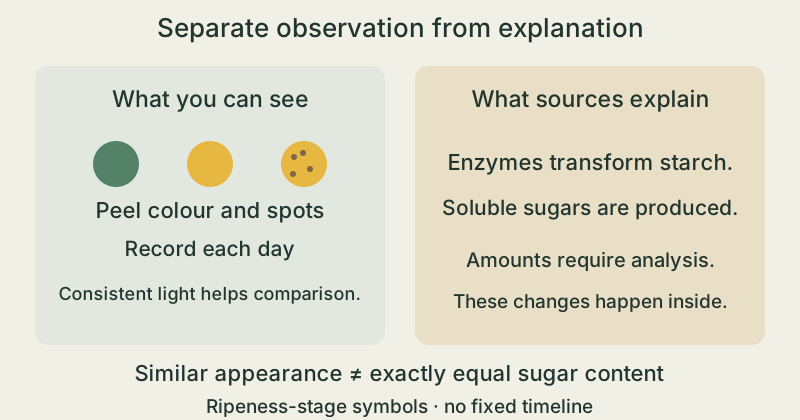
For common yellow dessert bananas, peel colour is a useful clue to ripeness. But variety and handling after harvest also influence composition. Bananas that look alike need not contain the same amount of sugar.
The rule 'more sugar every day' is too simple too. A 2021 study found a large increase in total sugar from unripe to ripe, but no detectable difference in total sugar between ripe and overripe fruit. This is a research finding, rather than a fixed value for every individual banana.
Keep a banana ripening diary
- With an adult, choose an undamaged dessert banana that is still a little green. Leave it unpeeled on a clean plate in its usual storage place. Draw its colour and visible spots, or photograph it under consistent lighting.
- Look once a day over the next few days while the fruit remains sound. Note the date, colour and new spots. Keep the peel intact and do not squeeze the banana. Leave temperature and packaging unchanged for this observation.
- Compare your pictures with diagram 2. Keep two notebook columns: 'observed' and 'explained by sources'. You can see colour changes. These do not measure starch breakdown or the exact amount of sugar; that requires suitable chemical analysis.
Observe with an adult. Use no ripening gases, chemicals, heaters or sealed experimental containers. Stop if mould, leaking liquid or a spoiled smell appears, and have an adult dispose of the fruit. The activity requires no eating or tasting.
The takeaway
As a banana ripens, enzymes convert some of its starch reserve into soluble sugars, making it sweeter. Colour and spots give clues to ripeness without revealing an exact sugar amount.
What explains an unripe dessert banana becoming sweeter as it ripens?
Sources & further reading
USDA Agricultural Research Service · Starch and sugars at different banana ripeness stages ↗Phillips et al. · Dietary fiber, starch, and sugars in bananas · PLOS ONE (2021) ↗OpenStax · Biology 2e: Carbohydrates ↗Our stories explain the main idea in our own words. Pictures and models simplify reality and are not drawn to scale.