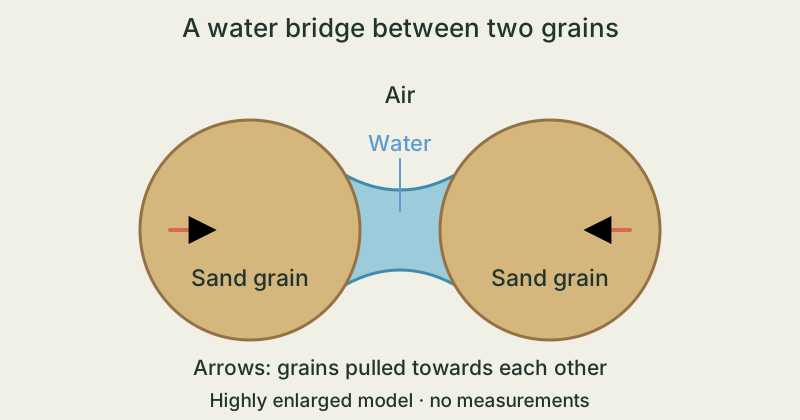
Tiny water bridges can form between neighbouring sand grains. Surface tension and a pressure difference act at their curved boundary with the air, pulling the grains towards each other. Many such connections help damp sand keep its shape.
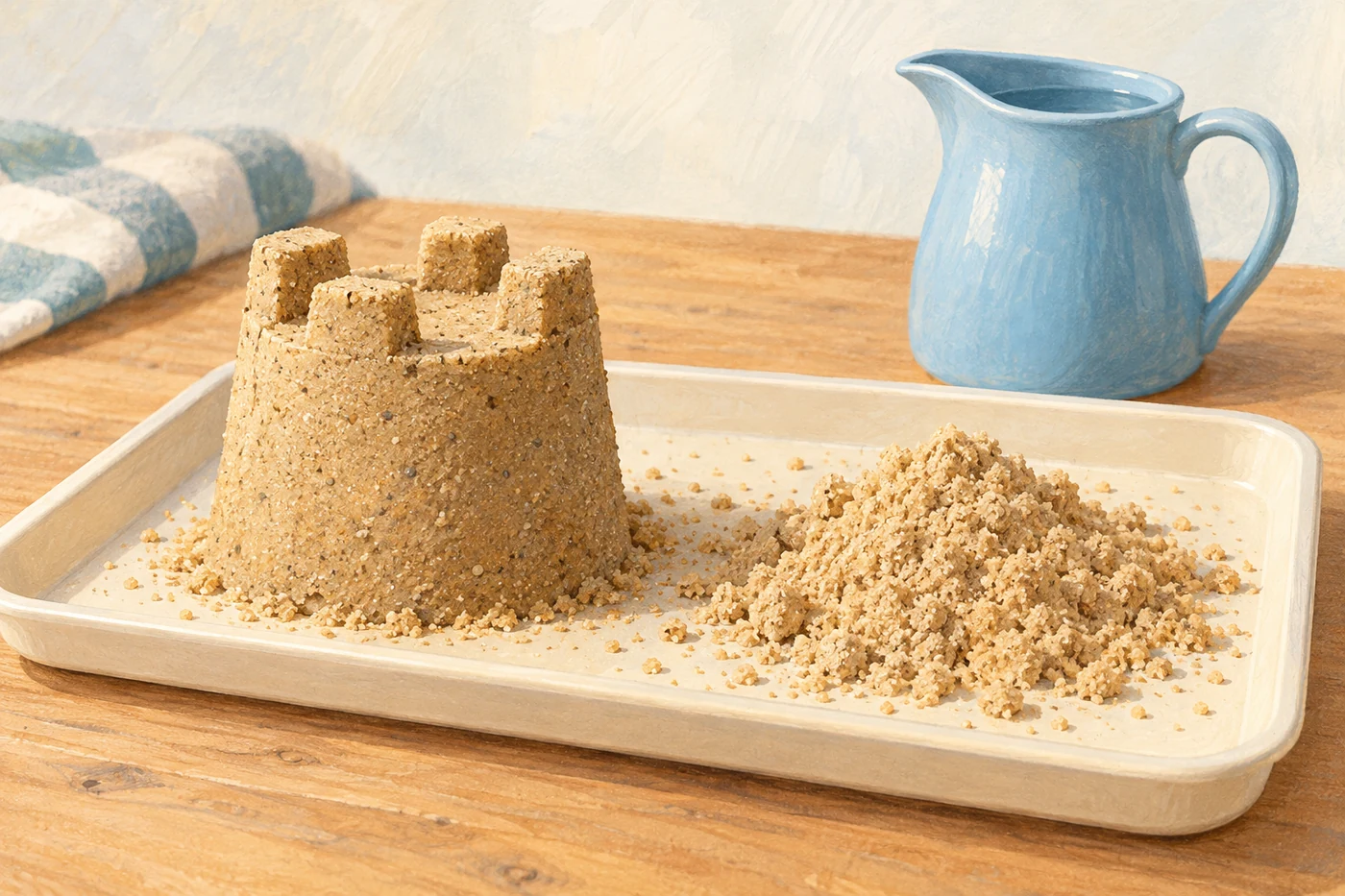
The cover is an illustration: a small castle of damp sand beside a loose pile. The tiny water connections inside would be hard to see with the naked eye.
Dry grains can slide
Sand contains many separate grains. They touch, and friction resists sliding. This lets even dry sand form a heap.
But steep walls of ordinary clean sand do not hold well without extra connections. When a mould is lifted, grains slide outwards and the shape falls apart.
Water makes tiny connections
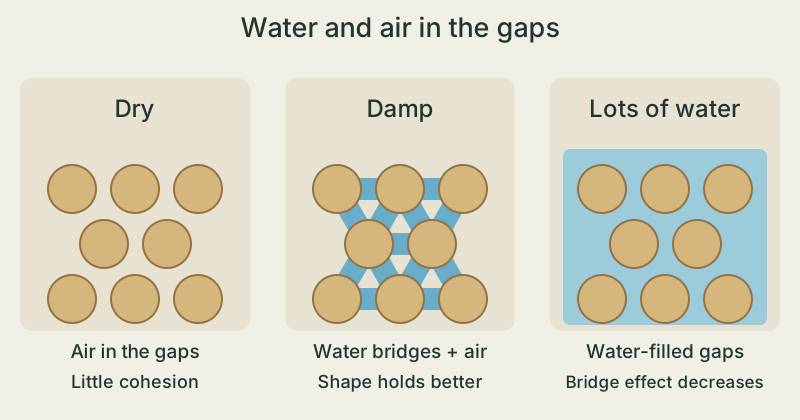
A little water wets the grains and also gathers near their contact points. Air remains in other gaps. Small liquid bridges form this way.
Surface tension is a property of the water surface, rather than a solid skin. Together with the lower water pressure in such a bridge, it can pull grains together. The network of water bridges resists the grains being pulled apart.
More water is not always better
With a lot of water, connections merge. When the gaps become completely water-filled, many curved boundaries between water and air are lost. The stabilising bridge effect decreases.
The best mixture also depends on grain size and packing. One exact recipe therefore cannot suit every sand. A low, wide castle is usually easier to build than a tall, thin column.
Drying removes the bridges
As water evaporates, the liquid connections disappear. A castle of ordinary sand can become crumbly again. The water has not permanently glued the grains together.
Our model describes clean sand and water. Clay, salts or special play mixtures may have other effects too.
Compare two small sand shapes
- With an adult, prepare two equal portions of clean, ordinary play sand on a tray: dry and damp. Add water to one portion a spoonful at a time and mix gently until it holds together when squeezed, without a puddle. Record how much water you add.
- Fill the same small plastic cup to the same level with each portion in turn. Press each equally gently, for example three times with a spoon. Turn the cup over and lift it slowly. Compare edges and shape immediately and after one minute. If possible, repeat both trials three times.
- Leave one damp shape undisturbed to air-dry completely. Later, gently use a spoon to check whether it crumbles more easily, and record the waiting time. It may take hours or longer. Packing differences can affect the result; this observation does not show the individual water bridges.
Have an adult help. Do not stir up or blow sand dust, or put sand in your mouth or eyes. Wash hands afterwards and wipe up spilled water. Make only small shapes on the tray; do not heat them to dry them. Keep sand out of drains.
The takeaway
Tiny water bridges can hold sand grains together. Some moisture helps with shaping; completely soaked or dry sand behaves differently. Grain size, packing and the shape of the structure also matter.
What helps a sandcastle of slightly damp sand hold its shape?
Sources & further reading
Science World British Columbia · Wet & Dry: Sandcastles, Seite / page 5 (PDF) ↗Max-Planck-Gesellschaft · Why anyone can build a sandcastle (2008) ↗Pakpour et al., Scientific Reports · How to construct the perfect sandcastle (2012) ↗Universiteit van Amsterdam, Maryam Pakpour · Dissertation, Kapitel / chapter 3 (2013, PDF) ↗Our stories explain the main idea in our own words. Pictures and models simplify reality and are not drawn to scale.