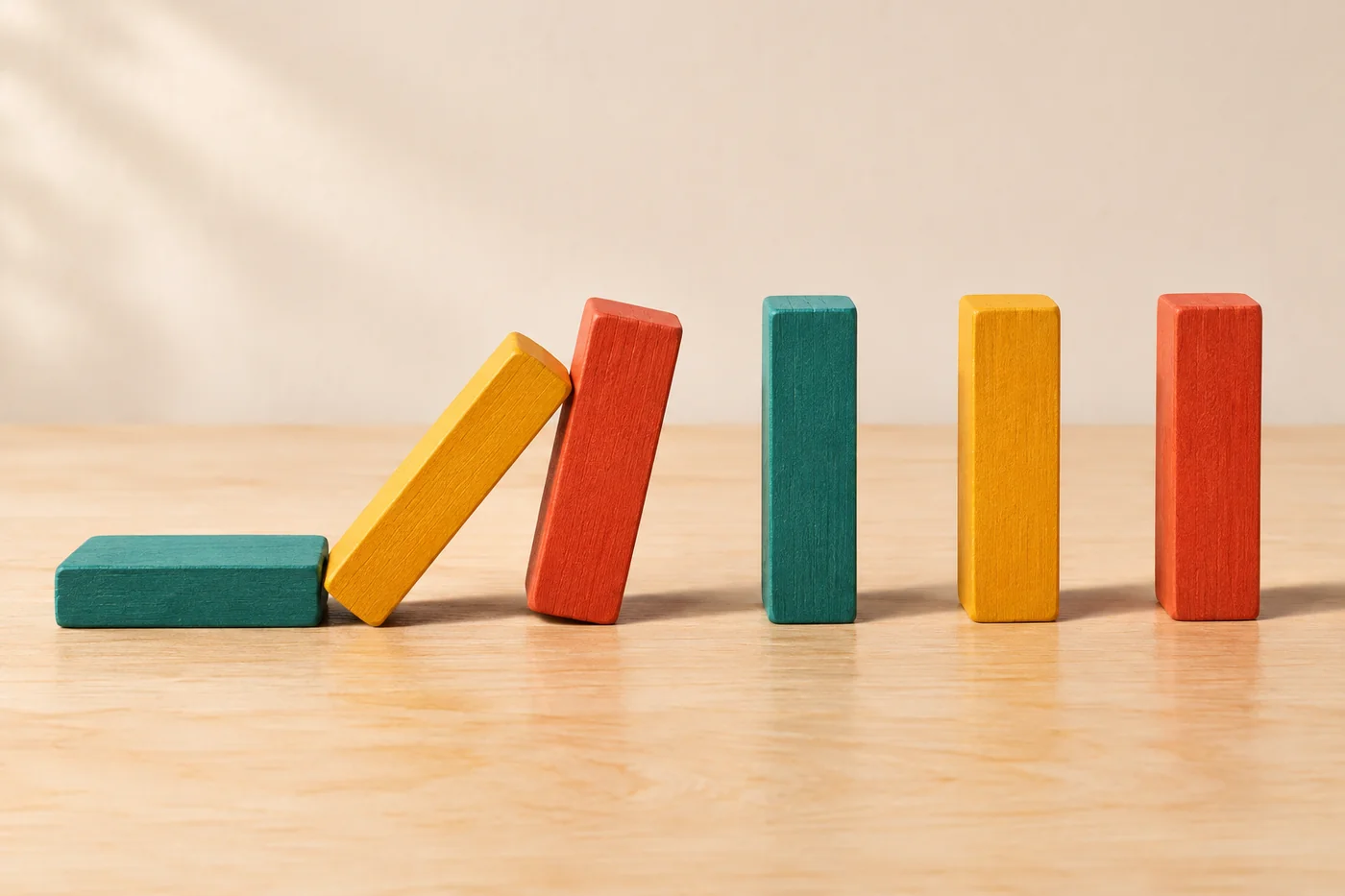
A falling domino nudges its neighbour. Once the neighbour tilts far enough, gravity pulls it down the rest of the way. As it falls, it nudges the next one. With the right spacing, the chain goes all the way to the end.
Stand six dominoes in a row and nudge just the first one. A quick clatter follows. How can one little push get all six dominoes moving?
A domino tips around its bottom edge
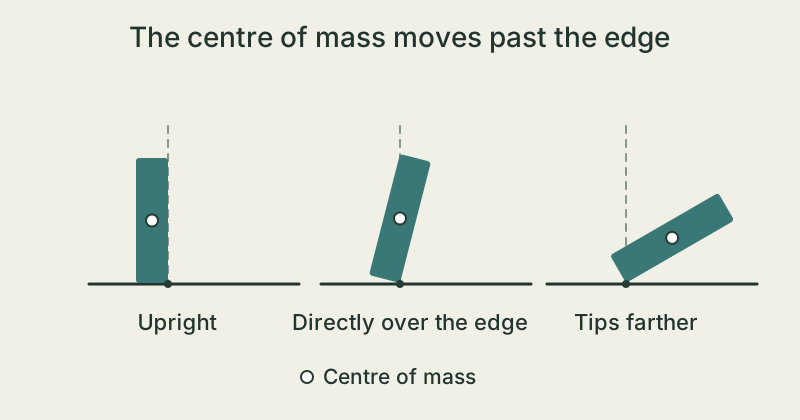
A domino made of the same material throughout has its centre of mass in the middle. You can picture gravity pulling down at that point.
When you tilt the domino a little, it turns around the bottom edge that still touches the table. Its centre of mass rises slightly at first. Once it passes to the other side of the edge, gravity pulls it down as the domino tips farther.
Each falling domino adds energy
A standing domino has stored energy because its centre of mass is high up. This is called gravitational potential energy. As the centre drops, some of that energy becomes energy of motion. When the domino bumps its neighbour, it passes some of that energy on.
The neighbour starts to tilt. Once its centre moves far enough past the edge, it falls too and gets the next domino moving. Some energy goes into sound and tiny changes in shape during the collision.
A wide gap stops the chain
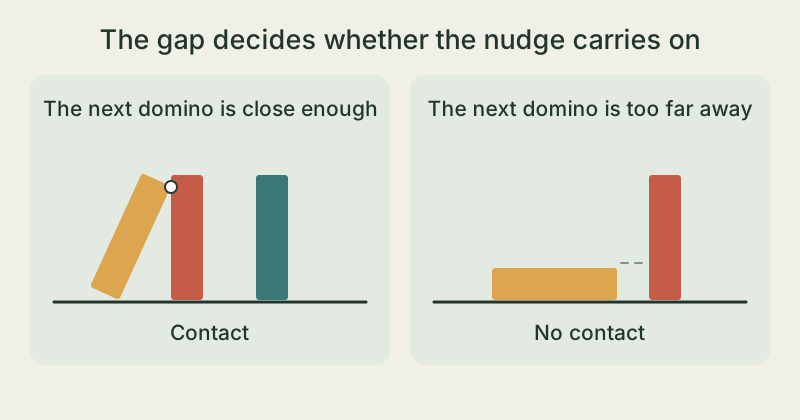
A falling domino can only reach so far. Across a wide gap, it doesn’t touch its neighbour. A very smooth surface can also disrupt the chain if a domino slips.
Change only one gap
- Stand six dominoes of the same size on a level table. Leave a gap of about half a domino’s height between each pair. Nudge the first domino and count how many fall.
- Set up the same row again. Make just the gap between the third and fourth domino wider than the height of one domino. Keep all the other gaps the same.
- Nudge the first domino again. Where does the clatter stop? Repeat both setups and compare how many dominoes end up lying down.
Use small playing pieces and set them up well away from the edge of the table.
The takeaway
The first nudge starts the chain. As each domino falls, it supplies energy to keep the motion going. If the gap is too wide, the next domino stays upright.
What happens if the third domino can’t reach the fourth as it falls?
Sources & further reading
J. M. J. van Leeuwen · The Domino Effect ↗D. Cantor & K. Wojtacki · Effects of Friction and Spacing on Domino Toppling ↗John D. Norton · Material Induction, Chapter 15 ↗Our stories explain the main idea in our own words. Pictures and models simplify reality and are not drawn to scale.