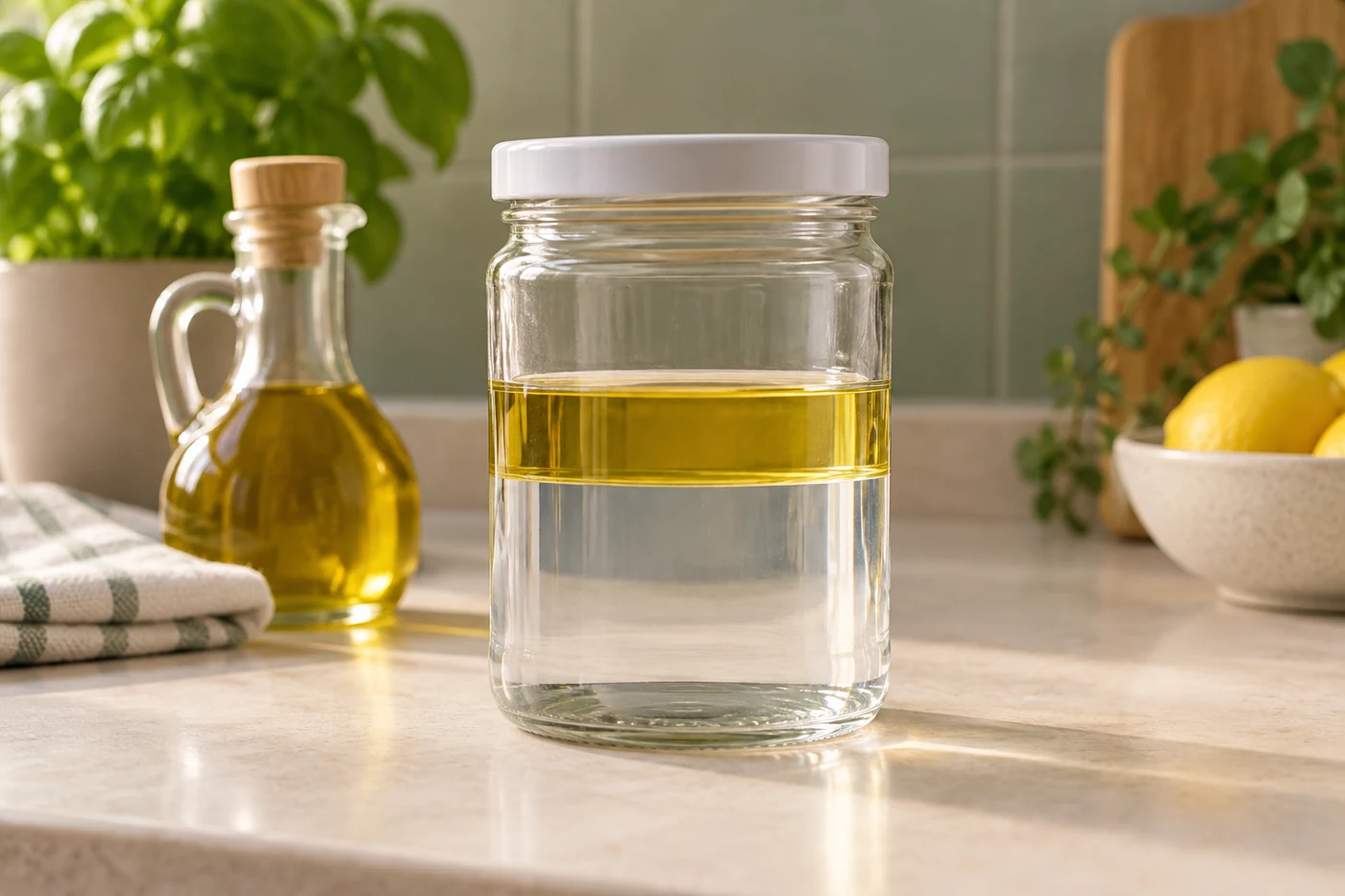
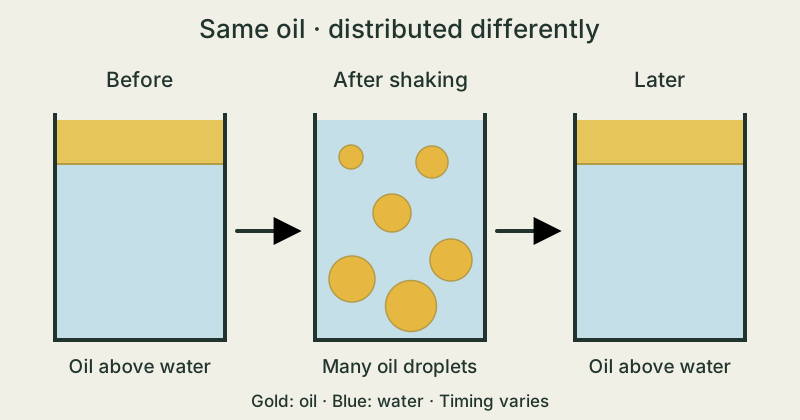
Water and cooking-oil molecules do not form a lasting, uniform solution. This depends on their different electrical properties and attractions. Shaking first disperses the oil as small droplets. Later, these gather again. Cooking oil ends up on top because it is less dense than water.
A simple salad dressing raises two questions: why do oil and water stay separate, and why does the oil float on top? Different properties explain these two effects.
The molecules have different properties
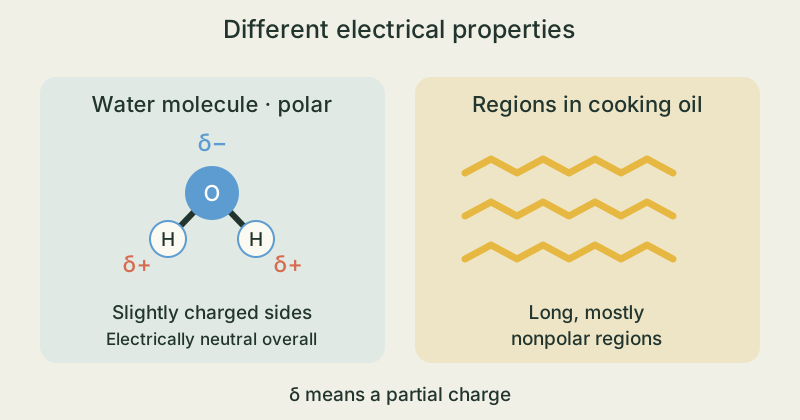
A water molecule has a slightly negative side and a slightly positive side. This makes it polar. Overall, it is electrically neutral. Water molecules form special attractions called hydrogen bonds with one another.
Cooking oil contains different molecules with long, mostly nonpolar hydrocarbon regions. These cannot replace water's contacts with equally favorable ones. For this mixture, separate regions are more favorable than a uniform solution. There are attractions between oil and water too; the liquids do not simply repel each other like matching magnetic poles.
Shaking makes droplets, not a solution
Shaking breaks the oil layer into many small droplets that can spread through the water. Each droplet contains very many oil molecules. A dispersion of one liquid in another is called an emulsion. It differs from a solution in which molecules are individually dispersed.
Without suitable stabilizers, droplets can merge and gather into a layer again. An emulsifier can slow this merging. That helps some salad dressings stay mixed longer than plain oil and water. How quickly your mixture separates also depends on droplet sizes and the type of oil.
Why is the oil on top?
Density means mass per unit volume. Imagine two measuring cups filled to the same mark: ordinary cooking oil has less mass than the same volume of water. It is less dense, so it floats on the water.
Density explains the order of the layers. Whether two liquids can form a solution depends on their molecular properties. A difference in density alone cannot explain why they do not mix.
Leave it still or shake it?
- Place two matching clear plastic containers with tight screw lids on a tray. Put 50 ml of room-temperature water and 10 ml of ordinary cooking oil in each. Leave plenty of air space below the lid. Label them “still” and “shaken,” and draw the layers.
- Tighten both lids. Leave the first container still. Shake the second for about ten seconds and place it beside the first. Look from the side: can you see small droplets or a continuous layer? Shaking can also introduce air bubbles.
- Record what you see immediately and after one, five and ten minutes, without shaking again. Compare it with the still container. Draw where the oil gathers. If droplets remain dispersed after ten minutes, record that too and keep watching: there is no fixed separation time.
Ask an adult to help. Use only water and cooking oil, do not heat anything, and do not drink the samples. Check the lids before shaking. Wipe up spilled oil straight away to prevent slips; keep oily leftovers out of the drain.
The takeaway
Molecular properties explain why oil and water stay separate. Lower density explains why cooking oil floats on top. Shaking disperses droplets but does not dissolve the oil.
What happens to the oil first when you shake it?
Sources & further reading
American Chemical Society · Can Liquids Dissolve in Water? (Lesson 5.7) ↗American Chemical Society · Density: Sink and Float for Liquids (Lesson 3.5) ↗OpenStax / Rice University · Chemistry 2e: The Dissolution Process ↗OpenStax / Rice University · Chemistry 2e: Colloids ↗Our stories explain the main idea in our own words. Pictures and models simplify reality and are not drawn to scale.