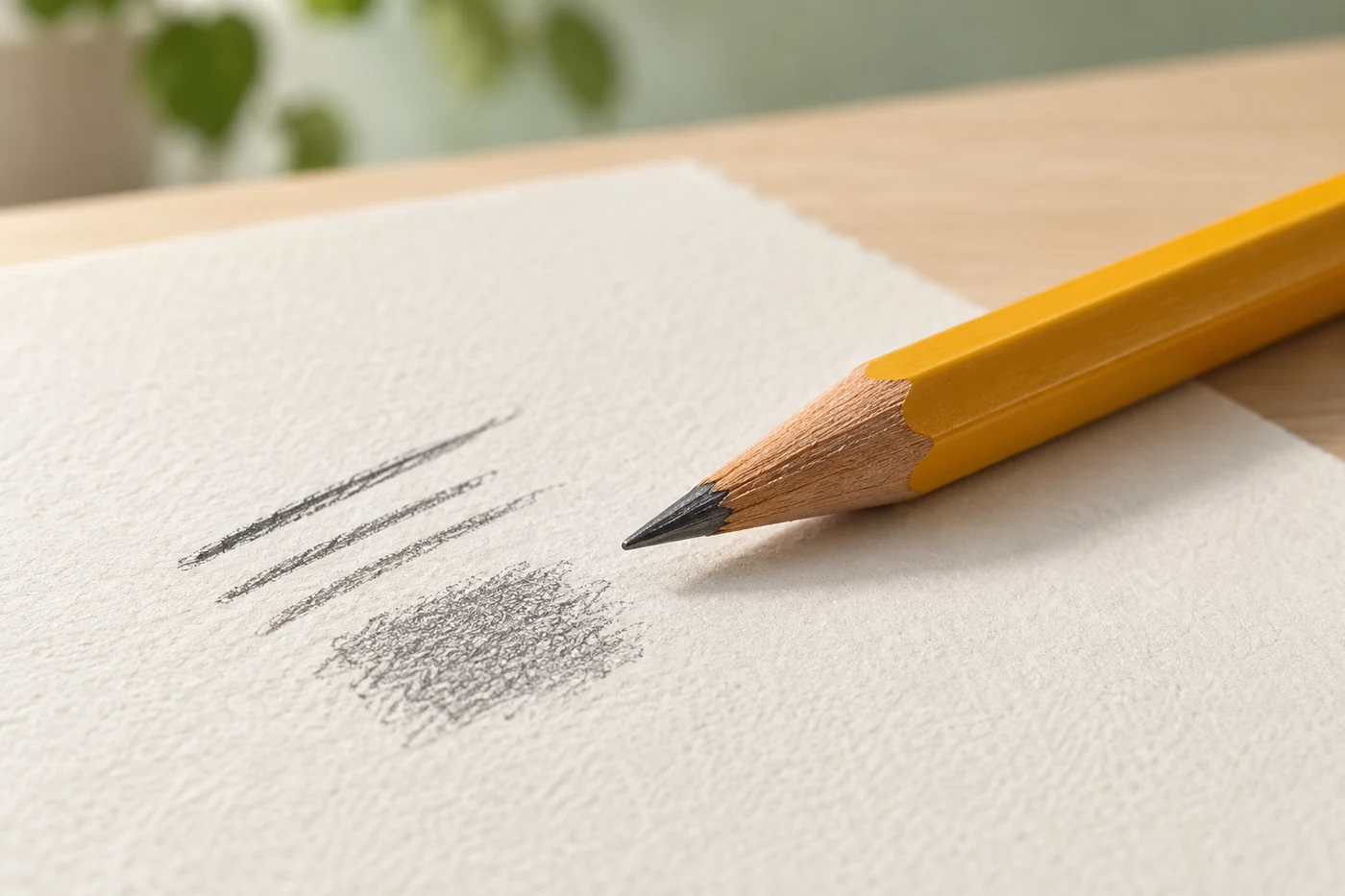
The dark core of an ordinary wooden pencil contains graphite. Writing rubs off tiny graphite-containing particles that remain on the paper. Graphite consists of strongly bonded atomic sheets with much weaker attractions between them. This lets thin pieces come away.
A pencil point gradually wears down as you write. The dark trail is material from its core. To understand why this works, we need to look at graphite's structure.
Graphite is made of layers
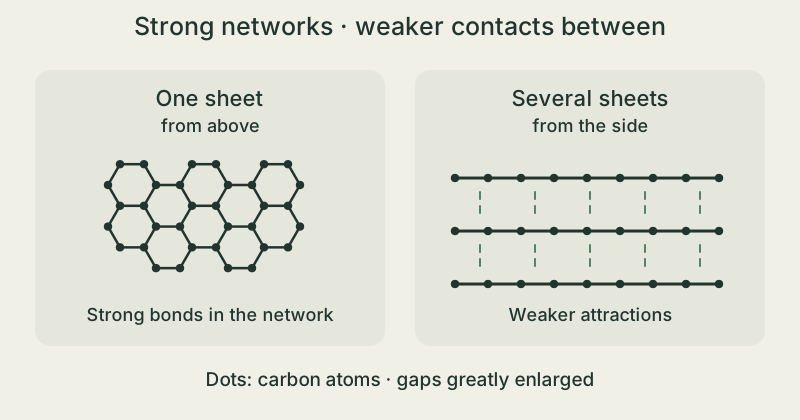
Graphite is a form of the element carbon. Within each sheet, its atoms are joined in a network of hexagons, like a tiny honeycomb pattern. Strong chemical bonds hold the atoms together in this network.
Many of these sheets are stacked together. Attractions between them are much weaker than the bonds within a sheet. Sheets can therefore slide past one another and separate. A single sheet, just one atom thick, is called graphene.
The core leaves tiny particles behind
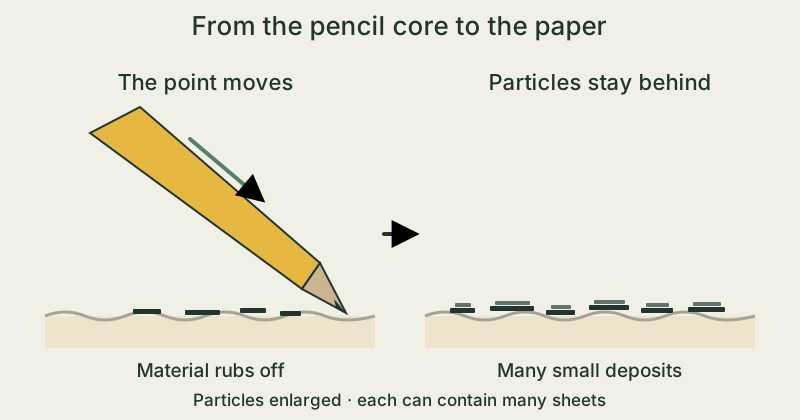
Moving the point across paper creates pressure and friction at the contact. Small graphite-containing pieces come away from the core and are deposited on the paper's surface. Together, they make the visible line.
One piece can contain many atomic layers. An ordinary pencil line is therefore not a uniform sheet just one atom thick. The gray mark consists of very many small deposits, while the core gradually becomes shorter.
What makes some pencil cores harder?
An ordinary wooden pencil's core contains mainly graphite and clay, with other additives depending on how it is made. More clay generally makes the mixture harder. With similar writing conditions, harder cores usually leave lighter marks and softer ones often leave darker marks.
Pressure, point shape and paper also affect the line. That is why the comparison below uses the same pencil on the same paper throughout. Only the number of strokes is changed.
The same atoms, different properties
Diamond is made of carbon too. Its atoms form a strongly connected three-dimensional network, rather than easily separated sheets. This makes diamond very hard, while graphite rubs off easily.
Which atoms a material contains tells only part of its story. How they are bonded and arranged helps determine its properties too. You can discover that with an ordinary pencil.
One stroke or five?
- Place a sheet of uncoated white drawing or writing paper on a firm surface. Take an ordinary graphite pencil and label two blank areas at the edge “once” and “five times.” Use the same pencil for both areas.
- Draw a line about five centimeters long in the first area. Draw a line of the same length beside it, then trace that second line four more times as closely as you can. Keep a similar angle and light pressure; do not press harder to force a particular result.
- Compare the marks in the same lighting, using a magnifying glass if you have one. Is the repeatedly traced line darker or more even? Record an unexpected result too. The point changes as you draw: this comparison shows deposits but measures neither their mass nor the thickness of individual atomic sheets.
Use the pencil only on paper and keep the point away from eyes and mouths. Do not break, grind or heat the core. If it needs sharpening, ask an adult for help if needed. Wash your hands afterward.
The takeaway
A pencil line consists of material rubbed from the core. Weaker attractions between strong carbon sheets help graphite release small pieces.
What mainly makes the gray mark left by a graphite pencil?
Sources & further reading
American Chemical Society · The Secret Science of Pencils & Erasers ↗OpenStax / Rice University · Chemistry 2e: The Solid State of Matter ↗The University of Manchester · Graphene: History and atomic structure ↗Royal Society of Chemistry · Carbon: Uses and properties ↗Our stories explain the main idea in our own words. Pictures and models simplify reality and are not drawn to scale.