
Steel and concrete usually grow a little when warmed. They contract again when cooled. An expansion joint accommodates movement between parts of a bridge, leaving room for the change in length.
The cover illustrates an intact bridge joint. It does not show a measured joint width.
Solid things change size too
A bridge can stay solid while changing its length a little. This is called thermal expansion.
Even a small change matters along a long structure. Its size depends on the material, the original length and the temperature change.
The particles stay together
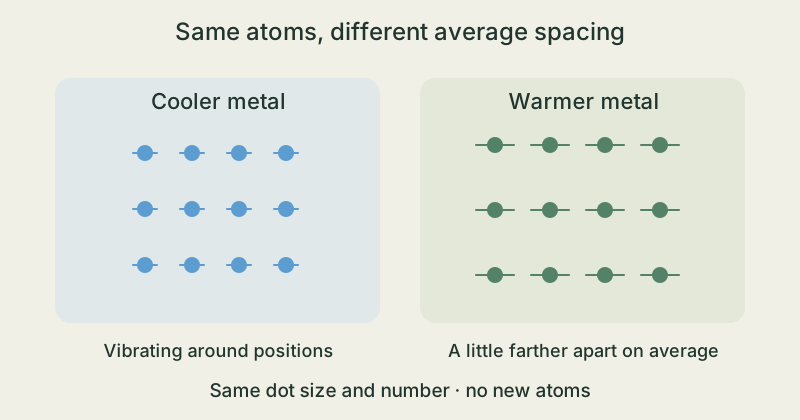
In a metal, tiny atoms vibrate around their positions. When warmed, they vibrate more strongly; their average separation usually increases a little.
The atoms do not inflate like balloons. Cooling reduces the separation again. The steel does not need to melt for this to happen.
A space that can change
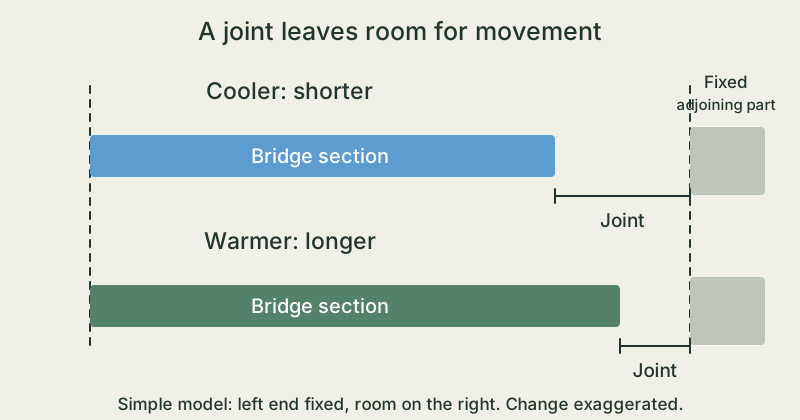
In a simple model, a bridge section expanding towards a fixed adjoining part makes the space between them narrower. Cooling makes it wider again.
A suitable joint can accommodate this movement. Completely preventing expansion could produce large forces and cause damage.
Bridges have different solutions
Some bridges have no expansion joints like these. Their design accommodates temperature movement in other ways.
A visible line is therefore not automatically an expansion joint. Joint widths also depend on more than the weather forecast: the temperature of the structure itself is one important factor.
Joint detective: a picture and a paper model
- With an adult, open the linked ACS page and find the photograph of the flexible bridge connection. Look for the connector between solid parts and sketch its shape. A single photograph shows the shape, but does not show movement over time.
- For a tabletop model, an adult cuts four paper strips: two 10 cm long and two 10.5 cm long, all about 3 cm wide. On a sheet of paper placed sideways, draw two marks 22 cm apart. Put the shorter pair between the marks with their outer ends touching the marks. Measure the clear space in the middle. It should be about 2 cm.
- Replace both strips with the longer pair, keeping their outer ends at the same marks. Measure again: about 1 cm remains. Swap back and compare. The longer strips stand for expanded bridge sections. The paper has not been heated and does not grow by itself. These large model changes only show why room for movement helps; they do not predict the width of a real bridge joint.
An adult cuts the strips. Keep everything on the table and do not heat anything. Do not touch or probe real joints, or enter areas that are not open public walkways. The linked photograph is enough for this activity.
The takeaway
Even steel and concrete change size with temperature. Many bridges have joints that accommodate movement. In a metal, the atoms' average separation changes. Other bridges handle this movement without such joints.
What is an expansion joint on a bridge for?
Sources & further reading
American Chemical Society · Moving Molecules in a Solid — Flexible Bridge Connections ↗OpenStax / Rice University · University Physics Volume 2: Thermal Expansion ↗Federal Highway Administration · Concrete Coefficient of Thermal Expansion ↗Federal Highway Administration · Jointless Bridges / Bridge Expansion Joints ↗Our stories explain the main idea in our own words. Pictures and models simplify reality and are not drawn to scale.