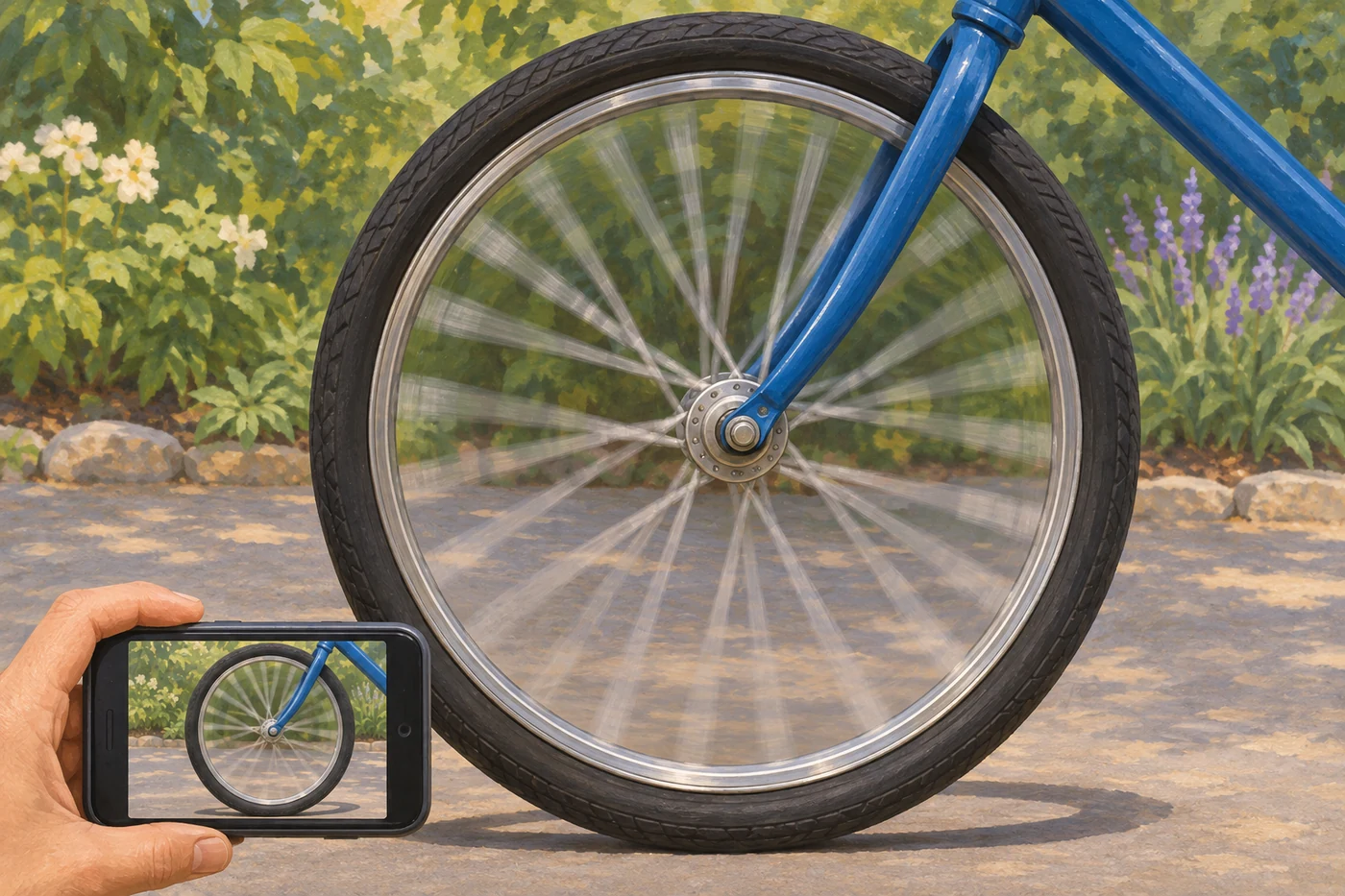
The camera captures the wheel at a series of moments. If a mark on the wheel goes nearly all the way around between two frames, it appears a little behind its old position in the next one. When the frames play back, this can look like a turn in the opposite direction.
A bicycle is moving forward in a video. Suddenly its wheel seems to spin backward. How can a bike rolling forward produce such a strange picture?
A camera takes a series of pictures
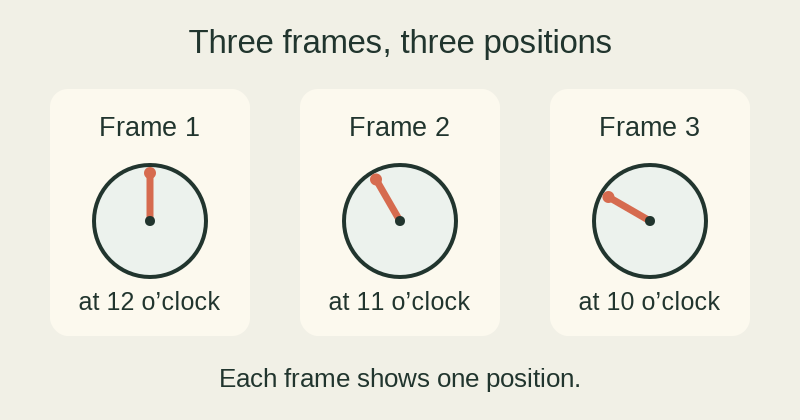
A video looks like smooth motion. The camera makes it from still pictures called frames, taken close together. Each frame shows where the spokes were at that moment.
As you watch, you piece together the motion between frames from the positions you can see. When the frames are taken close enough together, this usually works well.
Almost a full turn can look like a small step back
Imagine a wheel with a red mark. In the first frame the mark points straight up, like a clock hand at 12. Before the next frame it goes almost all the way around clockwise and ends up at 11.
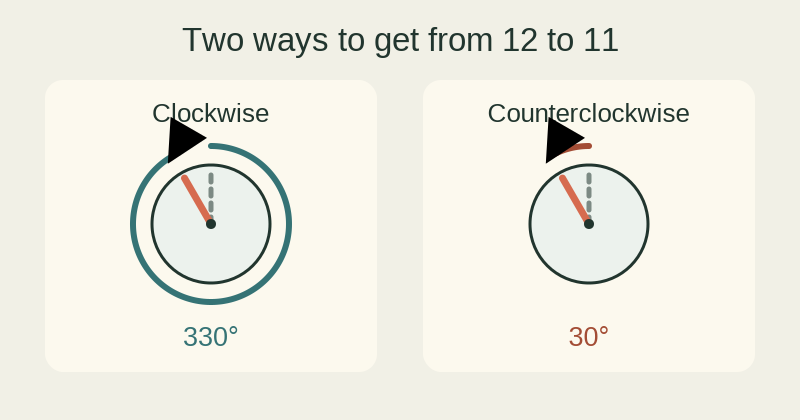
There are two ways to get from 12 to 11. Clockwise takes almost a full turn. Counterclockwise takes just one small step. If the same thing happens from frame to frame, the mark may seem to move backward in little steps. This is called temporal aliasing.
Matching spokes make the effect easier to see
A wheel with six identical, evenly spaced spokes looks the same again after one sixth of a turn. If that takes exactly as long as the gap between two frames, the wheel can appear to stand still.
If the wheel turns a little less than one sixth of a turn in that time, the pattern in the next frame looks like it has shifted slightly backward. The wheel can seem to spin backward then too. At more frames per second, the camera captures positions closer together in time. That can make the real direction easier to see.
Be the camera with a paper clock hand
- Draw a large clock face on paper. Lay a narrow strip of paper on it like a clock hand, with one end in the center. Color its tip so it stands out.
- Start at 12. With your finger, move the paper hand nearly all the way around clockwise until it reaches 11, then do the same to reach 10. Remember only the three positions where you stopped.
- Ask someone else to look only when you stop. Which way does the hand seem to move if they connect those three positions by the shortest turns?
- Try smaller clockwise steps from 12 to 1 and then 2. Compare which direction the three positions suggest this time.
Keep the paper flat on a table. A marker and a strip torn by hand are all you need.
The takeaway
A video shows a series of positions. If a wheel turns far enough between frames, those positions can look like small steps backward.
Between two frames a red mark goes almost all the way around clockwise from 12 to 11. What motion can the video make it look like?
Sources & further reading
TU Delft · Sampling and the wagon-wheel effect ↗UC Davis · Temporal Aliasing: The Wagon Wheel Effect ↗Our stories explain the main idea in our own words. Pictures and models simplify reality and are not drawn to scale.