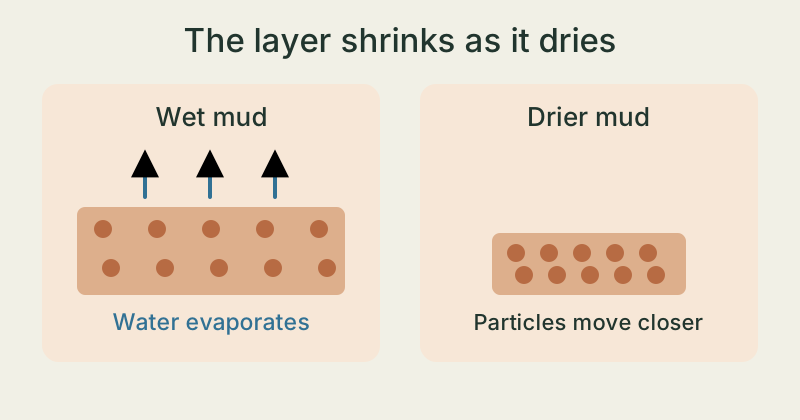
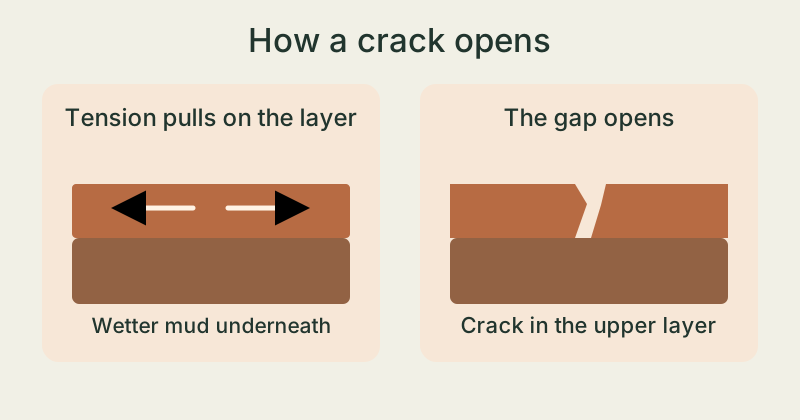
Water evaporates from the surface. As clay-rich mud dries, its tiny particles move closer together. The layer shrinks. If the ground holds it in place or wetter mud beneath it slows its movement, the layer is pulled tight. When the pull gets too strong, the layer cracks.
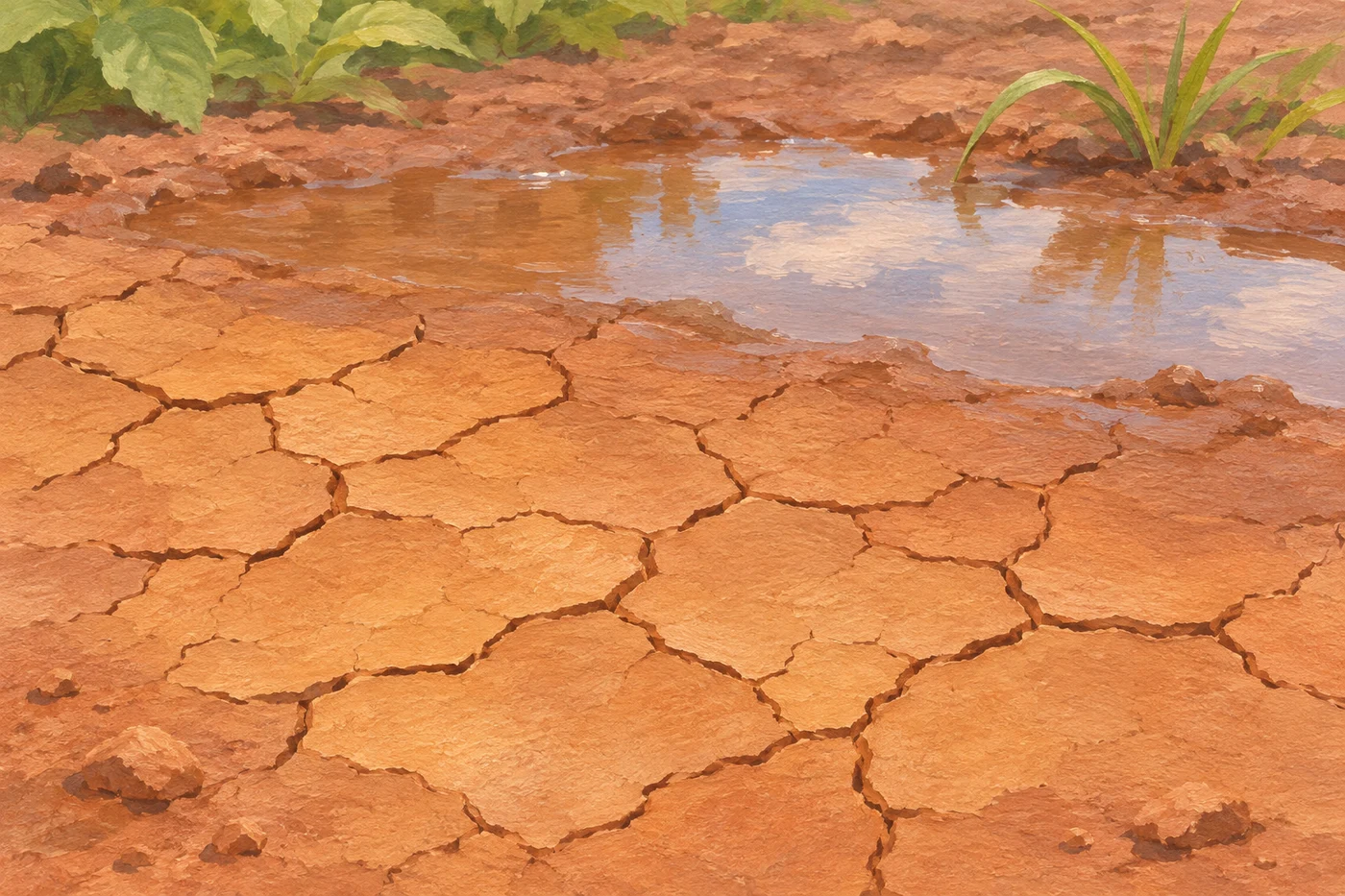
After it rains, a puddle sometimes leaves a brown patch of mud around its edge. Take another look the next day. You might see dark lines dividing the mud into small patches.
Water leaves and the mud shrinks
Mud is a mixture of water and tiny soil particles. Clay contains especially fine particles. Some of the water sits in the tiny spaces between them. At the surface, liquid water slowly escapes into the air as water vapour. That is evaporation.
As clay-rich mud dries, its particles can pack closer together. The layer takes up less space. How much it shrinks depends in part on which clay minerals are in the soil.
A layer held in place is pulled tight
Imagine the top layer trying to get shorter. It is still attached to wetter mud underneath. The ground can also hold it in place. As neighbouring parts pull on one another, tension builds in the layer.
When the layer can no longer withstand that pull, a crack opens. The two sides at the edge of the crack can move a little farther apart.
The cracks form a network
A crack can grow longer as the mud keeps drying. New cracks can form and meet older ones. This leaves patches with several corners.
The patches often differ in size. The thickness of the layer and the kind of soil play a role. That is why puddles do not all leave the same pattern.
Watch a patch of mud dry
- Mix a small piece of water-based pottery clay with a little water to make a thick paste. Spread it about half a centimetre thick on a flat plate you use only for crafts.
- Leave the plate at room temperature. Sketch the outline of the patch or take a photo from above. Compare it with your first picture after a few hours and again the next day.
- See whether a gap at the edge or a crack across the middle appears first. Give it another day if needed. If the patch gets smaller without a visible crack, the clay has still shrunk.
Wash your hands afterwards. Wipe up leftover clay with a damp cloth and put the scraps in the bin.
The takeaway
Clay-rich mud can shrink as water evaporates. If the mud cannot shrink freely, tension builds. If the tension gets too strong, a crack opens.
Why can the layer split as it dries?
Sources & further reading
USDA Natural Resources Conservation Service · Vertisols ↗R. W. Style, S. S. L. Peppin und A. C. F. Cocks · Mud peeling and horizontal crack formation in drying clays ↗Our stories explain the main idea in our own words. Pictures and models simplify reality and are not drawn to scale.