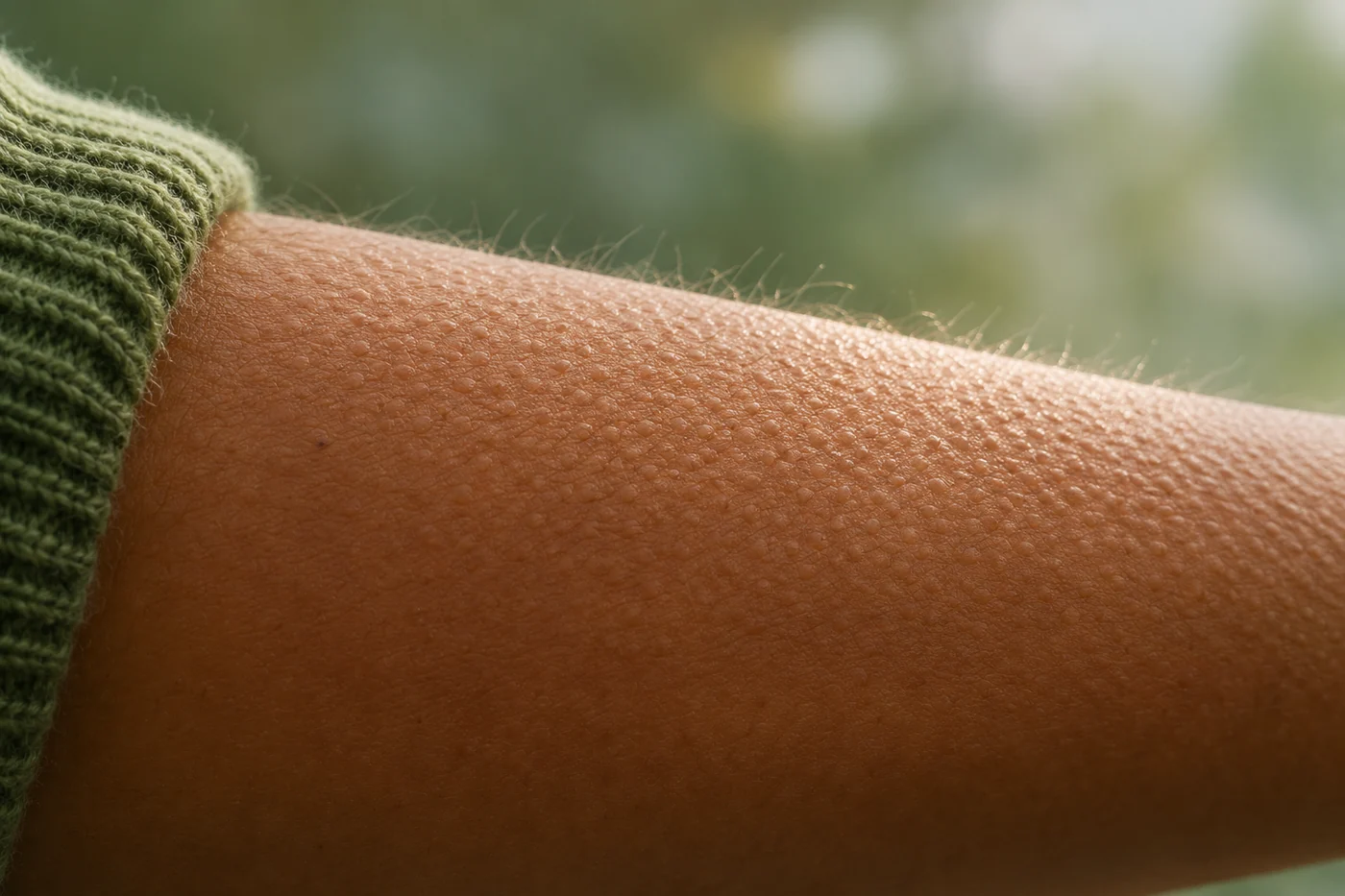
When you're cold, nerves can make tiny muscles in your skin tighten. The muscles pull where the hairs sit in your skin. The hairs stand up and small bumps form around them.
You step out of a warm room and a cool breeze brushes your arm. Suddenly your skin looks as if someone has dotted it with tiny bumps. What moved under the surface?
A tiny muscle pulls on the hair
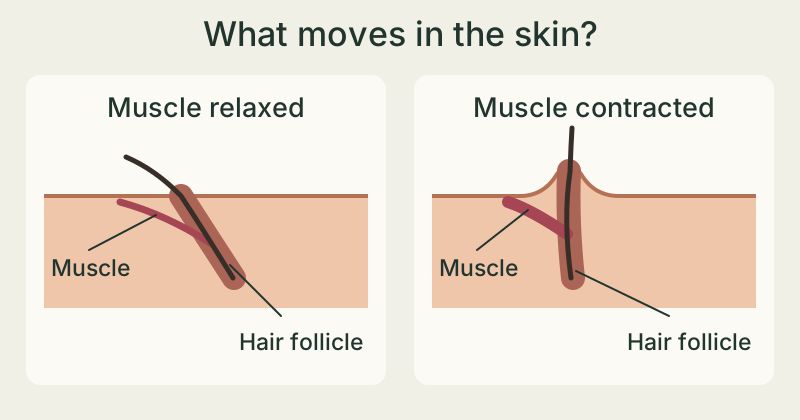
A hair grows in a tiny pocket in your skin called a hair follicle. For many body hairs, a tiny muscle is attached to the side of the follicle. When the muscle is relaxed, the hair usually lies flat or at a slant.
When you get cold, nerves can send these muscles a signal. The muscles tighten and pull on the follicles. The hairs stand up and the skin rises a little around them. Those tiny raised spots are goosebumps.
It happens automatically. Your skin can react the same way when something scares you.
Thick fur holds air in place
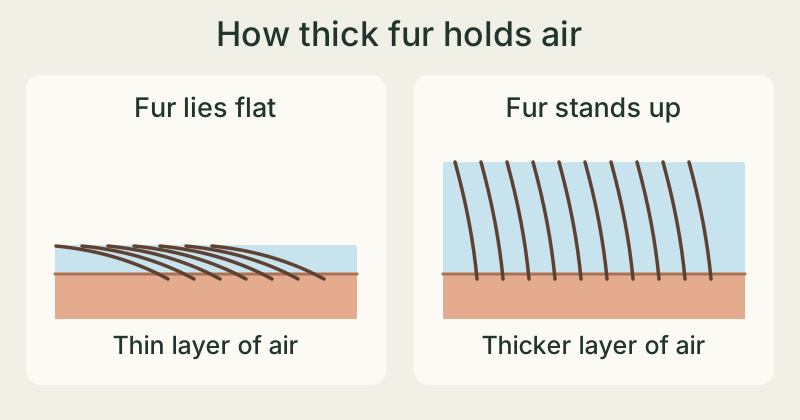
In an animal with thick fur, raised hairs can hold more air between them. When that air stays fairly still, heat escapes from the body to the surroundings more slowly.
The fine, short hairs on our arms can't hold such a thick layer of air. That's why goosebumps do little to keep us warm.
Take a close look at your forearm
- Look at your forearm in good light while you're comfortably warm. Notice the angle of the fine hairs.
- The next time you happen to get goosebumps, try looking at your arm from the same angle. Do you see raised hairs, little bumps, or both?
- Look again once you're warm. Compare the direction of the hairs and how the skin looks.
Wait until goosebumps happen on their own. If you feel chilly, put on something warm.
The takeaway
Goosebumps form when tiny muscles pull on hair follicles. In thick fur, raised hairs help hold a layer of air that slows heat loss.
What makes the hairs stand up when you get goosebumps?
Sources & further reading
Washington State University · Why do we get goosebumps? ↗Smithsonian Institution · Why do we get goose bumps? ↗Shwartz et al. · Cell types promoting goosebumps (Cell, 2020) ↗Our stories explain the main idea in our own words. Pictures and models simplify reality and are not drawn to scale.