
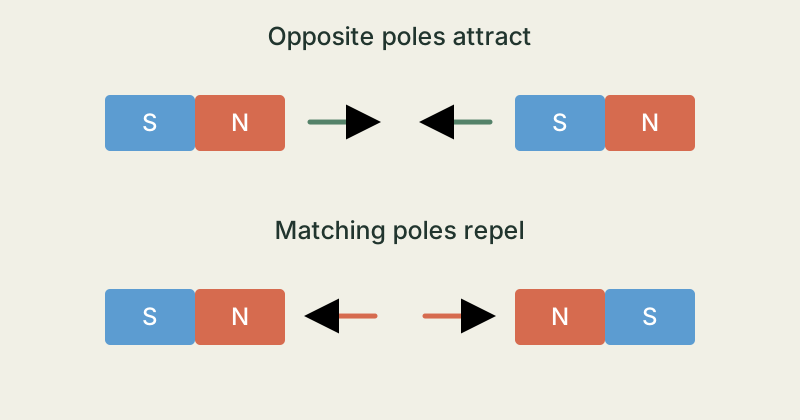
Every magnet has two poles. A north pole and a south pole attract. Matching poles repel. The magnetic field around them produces these forces.
Bring two magnets together and you feel a gentle tug before they even touch. Turn one around and an invisible cushion seems to keep them apart. No magic is involved: you are feeling a force that works across a gap.
An invisible field
A magnet has a magnetic field around it. Think of it as the region where another magnet can experience a force. The field is not made of invisible threads. Lines in a drawing simply help us show its direction and shape.
An ordinary bar magnet has a north pole and a south pole. Opposite poles attract; matching poles repel. When you turn a magnet around, you change which poles face each other. That is why the same pair can either pull together or push apart.
Where does magnetism come from?
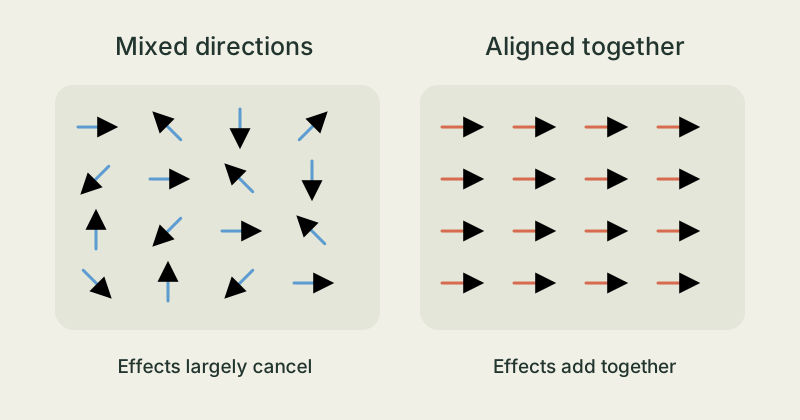
Inside some materials, electrons contribute to magnetism. Iron contains tiny regions where many magnetic effects point in the same direction. These regions are called magnetic domains. A helpful, simplified picture is to imagine groups of very small compass needles.
When the groups point in different directions, their effects largely cancel. In a permanent magnet, many are aligned. Their effects add up and create a noticeable magnetic field outside the material. The compass needles are just an analogy, not actual needles hiding inside the metal.
Why does a paperclip stick?
A steel paperclip does not need to start out as a permanent magnet. A nearby magnet can make its magnetic domains line up more strongly. The clip becomes temporarily magnetized and is attracted. It may even pick up a second clip.
This does not work with every metal. A wooden bead stays put, and ordinary aluminium foil is not noticeably attracted by a fridge magnet. The kind of material matters, not just whether it looks shiny and metallic.
Turn the magnet around
- Place two large, weak bar magnets on a smooth table.
- Move them slowly toward each other. Do they attract or repel?
- Turn one around and try again. Different poles are now facing each other.
Use large magnets, not tiny swallowable magnets or powerful neodymium magnets. Keep them away from medical implants.
The takeaway
Matching poles: apart. Opposite poles: together. A magnetic field carries the force.
Two north poles face each other. What happens?
Sources & further reading
Exploratorium · Magnetic Domains ↗National MagLab · Electromagnets ↗Our stories explain the main idea in our own words. Pictures and models simplify reality and are not drawn to scale.