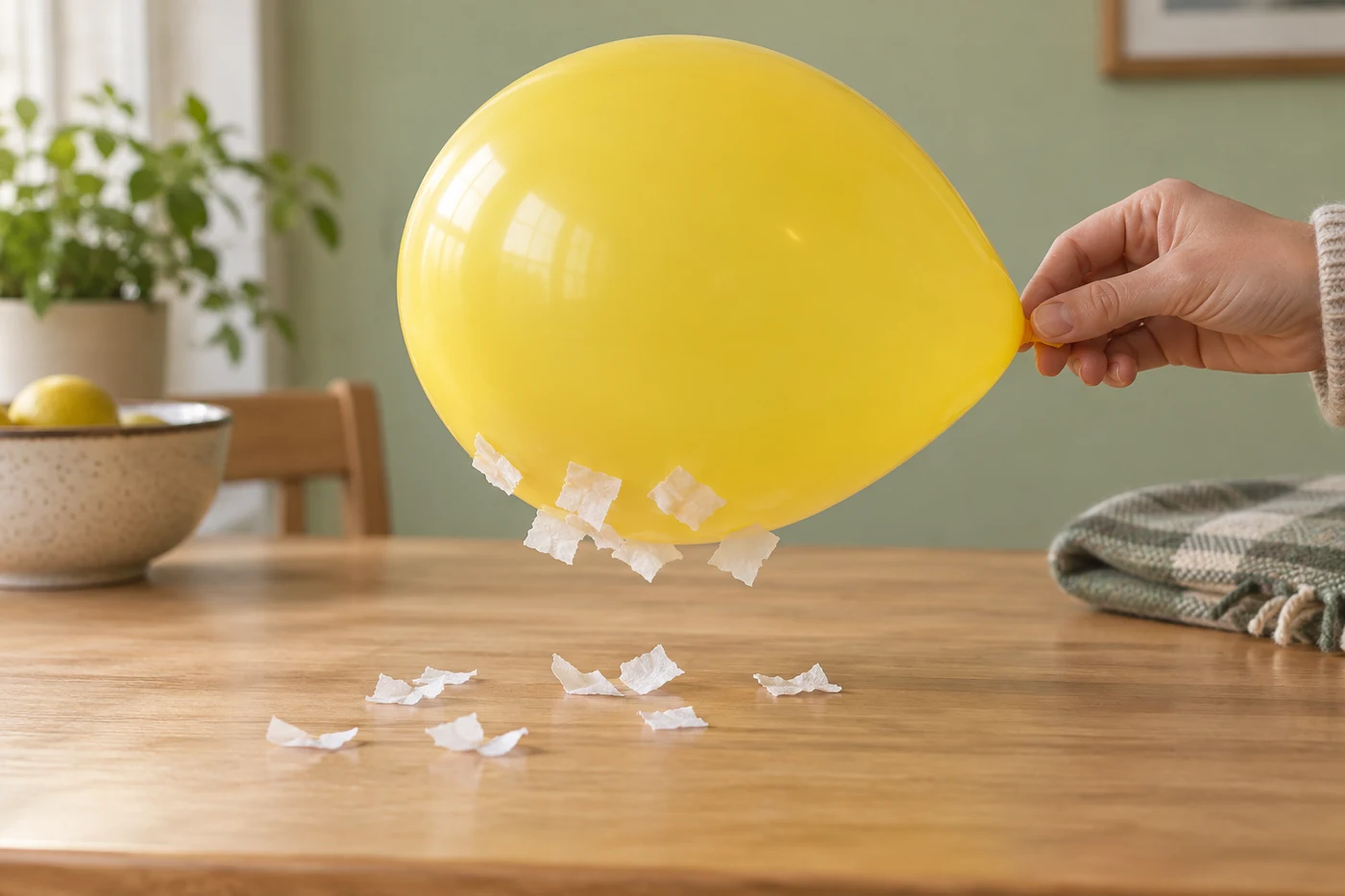
Rubbing can give the balloon an electric charge. In initially neutral paper, the charge distribution shifts slightly. Opposite charge lies closer to the balloon, so attraction wins overall.
A balloon, a wool cloth and a few tiny paper scraps are enough for this everyday puzzle. After rubbing, the balloon can attract the scraps before it even touches them. What makes the paper move?
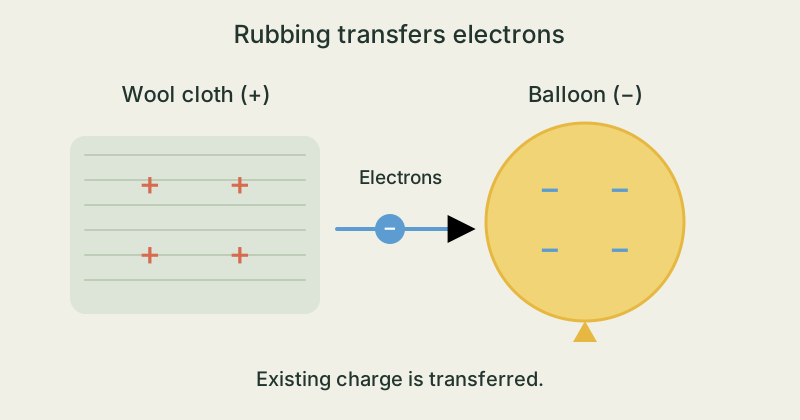
Rubbing transfers electrons
Matter contains positive and negative electric charges. Electrons are tiny particles with negative charge. Rubbing a rubber balloon with wool can transfer some electrons to the balloon. It then has a net negative charge, while the cloth has lost those electrons.
Existing charge moves; it is not newly created. Rubber conducts charge poorly, so the extra charge stays for a while. We call this static electricity. You can explore the transfer in the PhET simulation linked below.
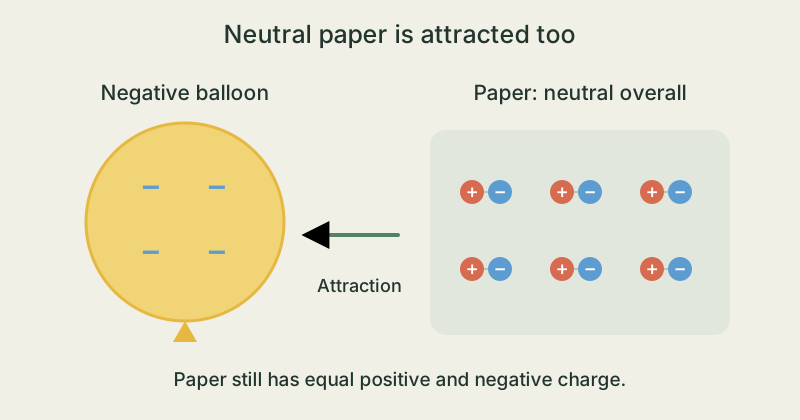
Neutral paper can be attracted too
Neutral does not mean there are no charges. The positive and negative charges in paper balance overall.
Near the charged balloon, negative charge shifts a tiny distance within the paper's atoms and molecules. A negative balloon leaves positive parts closer and negative parts farther away. The nearer attraction is stronger than the more distant repulsion. The paper initially stays neutral overall. This small shift is called polarisation.
Why do small scraps work best?
To lift the paper, the electric force must overcome its weight. Light scraps are therefore easier to move than a heavy sheet. The electric force gets weaker as the distance increases.
Over time, charge can leak away and the effect can fade. Different plastics and cloths do not charge equally well. A plastic comb can attract small paper scraps too.
Catch paper with a comb
- Tear thin paper into a few tiny scraps and place them on a dry table. Hold a dry plastic comb close above them without touching. Observe before rubbing it.
- Rub the comb with a dry wool cloth for about ten to twenty seconds. Hold it at the same height above the scraps again. Do they move more now?
- Slowly increase the gap. Compare with your first try. If little happens, try smaller paper scraps or a different plastic comb.
Keep paper scraps away from mouths and noses. Young children should observe with an adult. This activity needs no electrical sockets or powered devices.
The takeaway
A charged balloon can attract neutral paper. A tiny shift in the charges is enough.
Must the paper already have a net charge for the balloon to attract it?
Sources & further reading
OpenStax College Physics 2e · Static Electricity and Charge ↗OpenStax University Physics · Conductors, Insulators, and Charging by Induction ↗University of Colorado Boulder · PhET: Balloons and Static Electricity ↗Our stories explain the main idea in our own words. Pictures and models simplify reality and are not drawn to scale.