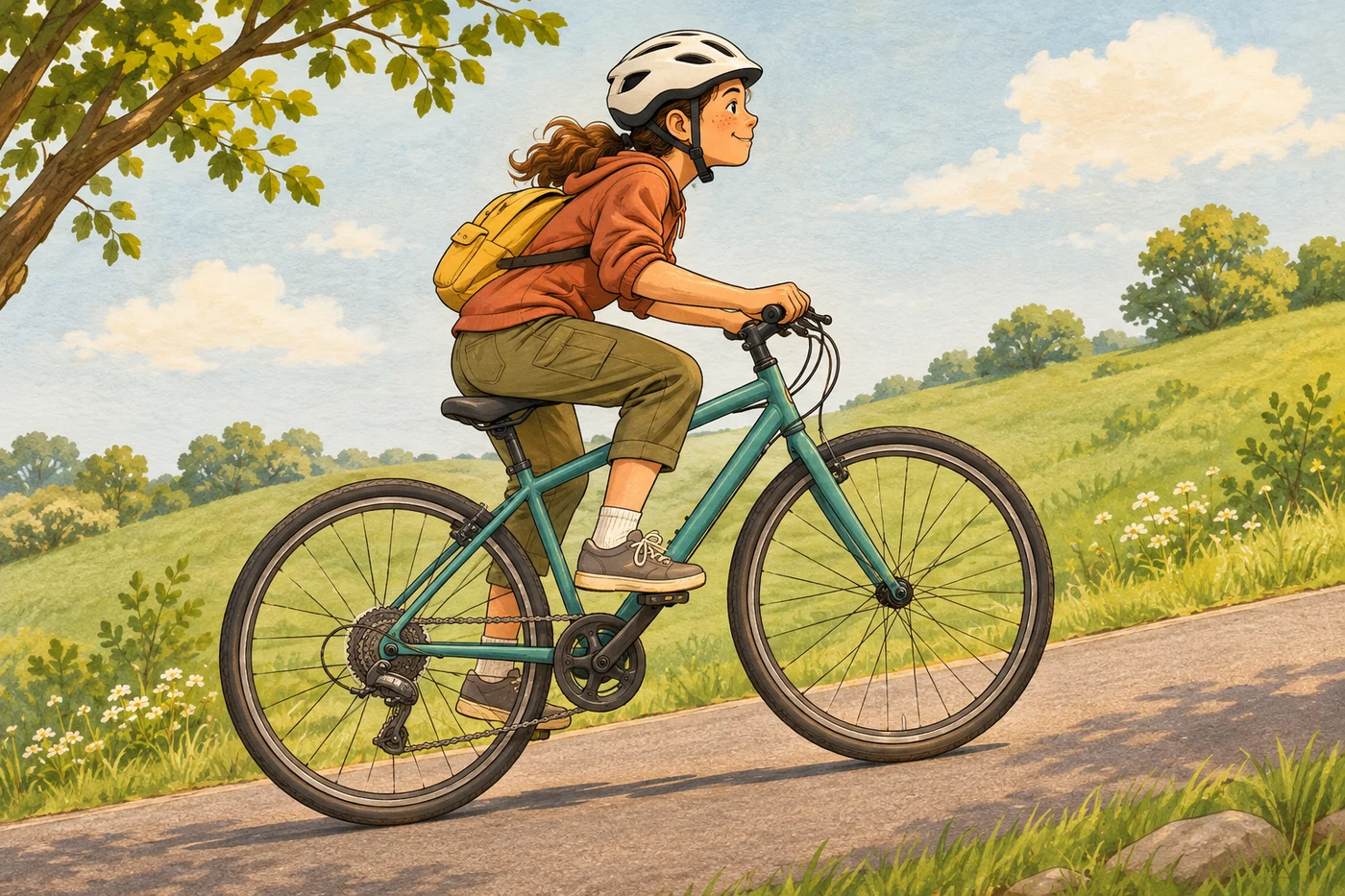
In a low gear, the back wheel turns less for each full turn of the pedals. This lets you push less hard to drive the bike uphill. To cover the same distance, you turn the pedals more times.
Have you ever reached the bottom of a hill and suddenly found it hard to pedal? Shift down and the pedals turn more easily. What changed?
The chain connects the pedals to the back wheel
When you pedal, the front chainring turns. Its teeth pull the chain along. At the back, the chain wraps around a toothed wheel called a sprocket. While you pedal, that sprocket drives the back wheel. On a bike with a derailleur, shifting can move the chain onto a different rear sprocket.
A larger sprocket turns less
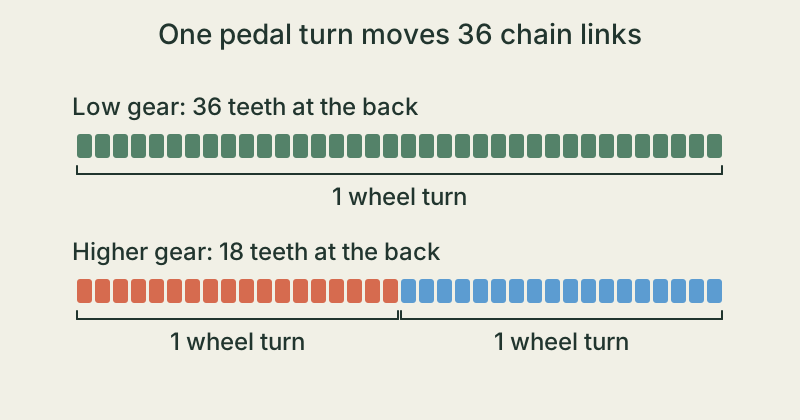
Imagine a front chainring with 36 teeth. One full turn of the pedals moves 36 links of chain along. A rear sprocket with 36 teeth turns once. One with 18 teeth turns twice. On the same bike, the second setup takes you twice as far per turn of the pedals.
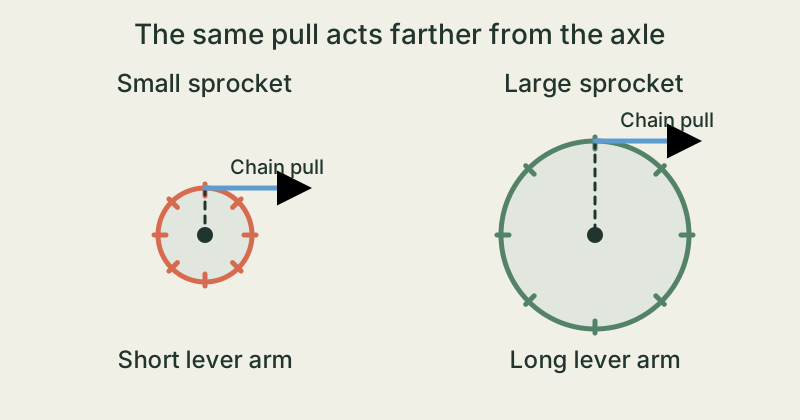
Less force, more turns of the pedals
The chain pulls at the edge of the sprocket. On a larger sprocket, that edge is farther from the axle. The same pull on the chain can therefore turn the back wheel with a stronger twisting effect. Think of a door: it's easier to turn it by pushing at the handle than close to the hinge.
Gears don't give you extra energy. Lifting you and your bike to the same height takes the same amount of work against gravity. In a lower gear, you spread that work over more turns of the pedals.
Count the turns on paper
- Draw a row of 36 boxes. Each box stands for one chain link that moves along during a full turn of the pedals.
- Colour the first 18 boxes one colour and the other 18 a second colour. For a sprocket with 18 teeth, each colour group represents one full turn.
- Now treat all 36 boxes as one group. That's one turn for the 36-tooth sprocket. Which sprocket turns more times for the same turn of the pedals?
- If you have a parked bike with a derailleur nearby, look for the chainring and rear sprockets. See which sprocket the chain sits on.
Just look at the parked bike. Keep your hands away from the chain, pedals and wheels.
The takeaway
With the same front chainring, a larger rear sprocket gives you a lower gear. You go less far per turn of the pedals and can push less hard on the same slope.
With the same front chainring, what happens if you shift to a larger rear sprocket?
Sources & further reading
Exploratorium · Science of Cycling: Drives & Gears ↗Stanford University · E14 Lab 4: Bicycle Gearing ↗Our stories explain the main idea in our own words. Pictures and models simplify reality and are not drawn to scale.