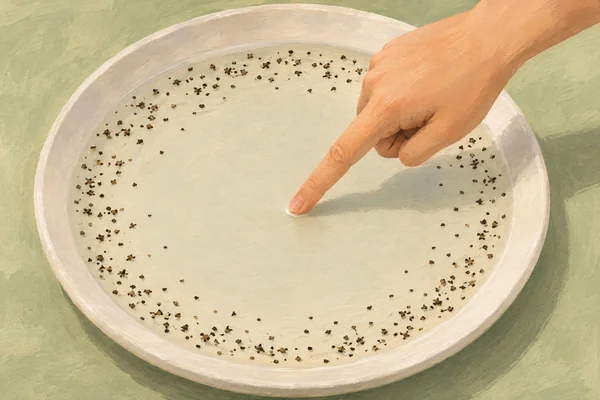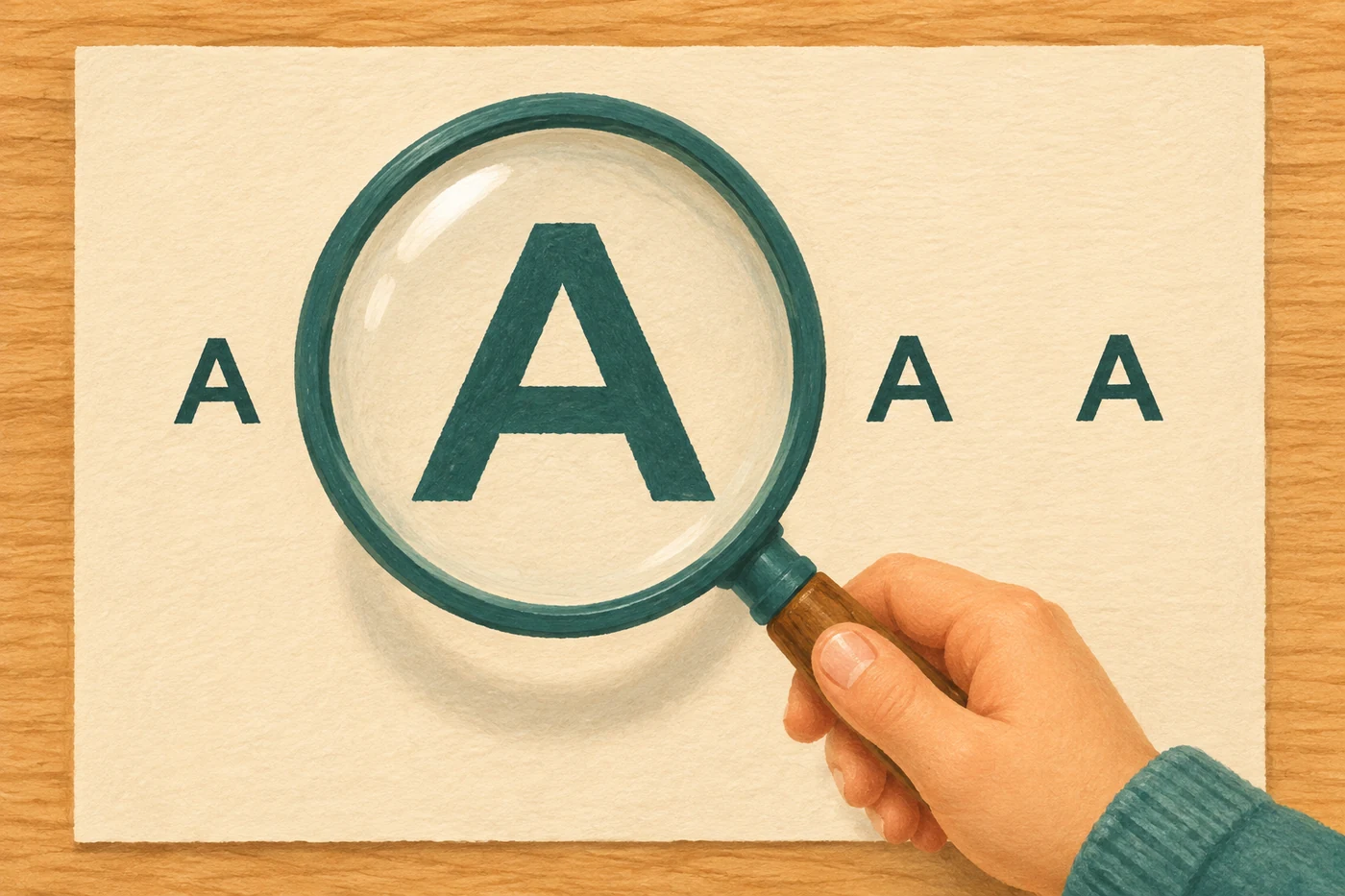
A magnifying glass is thicker in the middle than at the edge. Its curved surfaces change the direction of light. Hold it close enough to the page and your eye sees a larger, upright image of the letters.
Put a page of small print on a table. Hold a magnifying glass just above it and slowly lift it a little. The letters look bigger, even though nothing on the page has changed. What does the magnifying glass do to the light?
A curved lens bends light
Light changes direction when it passes at an angle from air into glass or plastic. This is called refraction. The surfaces of a magnifying glass are curved, so light meets the lens at different angles in different places.
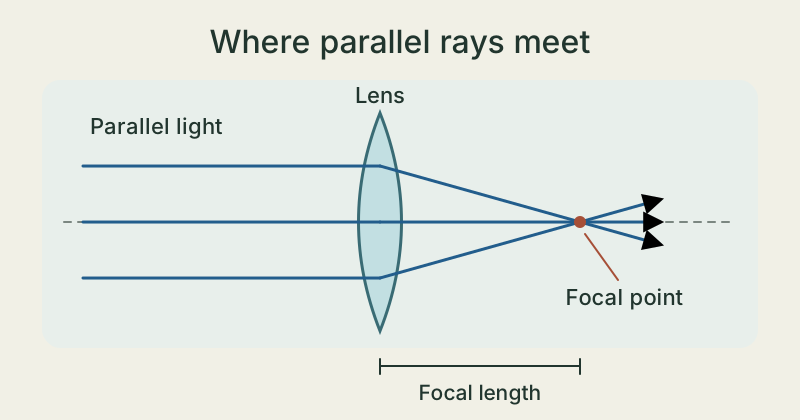
Rays that arrive at the lens parallel to one another meet at a point on the other side. That is the focal point. The distance from the lens to that point is called the focal length. It helps explain how close you need to hold the lens to the page.
A bigger image for your eye
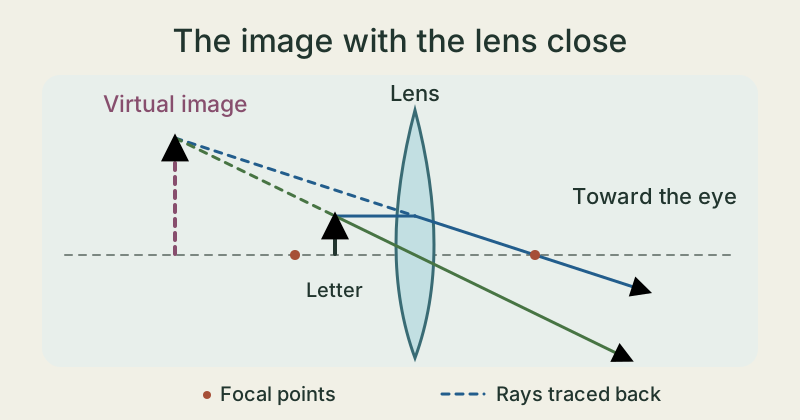
When a letter is between the lens and the focal point on the letter’s side, the rays spread apart after passing through the lens. To your eye, they seem to come from a larger letter farther away.
This is called a virtual image. The dashed lines in the drawing show where the rays seem to come from. With the lens in the right position, the letters take up a wider angle in your view and look bigger.
Distance changes what you see
With the lens right against the page, you usually see little change in size. Lift the lens a little and the letters can look bigger and still be sharp. If you lift it too far, the image can blur. Farther away, it may even appear upside down.
Find the distance that gives a sharp image
- Write three capital As of the same size next to one another. Leave some space between them and put the paper under a room lamp.
- Hold the magnifying glass close to the middle A and look down through it. Compare the middle A with the two beside it.
- Keep your head as still as you can and slowly lift the lens. Find a position where the middle A looks large, upright and sharp. Lift the lens farther and notice when the image blurs.
Use the magnifying glass in ordinary room light. Never look at the Sun through it or point it into direct sunlight.
The takeaway
A magnifying glass bends light. When held close to the print, it makes an upright, enlarged image. Moving it up or down helps you find a position where that image is sharp.
Where should the letter be to get a larger, upright image?
Sources & further reading
OpenStax · The Simple Magnifier ↗University of Illinois Urbana-Champaign · Thin Lenses ↗University of Sydney · Magnifying Glass ↗Our stories explain the main idea in our own words. Pictures and models simplify reality and are not drawn to scale.